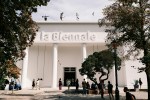
by Fatima Babih, EdD From British State House official Tony Morgan and Tanzanian Honorary President Kevin Nyerere to the Italian curators and organizers: Who was actually behind Sierra Leone’s historic National Pavilion? By the end of Part II, my investigation … Continue reading →
by Fatima Babih, EdD The people, power, and unanswered questions behind Sierra Leone’s historic debut in Venice Part I: A Pattern Hiding in Plain Sight Sierra Leone made history this year. But we did not hear about it from our … Continue reading →
Pip: When a First Lady gives a speech technically addressed to traditional women's society members but linguistically aimed at international NGOs, you have to admire the ambition — if not the direction.
Mara: This episode draws on reporting from Mama Salone Blog, and the territory is pointed: political theater dressed as cultural identity, and what happens when presidential ambition collides with child-protection advocacy.
Pip: Let's start with the speech itself — and why the language choices matter more than anything else in it.
First Lady Fatima Bio, the Sande Stage, and a Dangerous Signal
Mara: The central question here is whether Fatima Bio's appearance before Sande women in Sierra Leone's southeast was a cultural event or a political maneuver — and the analysis lands firmly on one side.
Pip: The speech was delivered in Krio to a predominantly Mende-speaking audience, which is the first tell. The argument is that the real audience wasn't in the room.
Mara: That's stated directly. The speech was meant for "anti-FGM activists, child-rights advocates, international NGOs, donor organizations, and critics questioning her sudden political embrace of Sande society." Not cultural communication — political signaling.
Pip: So the women sitting in front of her were essentially set dressing for a message aimed at people watching from outside the country.
Mara: And then there's the linguistic detail that does the most damage to her claimed cultural authenticity. She repeatedly said "Bondo" while addressing southeastern women who traditionally know the society as "Sande." She never once said "Sande."
Pip: That is a small word doing enormous work.
Mara: The piece calls it exactly that — enormously revealing. Anyone genuinely rooted in these traditions would instinctively use the regional term. The slip exposed what the analysis calls "a failed performance."
Mara: Then came the part that moves this beyond political theater. Bio told the society women they should not fear, that nobody can touch them, nobody can stop them, and they should continue their cultural practices freely.
Pip: With FGM prevalence among Sierra Leonean women aged fifteen to forty-nine sitting at approximately eighty-three percent — one of the highest rates in the world — that assurance is not a cultural affirmation. It's an instruction to continue.
Mara: It directly undermines the local Memoranda of Understanding that some communities have voluntarily adopted to protect girls under eighteen. Those MOUs represent fragile, hard-won progress, and the speech treated them as obstacles.
Pip: And she tied all of it to a political slogan — "Ebema" — which means the line between cultural gathering and campaign infrastructure has effectively disappeared.
Mara: The piece frames the contradiction plainly: internationally, Bio has built her reputation on protecting girls and opposing child marriage. That reputation and this speech cannot both be true at the same time.
Pip: The stakes, as the analysis puts it, are no longer cultural but national — reaching into public health, child protection, and Sierra Leone's international standing. That's where this lands.
Mara: The question the piece ends on is the one that stays with you: what kind of political future is being built when presidential ambition positions itself against child-protection advocacy?
Pip: Culture is a real thing worth protecting. It's just not a shield that fits over everything.
Pip: When the First Lady of Sierra Leone shows up to a cultural gathering wearing a headscarf printed with her own political slogan, you have to ask: whose culture, exactly, is being celebrated?
Mara: That question sits at the center of what Mama Salone Blog is examining — how traditional women's institutions are being pulled into the orbit of electoral ambition, and what that costs the communities those institutions are supposed to serve.
Pip: Let's start with the Kenema procession and what it actually was.
Cultural Celebration or Campaign Rally?
Mara: The tension here is specific: did a public event organized around Sande society in Kenema function as cultural preservation, or as the opening move in a 2028 presidential campaign?
Pip: The BBC interview answer is the load-bearing fact. When asked directly whether she planned to contest the presidency after her husband's term, Fatima Bio said, "If it is willed by God, nobody is going to stop me."
Mara: That is not a denial. And the post traces how the Kenema event fits a pattern of nationwide appearances that increasingly resemble campaign infrastructure rather than First Lady ceremonial duties.
Pip: The coordinated white headscarves are the detail that collapses the official narrative. "EBEMA GBI" — her emerging political slogan — printed on the attire of women at a so-called cultural procession. That is a campaign visual, not a heritage one.
Mara: The post frames this as a structural problem, not just optics. The office of First Lady occupies what it calls a politically ambiguous space: not elected, not constitutionally defined, and not directly governed by campaign regulations. That ambiguity is being used to run a shadow campaign outside the accountability rules that apply to every other political actor.
Pip: Her husband publicly warned his own party against premature campaigning — "mango mango politics," he called it. The irony is doing a lot of heavy lifting there.
Mara: The post also challenges her cultural standing within Sande itself, arguing that her prominence in these spaces comes from proximity to state power rather than any organic tribal or lineage connection to the institution.
Pip: And then there is the contradiction the post calls impossible to ignore: someone internationally recognized for anti-child-marriage advocacy is now politically empowering institutions that, in many traditional contexts, have historically intersected with early sexualization and early marriage expectations for girls as young as eleven.
Mara: The post closes by asking where Sande's protective voice is amid Sierra Leone's current crisis of sexual violence and abuse — noting that the loudest mobilizations from these society structures increasingly look political rather than protective.
Pip: Culture absorbed into branding. The road to 2028 is apparently already paved.
Mara: The question underneath all of this is whether traditional institutions can survive being instrumentalized by elite ambition — and who pays the cost when they can't.
Pip: Sierra Leone is going to be answering that question for a while. We'll be watching.