Cultural Celebration or Campaign Rally in Kenema? Fatima Bio’s Political Appropriation of Sande for Her 2028 Ambition
by Fatima Babih, EdD
On Saturday, May 23, 2026, Fatima Bio flooded social media with triumphant images and carefully curated videos, photos and crafted language celebrating what she described as a grand cultural gathering of Sande/Bondo women in Kenema.
In her post, she spoke glowingly about “culture,” “heritage,” “unity,” “women’s strength,” and “preserving traditions.” But beneath the polished rhetoric lies a much more political reality.
This was not merely a cultural celebration. It was a political rally disguised as cultural preservation. And many Sierra Leoneans can see right through it.
Political Rally Hidden Behind Cultural Language
The context matters. Recently, during her BBC interview with journalist Megha Mohan, Fatima Bio was directly asked whether she intended to contest for the presidency in 2028 after her husband’s term ends. Her answer was deeply revealing: “If it is willed by God, nobody is going to stop me.”
That was not a denial. That was political positioning. And even before that interview, her nationwide public appearances have increasingly resembled campaign rallies rather than ceremonial First Lady engagements. The Kenema Sande procession fits perfectly into that emerging pattern.
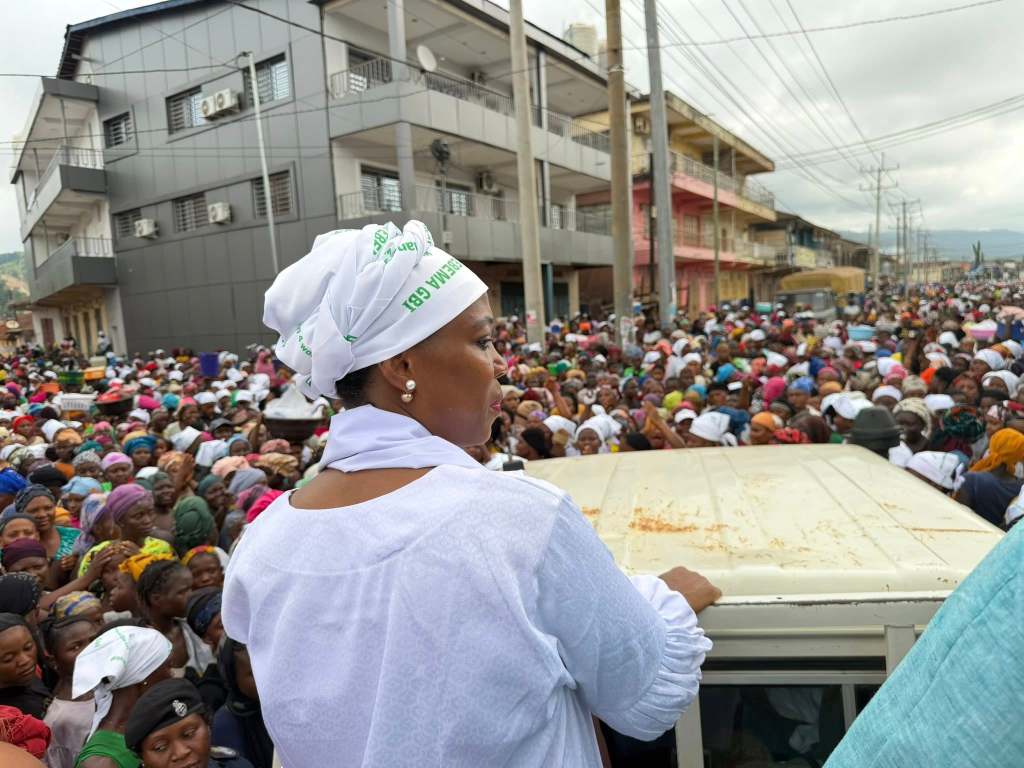
Let us examine what actually happened in Kenema. Thousands of women were mobilized. The First Lady arrived as the central political attraction. Images of crowds flooded social media. Political symbolism surrounded the event. And Fatima Bio positioned herself at the center of a massive public mobilization exercise. That is politics. Not culture.
Because genuine cultural preservation does not usually revolve around the political elevation of one individual preparing for national leadership.
And the more photos and videos emerge from the so-called “cultural celebration” led by Fatima Bio in Kenema, the harder it becomes to accept her official narrative that this was merely about “culture,” “heritage,” and “unity.” Because the evidence now speaks for itself. The women mobilized for this procession were not simply wearing traditional attire. Fatima Bio and many of the women at the even were wearing coordinated white headscarves boldly printed with:
“EBEMA GBI”
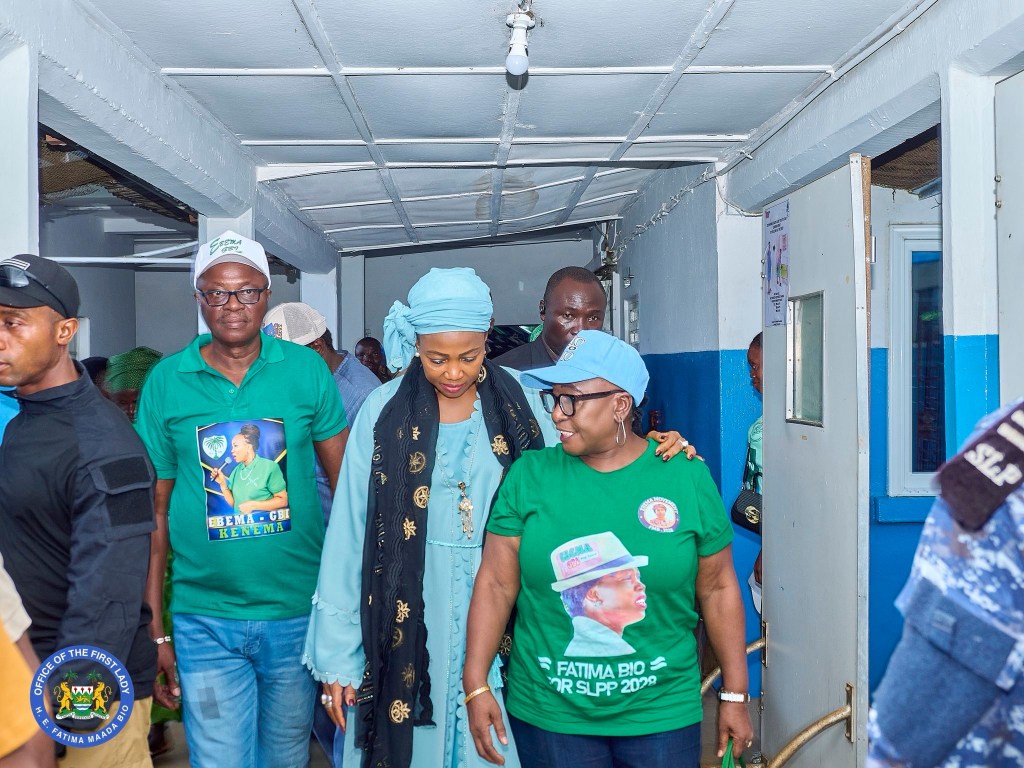
Fatima Bio As Central Figure In Her Kenema Political Rally Wearing her Political Slogan “EBEMA GBI“
Fatima Bio’s emerging political slogan tied to her widely suspected 2028 presidential ambition. That changes everything. This event was carefully stage-managed to make the public believe that Fatima Bio has popularity, female solidarity, regional influence, and grassroots mobilization capacity ahead of 2028.
In other words: it functioned politically.
Legal & Ethical Contradiction
What makes this even more troubling is the political double standard involved. In Sierra Leone, opposition political parties are not legally permitted to openly campaign before the Political Parties Regulation Commission (PPRC) officially declares campaign season open.
Even her husband Julius Maada Bio himself has publicly warned members of his ruling party against premature campaigning, which he referred to as “mango mango politics.”
Yet Fatima Bio continues moving around the country organizing mass political-style gatherings without scrutiny.
Why?
Because the office of First Lady occupies a politically ambiguous space:
not elected,
not constitutionally defined,
and not directly governed by campaign regulations.
Fatima Bio is weaponizing that ambiguity. The result is a shadow campaign structure operating outside the accountability standards imposed on ordinary politicians.
No Organic Cultural Connection to Sande/Bondo
Another major contradiction in her post is the attempt to portray herself as a cultural representative of Sande/Bondo society. Sande (in the south-east) and Bondo (in the north-west) are not generic women’s clubs. They are deeply rooted tribal initiation societies tied to specific ethnic communities and traditional structures.
And importantly: Fatima Bio has no tribal or cultural lineage connection to the traditional Sande/Bondo societies of Sierra Leone. Yes, she may be a circumcised woman. But circumcision alone does not automatically make someone a recognized cultural member or inheritor of these tribal institutions.
Her sudden elevation within Sande spaces stems less from organic cultural belonging and more from proximity to state power.
In simple terms: power opened the door for Fatima Bio into Sande society.
Sande as a Political Weapon
What Fatima Bio is doing with Sande is not new in Sierra Leonean politics. Historically, both male and female secret societies have been politically exploited by elites seeking regional influence and electoral loyalty. For years:
male politicians have strategically aligned themselves with Poro and other society structures,
recruited supporters through traditional networks,
and leveraged society loyalty for political consolidation.
Today, many figures within the ruling SLPP network openly identify with Poro society structures, including politically connected elites and regional influencers.
Fatima Bio is essentially replicating the same strategy through Sande. This is not cultural preservation. It is political misuse of cultural spaces.
Fatima Bio is attempting to build a female mobilization machine parallel to the male Poro political structures already operating within the ruling political ecosystem.
Contradiction Nobody Wants to Address
Perhaps the greatest contradiction of all is this: Fatima Bio has built her international reputation around fighting child marriage and protecting girls. Yet she is now publicly embracing and politically empowering a system long criticized for facilitating conditions linked to early marriage.
Because the reality is uncomfortable: Within many traditional contexts in Sierra Leone, girls inducted into Sande/Bondo are often socially viewed as “ready for womanhood” regardless of age. And historically, that transition has frequently intersected with:
early sexualization,
early marriage expectations,
and pressure toward adult domestic roles.
Thousands of girls, some as young as 11 years old, continue to enter Sande/Bondo annually and are forced into early marriage or sexualization.
So, the contradiction becomes impossible to ignore. How does someone internationally celebrated for anti-child-marriage activism politically align herself with institutions historically associated with social practices that can reinforce early marriage culture?
That question deserves serious public discussion.
Silence of Sande in the Face of VAW
Historically, Sande society was viewed, at least symbolically, as a protector of women and girls. But many Sierra Leoneans are increasingly asking: Where is that protection today? Because Sierra Leone is currently facing:
rampant sexual violence,
rising abuse against girls,
failed prosecutions,
collapsing trust in justice systems,
and growing fear and silence among women.
Yet the loudest public mobilizations from these society structures increasingly appear political rather than protective. The societies mobilize for political rallies.
But where is the mobilization when children are raped?
Where is the outrage for child and women victims of violence?
Where is the national protection structure for vulnerable girls?
That silence is becoming harder to defend.
Culture Is Now Fatima Bio’s Campaign Tool
Ultimately, the Kenema event exposed something much bigger than one procession. It revealed how culture, tradition, women’s identity, and tribal institutions are increasingly being absorbed into political branding exercises tied to elite ambition.
Fatima Bio stages these events and hopes the public will see empowerment, culture, and unity. But many Sierra Leoneans instead see:
political calculation,
premature campaigning,
strategic mobilization,
and the appropriation of tradition for personal ambition.
And perhaps the biggest irony of all is this: A woman who claims to stand against systems that harm girls is now embracing structures long criticized for helping sustain those same systems.
That contradiction may become one of the defining political questions of Sierra Leone’s road to 2028.