
by Fatima Babih, EdD
From British State House official Tony Morgan and Tanzanian Honorary President Kevin Nyerere to the Italian curators and organizers: Who was actually behind Sierra Leone’s historic National Pavilion?
By the end of Part II, my investigation had moved far beyond the simple question of why First Lady Fatima Jabbie Bio was appointed Commissioner of Sierra Leone’s historic first National Pavilion at the Venice Biennale.
I had discovered that Venice was not an isolated event. Five years earlier, Fatima Bio had been Commissioner-General for Sierra Leone at Expo 2020 Dubai, with Tony Morgan serving as Deputy Commissioner-General. Even more significantly, a contemporaneous NASSIT account described an Expo Secretariat headed by the First Lady and reportedly tasked with mobilizing national collaboration.
And Tony Morgan’s relationship with Fatima Bio went back even further to their documented association in the UK Nollywood project before she met Julius Maada Bio, who later became President.
By Venice 2026, however, something had changed.
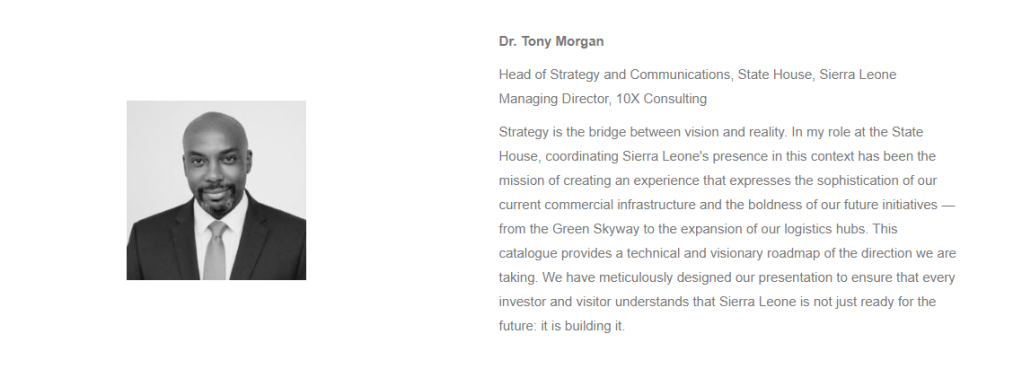
Tony Morgan was no longer being presented merely as a communications official attached to the Office of the First Lady. The Sierra Leone Pavilion presented him as:
- Head of Strategy and Communication, State House, Sierra Leone
and simultaneously:
- Chief Executive Officer, 10X Consulting.
The pavilion then went further. Morgan himself said that, “in my role at State House,” he had coordinated Sierra Leone’s presence in Venice. He described a presentation deliberately designed to communicate Sierra Leone’s commercial infrastructure, future initiatives and logistics ambitions to investors and visitors (Sierra Leone Pavilion).
That combination caught my attention.
But as I began looking more closely at the people occupying prominent positions around Sierra Leone’s historic first National Pavilion, something else became difficult to overlook.
Several of the people prominently positioned around this national project were not Sierra Leonean.
Tony Lloyd Morgan, the man presented to the international audience as a State House strategy and communications official, and who says he coordinated Sierra Leone’s presence in Venice, is recorded in official British corporate records as a British national resident in the United Kingdom; he is also believed to be British-Nigerian (Find and Update Company Information).
Then there was Kevin Nyerere, the Tanzanian businessman presented as Honorary President of Sierra Leone’s National Pavilion.
And the two men responsible for curating the exhibition, Sandro Orlandi Stagl and Willy Montini, were Italian. La Biennale officially identifies them as the pavilion’s curators. (La Biennale di Venezia)
As my investigation continued, I would discover that the Italian presence extended considerably beyond the two curators. I will return to that network in Part IV.
Nationality is not the problem.
Let me make something clear before going further. The Venice Biennale is an international art exhibition. Foreign curators, consultants, organizers, artists and advisers can bring valuable experience and expertise to a country making its first appearance on one of the world’s major cultural stages.
Nor does being foreign disqualify someone from working for, advising or representing a government if that person has been lawfully appointed to do so.
The question raised by Sierra Leone’s pavilion is therefore not whether foreigners should have been involved. The question is one of national authority, institutional responsibility and transparency.
- This is not a private exhibition bearing Fatima Bio’s name.
- It is not Tony Morgan’s exhibition.
- It is not Kevin Nyerere’s exhibition.
It is officially Sierra Leone’s first-ever National Participation at the Venice Biennale, one of seven countries making their Biennale Arte debut in 2026. La Biennale identifies it explicitly as “Sierra Leone (Republic of)” and identifies Fatima Maada Bio as Commissioner. (La Biennale di Venezia)
Therefore, if this was the historic first National Pavilion of the Republic of Sierra Leone, I wanted to understand: Who within Sierra Leone’s established governmental and cultural institutions was actually directing the national project?
- What roles were being performed by Sierra Leoneans?
- What roles were being performed by foreign nationals?
- Who appointed them?
- Who authorized them to act in Sierra Leone’s name?
- And where were the Sierra Leone government institutions whose established mandates covered the very activities being promoted in Venice?
Those questions became even more significant when I returned to Tony Morgan. Because Morgan was not presented in Venice as a foreign consultant assisting the pavilion.
He was presented as a State House official. But first, I needed to understand exactly what Morgan said Sierra Leone was doing in Venice.
Venice Was Not Just About Art
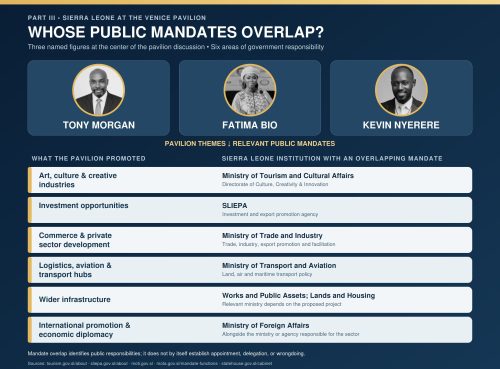
Morgan’s statement makes clear that the pavilion was doing more than exhibiting art. His references to commercial infrastructure, future initiatives, investors and logistics presented Sierra Leone as a destination for development and business. Fatima Bio’s description of a dialogue between culture and commerce reinforced that broader purpose.
There is nothing unusual about a country using a cultural event to promote investment. But once the pavilion made that choice, the responsibilities of Sierra Leone’s existing ministries and agencies became relevant.
The Ministry of Tourism and Cultural Affairs is especially relevant. It declared 2026 the “Year of Culture and Creativity,” a national effort to celebrate heritage, support creative talent and generate economic opportunity. Its published functions extend beyond cultural programming: they include coordination with other ministries and agencies, engagement with international organizations and the private sector, efforts to attract investment, and collaboration on infrastructure projects. Its Creative Day Salone brought creative entrepreneurs together with institutions concerned with business registration, taxation and finance.
These examples show that the Ministry had an established route for connecting culture with enterprise. (Ministry mandate; Year of Culture and Creativity)
- What role did that Ministry play in the pavilion?
- Were the relevant trade and transport institutions consulted about the investment and logistics messages?
- Did they supply or approve the information presented to international visitors?
- What, specifically, was “Green Skyway,” and
- which public authority was responsible for it?
I have not found answers in the public-facing pavilion material reviewed for this investigation. What the material does show is Morgan, using a State House designation, explaining economic and infrastructure ambitions in areas covered by specialized public bodies. His stated coordination role warrants a clear account of which institutions authorized the messages and how the work was organized.
State House Title Plus Private CEO
The pavilion displays Morgan’s State House designation immediately alongside “CEO, 10X Consulting.” It makes the terms of his public role and his private business interests pertinent, particularly when he speaks about commercial opportunities at a national event. (Sierra Leone Pavilion)
I sought the legal identity of the 10X Consulting named on the pavilion website: its jurisdiction, ownership, services, clients and any contracts connected to the Sierra Leone government, Expo Dubai or the Venice pavilion. Businesses with similar names exist in different jurisdictions. I could not establish with confidence which legal entity the pavilion meant.
The identity and relevant work of the business remain unanswered questions. My research did, however, identify a different company that can be documented.
- Sierra Leone Aerial Logistics Ltd
The United Kingdom’s Companies House officer record lists Tony Lloyd Morgan as director of Sierra Leone Aerial Logistics Ltd, incorporated on June 3, 2026. It records him as a British national resident in the United Kingdom. The company’s listed business classifications cover freight air transport and other transportation-support activities.
The timing and sector make the record relevant. The Venice pavilion opened in May 2026. Morgan’s pavilion statement discussed “Green Skyway” and expanded logistics hubs under his State House title. The company was incorporated while the Biennale was running.
These facts establish a chronology and an overlap in subject matter. They raise a specific disclosure question: Were Morgan’s private commercial interests identified and assessed in relation to his State House role and the logistics initiatives he promoted?
If the company had no connection to those initiatives, a clear account would resolve the issue. If there was a connection, the public should be told what it was and how it was managed.
Sierra Leone’s Anti-Corruption Commission explains why the relationship between public duties and private interests matters. It also describes disclosure requirements in circumstances involving a public officer’s interest in an undertaking with which a public body proposes to deal.
The case for asking about authority and disclosure does not depend on presuming either. The public record thus leaves several questions open:
- Who appointed Morgan to the State House role displayed in Venice, and what authority did that position carry for the pavilion?
- Which ministries or agencies approved the investment and logistics messaging?
- What was the legal identity and role of 10X Consulting?
- Was Sierra Leone Aerial Logistics Ltd connected in any way to the initiatives discussed at the pavilion, and were any relevant interests disclosed?
Sierra Leone’s first National Pavilion was an opportunity to show the world its art and ambition. That makes a transparent account of who spoke for the country, on whose instructions, and with what private interests all the more necessary.
Morgan was not the only foreign businessman whose role called for closer examination. The pavilion also named Kevin Nyerere as Honorary President. His publicly reported connection to Morgan predates the Biennale, and his place in the project leads to the next stage of this investigation.
NEXT
PART IV: KEVIN NYERERE, THE BUSINESS CONNECTIONS AND THE FOREIGN NETWORK AROUND SIERRA LEONE’S PAVILION
 MAMA SALONE ~ Lioness of the West Coast