
by Fatima Babih, EdD
A critical reading of the Institute for Governance Reform’s “Sierra Leone’s Political Marathon, Volume II: Battle for 2028” (October 2026)
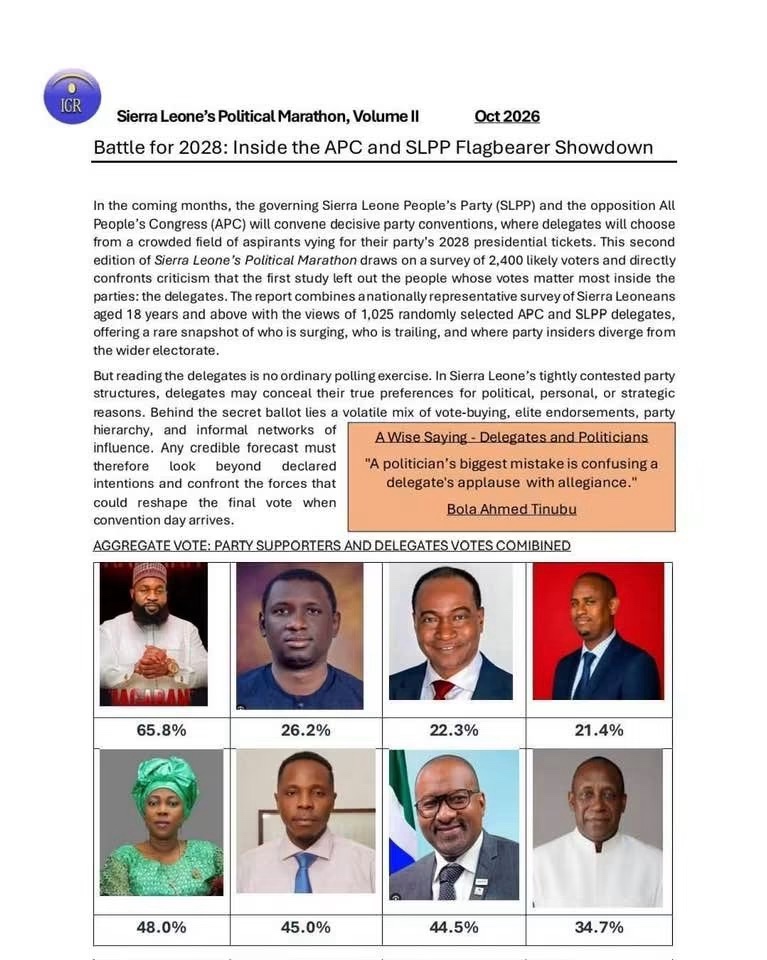
The cover page of IGR’s new report gives opposition party APC aspirant, Sheikh Mohamed Kamara (aka Jagaban) 65.8% and the wife of President Julius Maada Bio 48%, under a banner reading “Aggregate Vote.”
The figures sit beneath unlabeled candidate photographs and look like election results. They are not. They are simple averages of two different respondent groups, built from a three-choice question, with the first-choice rankings withheld and a methodology section that does not reconcile with its own tables.
I read all nine pages and checked the arithmetic. This is not a claim that IGR’s findings are false. It is a claim that, as published, they cannot bear the weight being placed on them, and that the burden of proof is highest where the headline concerns the wife of the sitting president in a contest to succeed her husband.
This Report Needs Scrutiny
IGR says its mission is to estimate how delegates are likely to vote. The SLPP is the governing party. The aspirant at the top of its headline ranking is the First Lady, wife of the President whose term she hopes to continue. For many Sierra Leoneans, a sitting president’s spouse seeking to succeed him raises hard questions about dynastic succession, the advantages of incumbency and the independence of a party’s own selection process. Whatever one concludes on those questions, a poll that appears to show her surging among party insiders does political work. It signals inevitability to delegates, donors and the press. Work that does political work must be open to inspection.
Two clarifications. First, I am not alleging that any candidate commissioned, funded or influenced this report. I have no evidence of that. My point is narrower: the report discloses nothing that allows a reader to rule it out. Second, the standard I apply is the report’s own. It warns that delegates may conceal their true preferences, and that vote-buying, elite endorsements and party hierarchy shape convention outcomes. It then publishes declared intentions as its headline.
Headline Not Vote Shares
Respondents were asked to name three aspirants they were willing to vote for. Each table note says the figures show the “percentage of total mention.” They cannot be shares of mentions, because shares of mentions would sum to 100%. Adding up the SLPP columns in Table 4 gives roughly 193% for ordinary supporters and roughly 267% for delegates (my arithmetic, including the “none,” “prefer not to say” and “don’t know” rows). These are inclusion rates: the share of respondents who named a candidate somewhere among their three.
A delegate who lists the First Lady as one of three acceptable names counts the same as a delegate who ranks her first. IGR collected first, second and third rankings from delegates and did not publish them. The cover therefore cannot show who leads a convention. It shows who is acceptable to the broadest share of respondents. Those are different questions, and the difference is what decides conventions.
The labels compound the problem. The cover calls the figure an “Aggregate Vote.” Table 4 calls it an “Aggregate score.” The text asks who respondents “would actually vote for.” The label must match the measure.
The two groups are also not measured on the same scale. On my arithmetic, SLPP supporters named about 1.7 candidates each, while delegates named about 2.7. Averaging their percentages blends columns that are not like for like.
The Averaging Problem
The “aggregate score” is the plain midpoint of the supporter and delegate percentages. The report never explains why the two groups should count equally, or why a blend is more informative than showing them separately.
| SLPP aspirant | Supporters | Delegates | Reported aggregate |
| Fatima Bio | 34.3% | 61.7% | 48.00% |
| David Moinina Sengeh | 35.8% | 54.3% | 45.05% |
| Mohamed Juldeh Jalloh | 29.2% | 59.8% | 44.50% |
| Kandeh Yumkella | 35.2% | 34.2% | 34.70% |
Source: IGR, Table 4. Multiple-response question: three names per respondent.
Here I want to be precise, because the strongest critique is not the most obvious one. The First Lady would still top the SLPP average unless ordinary supporters were given more than roughly 83% of the weight (my calculation from Table 4). So equal weighting is not what produces her lead. The delegate column is. That means the entire SLPP headline rests on 425 delegate interviews, which are the data the report documents least well.
Among ordinary SLPP supporters, she is third: Sengeh 35.8%, Yumkella 35.2%, Bio 34.3%. Without published sample sizes, nobody can say whether those gaps mean anything. What we can say is that the statement “Fatima Bio leads,” is inaccurate. She leads among whom, on which question and under which calculation?
The APC picture differs. Jagaban leads both groups, 66.2% among supporters and 65.4% among delegates, and no weighting changes that. The APC story is the supporter–delegate splits behind him, and those depend on the same delegate data.
Five Unresolved Pproblems
- The report undermines its own headline. It states that delegates may hide their preferences and that any credible forecast must look beyond declared intentions. It describes “anthropological evidence” and embedded field researchers. None of that evidence appears in the nine pages. The numbers published are the declared intentions the report itself calls unreliable.
- Zero non-response among SLPP delegates. In Table 4, “none of the above,” “prefer not to say” and “don’t know” are all 0.00% for SLPP delegates, against 25.6% combined for SLPP supporters. Among APC delegates, “prefer not to say” is 15.4%. A report that stresses fear and concealment among delegates then show not one of 425 SLPP delegates declining or hesitating. Either those options were not offered, or non-answers were excluded, or something else happened.
- Who counts as a delegate. The frame includes “Category A” super delegates: sitting and former presidents, ministers, MPs, council chairs and mayors. The SLPP delegate table lists the President and Vice President among its national officers. The report does not say whether the President was interviewed, how many officeholders whose positions depend on the incumbent were included, or whether their answers were treated differently from other delegates’. Page 1 calls the delegates “randomly selected.” Section 5 describes comprehensive mapping of Category A and a 50% random sample of everyone else. That is a hybrid design, and it needs an estimator that has not been disclosed.
- The APC sample does not match the described design. The APC frame lists 1,056 constituency delegates and 340 district delegates. A 50% sample of those two groups alone is about 698 people. Add the 54 APC MPs mapped comprehensively, and the design implies roughly 750 interviews before any other category. The achieved APC sample is 600. That implies substantial non-response or a departure from the design. The report gives no response rates, replacement rules or contact outcomes.
- The report’s own narrative and findings pull apart. It says elite endorsements and party hierarchy shape the final vote, yet only 3.8% of SLPP delegates and 0.4% of APC delegates rated the blessing of senior party leaders, such as the president, as a key consideration (Table 6). Would delegates say otherwise to an interviewer? The report does not address it.
Margin of Error Not Holding Up
The report claims a margin of error of about ±2 points at 95% confidence for the delegate sample. Using IGR’s own inputs (1,100 SLPP and 1,915 APC delegates; samples of 425 and 600), the conventional worst-case calculation with finite-population correction gives about ±2.5 points for the combined sample, ±3.7 for SLPP delegates and ±3.3 for APC delegates. So even the combined figure misses the stated ±2. For reference, ±2 is what a simple random sample of about 2,400 would yield, which is the size of the public survey and not of the delegate sample. IGR does not say which sample the figure refers to.
These are illustrative calculations from published inputs. They are not estimates of uncertainty under IGR’s actual design, which is undisclosed. But they show why one rounded figure cannot describe every result. The First Lady’s 61.7% and the Vice President’s 59.8% among SLPP delegates differ by 1.9 points. On the information published, that is not a demonstrated lead.
Public Survey Thinly Documented
The report describes 2,400 “likely voters,” calls the survey nationally representative and gives fieldwork dates. It gives no account of geographic allocation, household or respondent selection, how “likely voter” was defined (page 1 says only “aged 18 years and above”), response rates or weighting. It does not publish how many APC and SLPP supporters sit behind each candidate table. A total of 2,400 does not mean 2,400 respondents contributed to each party’s percentages. The party subgroups are the denominators that matter, and they are not reported.
The report also asserts that Jagaban’s support among ordinary voters has “leapt by 14 percentage points” since IGR’s December 2025 survey. No earlier data, question wording or comparability test appears in this report. The cover’s language about who is “surging” and “trailing” has no trend data behind it for any other aspirant.
Report Not Reconciling
Several problems can be checked in minutes by anyone with the nine pages:
- The SLPP delegate table sums to 1,104, not the stated 1,100, and has 13 quantity rows against 12 stated categories. Its diaspora breakdown adds up to 94, not the stated 95.
- The sampling narrative cites 81 SLPP MPs; the table lists 82. The narrative also cites 135 MPs across both parties and 132 constituencies, which should be checked against official figures.
- The text says 25 candidates were presented, 15 APC and 10 SLPP. Table 5 alone lists 16 APC names, and the candidate lists differ between tables.
- Candidate names vary: Jagaban appears as “Mohamed Omodu Kamara” and “Sheik Mohamed Kamara”; one APC aspirant appears as both “Chernor Ramadan Bah” and “Chernor Maju Bah”; Marrah and Conteh are each spelled two ways.
- Table 1 asks for the “two most important issues.” The delegate columns sum to roughly 213% for SLPP and 212% for APC. A two-answer question cannot exceed 200%. The SLPP column also shows “women’s rights” at 9.44%, the only figure in the table with two decimals.
- The text describes Chernor Bah as a running mate in “2018 & 2013.” There was no 2013 election.
- The epigraph, a quotation attributed to Nigerian President Bola Tinubu, has no source.
Together these inconsistencies make it unreasonable to accept IGR’s report without questioning.
Rhetoric Ahead of Evidence
The report is full of hyperbolic phrases such as, “thunderous,” “explosive,” “rockets,” “dominated” and “the figures rocking Sierra Leone’s 2028 race.” That is the vocabulary of a campaign brochure, and it is not a stylistic quibble. Such dramatic language manufactures certainty the analysis does not support.
Two examples. The 23.7-point gap between Samura Kamara’s supporter and delegate figures becomes a “rejection by the APC kingmakers.” The table shows a difference between two groups on a multiple-response question. It does not show a collective act of rejection or any motive. And the leadership criterion that Table 6 labels “Money: ability to finance a campaign and party members” becomes “generosity” in the text, an interpretive relabeling that makes an expectation of paying for support sound like a virtue.
The measures must also stay separate. Which issues matter, which aspirants can address them, which three are acceptable, and how delegates rank their first choice are four different questions. Perceived competence is not willingness to vote. Willingness to include a name is not a first-choice commitment. And none of them measures a general-election outcome in 2028.
Funding Question Unresolved
The nine page report does not name a study-specific funder or commissioner, carries no conflict-of-interest statement, and does not include the questionnaire, an anonymized dataset, a codebook or analysis code. It does not say how IGR obtained the official master rosters of certified delegates for two rival parties, or whether either party’s secretariat assisted.
These are standard disclosures under the transparency norms of professional bodies such as AAPOR and ESOMAR/WAPOR: sponsor, question wording, sampling frame, weighting, response rates and margin of error. Respondent privacy must be protected, but privacy protects people, not methods, funding or question wording.
On October 15, 2025, I wrote to IGR by email, requesting the supporting documentation and clarification on the points in this article. As of this publication, I have received no response. I will update this piece if IGR replies.
What IGR Must Publish Now
- The full questionnaire, including wording, answer options and whether non-response options were offered to delegates.
- The study’s sponsor, commissioner and any conflict-of-interest declaration, plus the identity of any partner institutions.
- Party-wide first-choice totals for delegates, with small-cell suppression where disclosure risk is real. The report already publishes party-wide candidate percentages, so aggregated first-choice figures carry no obviously different risk.
- Sample counts by stratum, response rates, replacement rules, selection probabilities and weights, for both the delegate and public surveys.
- Confidence intervals for the principal comparisons, computed under the actual design.
- A clear statement of whether the President and other incumbent officeholders were interviewed, and how Category A responses entered the estimates.
- The reasoning for an equal-weight aggregate, or its withdrawal, and a relabeled cover that does not call an average score a vote.
- Corrections for the discrepancies listed in section 6.
The report does support a few things. Economic issues dominate every group surveyed. Jagaban is named by about two in three APC supporters and delegates on a three-name measure. Ordinary supporters and party insiders appear to differ in ways that deserve explanation, and that finding is where IGR’s work is most valuable.
But the report does not support the claim that the First Lady leads the SLPP race. She is third among ordinary supporters, her margin among delegates over the Vice President is within the uncertainty the report itself leaves undocumented; and first-choice data that could settle the question remain unavailable. It does not show how any convention will go. It says nothing about who would win the 2028 presidential election.
Until IGR answers the unresolved questions, the figures on that cover page should be treated as an unverified scorecard and not as evidence of First Lady Fatima Bio leading the 2028 SLPP race.
Read the IGR Report here: Political Marathon 2 – Status of APC and SLPP Flagbearer races

