
by Fatima Babih, EdD
The Tony Morgan trail to Nyerere, including their earlier business relationship, Nyerere’s Tanzanian identity, his business interests, his designation as Morgan’s business associate in earlier material, and the unexplained pathway by which he became Honorary President of a Sierra Leone National Pavilion.
At the end of Part III, we were left with the question of authority: Who authorized Tony Morgan to play this role on behalf of Sierra Leone, and under whose authority was this network assembled?
Here was a British national being presented internationally as Head of Strategy and Communication at Sierra Leone’s State House, with him saying that in that role he had coordinated Sierra Leone’s presence at the Venice Biennale and speaking about investors, commercial infrastructure, logistics hubs and future development initiatives.
At the same time, the Sierra Leone Pavilion identified him as CEO of 10X Consulting. And while the Biennale was underway, a British company called Sierra Leone Aerial Logistics Ltd, with Tony Morgan as its director, was incorporated to engage in airfreight and transportation-support activities.
This raises a legitimate disclosure and accountability question arising from the simultaneous presentation of public authority and private commercial interests.
But while investigating Tony Morgan’s business interests and the people occupying prominent positions around Sierra Leone’s National Pavilion, I encountered another name. A name that appeared prominently in an official Sierra Leone national project, but whose role was not immediately obvious to me.
WHO IS KEVIN NYERERE?
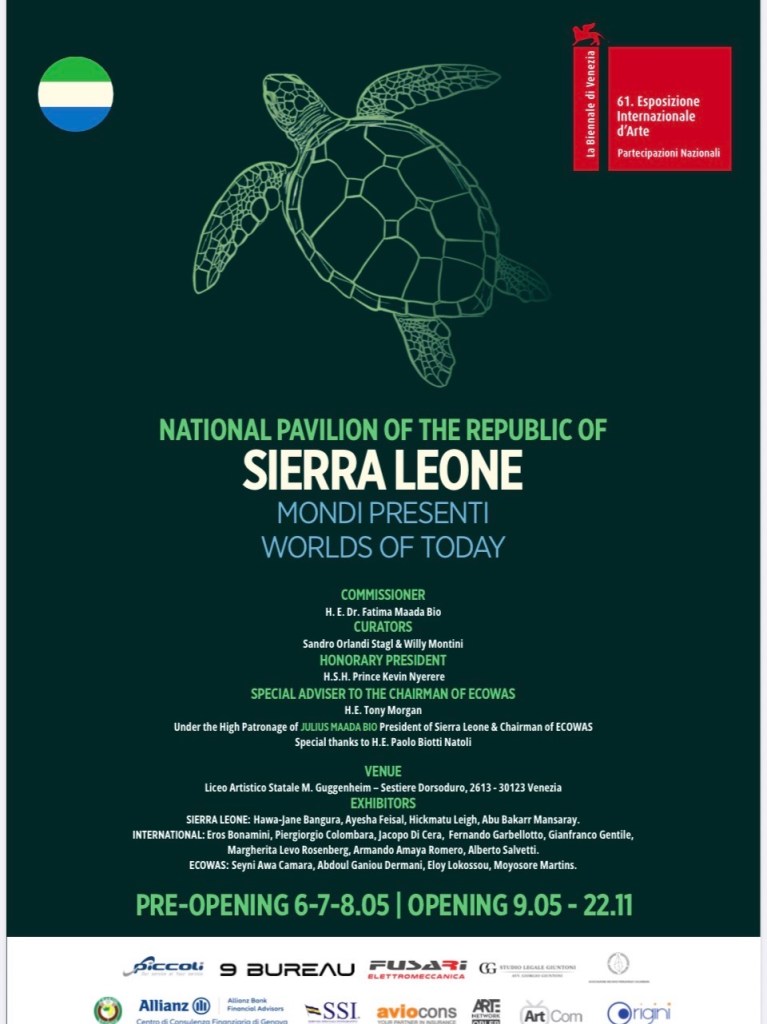
As previously established, the official La Biennale page for Sierra Leone’s pavilion identifies First Lady Fatima Maada Bio as Commissioner and Sandro Orlandi Stagl and Willy Montini as curators. And then it identifies another person: “Prince Kevin Nyerere, Honorary President“
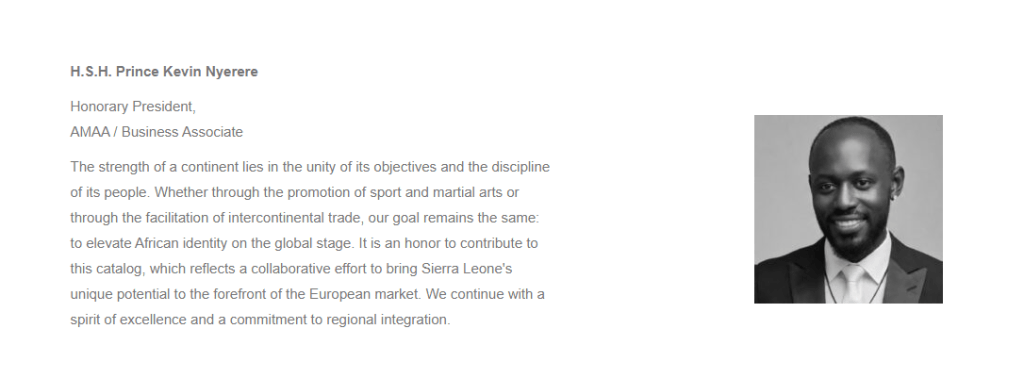
La Biennale says the project is led by Commissioner Fatima Maada Bio, with Kevin Nyerere serving as Honorary President (La Biennale di Venezia). The Sierra Leone Pavilion website gives him an even more intriguing description: S.A.S. Prince Kevin Nyerere, Honorary President, AMAA / Business Associate.
The pavilion also carries a statement attributed to Nyerere referring to the promotion of sports and martial arts, the facilitation of intercontinental trade, African identity on the global stage, and bringing Sierra Leone’s potential to the European market (Sierra Leone Pavilion). This statement immediately raised some questions:
- What is AMAA in this context?
- What exactly does “Business Associate” mean?
- And what is an Honorary President of a National Pavilion supposed to do?
- Who selected Kevin Nyerere?
- And what governmental authority, if any, approved that appointment?
La Biennale confirms that Nyerere holds the title. The public-facing material I reviewed, however, does not explain the appointment process (La Biennale di Venezia). And there was another reason his presence interested me: Kevin Nyerere is not Sierra Leonean.
He is Tanzanian, and his publicly documented professional background is centered not mainly on visual art or curatorial practice, but on business, investment and connecting European companies with African markets. That fact alone is not problematic.
As I emphasized in Part III, nationality is not the issue.
The Venice Biennale is international by its very nature. Foreign professionals can legitimately participate in national pavilions, advise governments, organize exhibitions and contribute expertise. The question is one of authority, function and appointment. Why was a Tanzanian businessman occupying the position of Honorary President of the Republic of Sierra Leone’s historic first National Pavilion at the Venice Biennale?
At first, I wondered whether Kevin Nyerere was simply another international figure brought into the Venice project by its curators or organizers. So, I started looking into him. And what I found changed the question, because Kevin Nyerere had not simply appeared around Sierra Leone’s pavilion in Venice in 2026. Tony Morgan already knew Kevin Nyerere.
More importantly, the public record had described a business relationship between them before the Venice Biennale. That discovery changed the significance of the appointment question and makes the appointment trail relevant. The question was no longer simply: Who is Kevin Nyerere? It had become: How did a pre-existing business associate of Tony Morgan become Honorary President of Sierra Leone’s National Pavilion?
To begin answering that question, we first need to understand who Kevin Nyerere is, and then go backward to a project involving Tony Morgan in Zanzibar in December 2024.
To understand why Kevin Nyerere’s presence in Sierra Leone’s National Pavilion caught my attention, I looked more closely at his documented professional background. In May 2020, Forbes Italia profiled Kevin Nyerere as a business intermediary working to connect companies with investment and commercial opportunities in Africa.
At the time, the profile described his business activities as operating primarily through two companies: Jasiri Ltd, focused on consulting for small and medium-sized enterprises, and Kevin Nyerere Ltd, focused on finance and investment.
Forbes Italia portrayed Nyerere’s role as that of a bridge between businesses seeking opportunities in Africa and governments, ministers and other decisionmakers. The profile quoted Nyerere describing how he connected Italian companies with African governmental officials and business opportunities (Forbes Italia). That background is relevant because Sierra Leone’s Venice pavilion was not being presented purely as an art exhibition. Tony Morgan was speaking about investors, commercial infrastructure and logistics. Fatima Bio spoke of culture and commerce.
And Kevin Nyerere brought a publicly documented background in precisely the world of business connections between Europe and Africa. Indeed, Nyerere’s own pavilion statement refers to facilitating intercontinental trade and bringing Sierra Leone’s potential to the European market (Sierra Leone Pavilion). That does not tell us why he was selected as Honorary President for Sierra Leone. But it makes the unanswered question about the function of his position particularly important.
Was Nyerere there principally as an honorary cultural figure? Or did his role have something to do with investment, business development, commercial networking or connecting Sierra Leone with European interests? The public-facing pavilion material I reviewed does not provide a clear answer.
Forbes Italia also described Kevin Nyerere as a grandson of Tanzania’s founding president, Mwalimu Julius Nyerere, and quoted him speaking about his grandfather (Forbes Italia). The Venice materials, however, style him as: “Prince Kevin Nyerere.” That is a separate claim from being Julius Nyerere’s grandson.
Ultimately, the title was not the most consequential discovery. The relationship was. When I researched backward through the public record, I discovered that Kevin Nyerere did not first enter Fatima Bio and Tony Morgan’s orbit in Venice. Their publicly reported connection went back to at least December 2024. And the language used to describe that earlier relationship was particularly significant.
TONY MORGAN ALREADY KNEW HIM
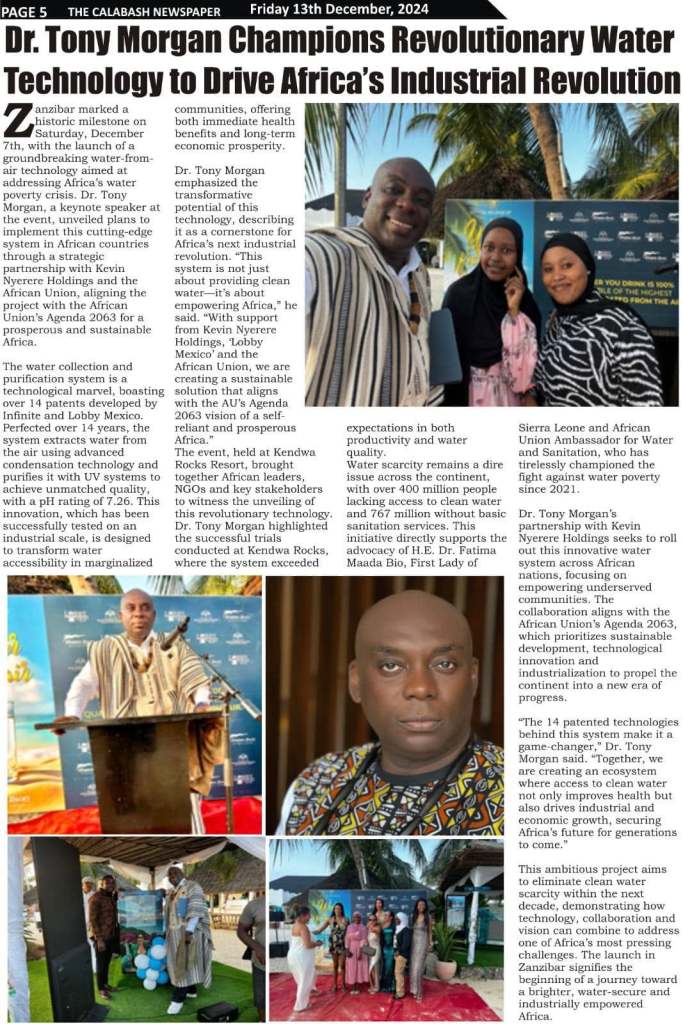
On December 7, 2024, an event took place at the Kendwa Rocks Resort in Zanzibar involving a technology designed to extract and purify drinking water from the atmosphere. Tony Morgan was a keynote speaker.
A few days later, Sierra Leone’s AYV Media Empire reported on the project. According to AYV, Tony Morgan announced plans to implement the technology across African countries through what the report described as: “a strategic partnership with Kevin Nyerere Holdings and the African Union”
The report said the project was aligned with the African Union’s Agenda 2063 and described Kevin Nyerere Holdings as supporting an initiative intended to address water scarcity across Africa (Ayv News). Another Sierra Leone publication, The Calabash Newspaper, carried substantially the same account (The Calabash Newspaper).
But one sentence in the reporting was especially important to my Venice investigation. AYV described the initiative as: “Dr. Tony Morgan’s partnership with Kevin Nyerere Holdings.” (Ayv News). That was December 2024. More than a year before Sierra Leone’s pavilion opened in Venice.
So, by the time Kevin Nyerere appeared in 2026 as Honorary President of Sierra Leone’s National Pavilion, he was not a stranger to Tony Morgan. The two men had already been publicly linked through a business-oriented African development project.
The Zanzibar reporting contained another connection that caught my attention. The water technology was being promoted as a response to Africa’s water and sanitation crisis. And AYV explicitly connected the initiative to the advocacy of First Lady Fatima Maada Bio, describing her at the time as an African Union ambassador for water and sanitation and saying the project supported her advocacy against water poverty (Ayv News).
So, by December 2024, the public reporting around this project brought together three names that would later occupy prominent positions around Sierra Leone’s Venice operation: Tony Morgan , promoting the technology and publicly described as partnering with Kevin Nyerere Holdings; Kevin Nyerere, through Kevin Nyerere Holdings; and Fatima Bio, whose involvement in the water-and-sanitation initiative the reporting said the project supported.
Now, let’s put the chronology together. In December 2024, Tony Morgan and Kevin Nyerere were publicly connected through an African development initiative involving atmospheric water technology. The reporting described “Dr. Tony Morgan’s partnership with Kevin Nyerere Holdings.” The same reporting linked the initiative to Fatima Bio’s water-and-sanitation advocacy (Ayv News).
Then, in 2026, Sierra Leone made its historic first appearance at the Venice Biennale. Fatima Bio becomes Commissioner. Tony Morgan says that, in his State House role, he coordinated Sierra Leone’s presence. And Kevin Nyerere becomes Honorary President of Sierra Leone’s National Pavilion. La Biennale confirms the Commissioner and Honorary President roles (La Biennale di Venezia).
The Sierra Leone Pavilion adds the intriguing description: “AMAA / Business Associate” (Sierra Leone Pavilion). These facts establish a chronology and a network of pre-existing relationships.
AND THE AFRICAN UNION?
The Zanzibar reporting deserves another careful distinction. Both AYV and The Calabash described the water initiative as involving or receiving support from the African Union, and said it aligned with Agenda 2063 (Ayv News). Those reports establish that the African Union relationship was claimed publicly.
In my research, I did not locate the underlying African Union agreement, memorandum of understanding, funding instrument or other primary document that would allow me to independently determine which African Union organ was involved; what “partnership” or “support” meant institutionally, etc.
What can be established is that Sierra Leone media reported the project as a strategic partnership involving Kevin Nyerere Holdings and the African Union, described it as aligned with Agenda 2063, and explicitly characterized Tony Morgan’s role as a partnership with Kevin Nyerere Holdings (Ayv News). The underlying institutional documentation remains to be found.
THE QUESTION IS BIGGER THAN THREE PEOPLE
By this point, my investigation had produced a remarkable configuration. Sierra Leone’s historic first National Pavilion is led by First Lady Fatima Bio as Commissioner.
The man who says he coordinated Sierra Leone’s presence under a State House title, Tony Morgan, had a longstanding relationship with Fatima Bio predating the presidency and simultaneously maintained private business interests.
And the pavilion’s Tanzanian Honorary President, Kevin Nyerere, had a publicly reported business relationship with Morgan predating Venice.
What the evidence establishes is a network of relationships, and a series of unanswered questions about appointment, authority, disclosure and accountability.
But there was still a major part of the pavilion I had not examined closely enough. Because Fatima Bio, Tony Morgan and Kevin Nyerere were not the only people behind Sierra Leone’s operation in Venice. There were the Italian curators; the Italian organizers; the Italian venue; an earlier Cameroon pavilion connection; and there was ECOWAS support.
There were sixteen exhibiting artists, only four of whom were Sierra Leonean. La Biennale’s official roster confirms the 16 exhibitors and the pavilion’s description says the project intentionally brought together artists from Sierra Leone, ECOWAS states and Italy (La Biennale di Venezia).
And there was still the question that had hovered over this investigation from the beginning: Who actually put Sierra Leone’s historic first National Pavilion together, and how was it authorized and financed? To answer that, I had to move beyond Fatima Bio, Tony Morgan and Kevin Nyerere. I had to follow the organizational and institutional trail into Italy, and examine what the public record does, and does not, reveal about the money behind the pavilion.

