
Fatima Babih, EdD
As 47,454 Young Sierra Leoneans Sit In Limbo for Alleged Malpractice, Who is Investigating the Adults Who Reported Their Alleged Crimes?
A piece of paper lands on the floor of an examination room. Nobody, it seems, can say for certain who threw it. But an invigilator picks it up, finds examination material on it, and reports it to the West African Examinations Council (WAEC) as attempted malpractice.
Weeks later, when the 2026 WASSCE results are released, every WASSCE student at that school has had their results withheld. They are now among the 47,454 candidates across Sierra Leone whose futures are on hold.
An Alleged Malpractice Scenario
Before the results were released, a source in Sierra Leone shared a troubling account with me about the examination arrangements at a school in her town. According to my source, the invigilators assigned to the school were not members of its teaching or administrative staff. She also reported that those invigilators had asked the principal for compensation, and that the principal refused.
At the time, my source wondered aloud whether that dispute over money might breed resentment, and whether that resentment could shape how irregularities were reported to WAEC. I treated it as speculation. A disagreement over payment is not evidence of misconduct.
Then came the second report about the incident with the piece of paper allegedly sent through a window at the same school where the principal refused to pay invigilators. Even then, I did not believe these accounts were enough to draw conclusions about anyone’s motives or conduct.
But the results of every WASSCE student at that school have now been withheld. When an entire graduating class’ results are held back, and the circumstances surrounding the reports include an unresolved financial dispute, those circumstances deserve careful, open, and fair examination.
But much of the national conversation about the 2026 WASSCE has asked one question: which students cheated?
That question matters. But we must also ask another question, and it may matter just as much: Who invigilates the invigilators?
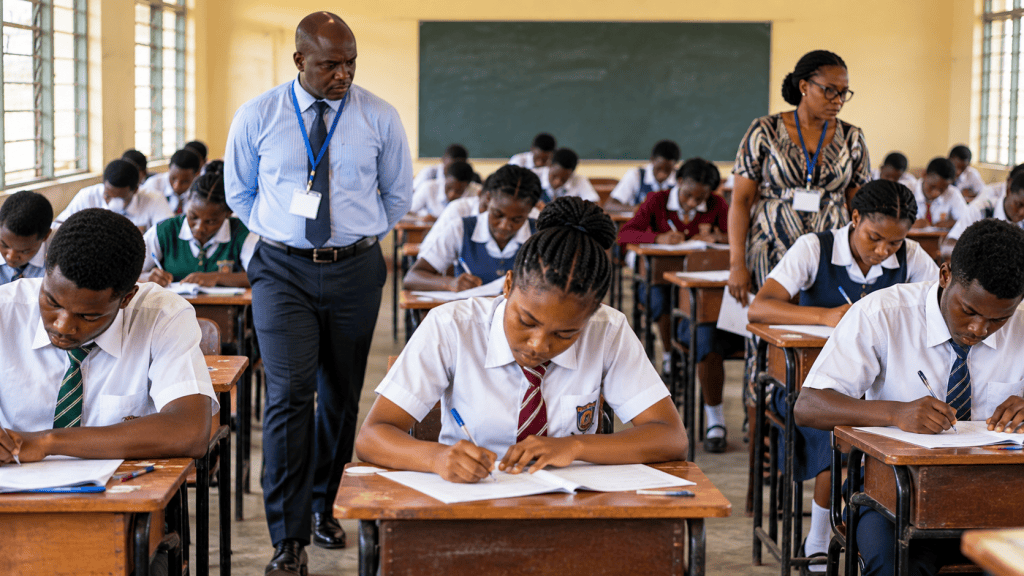
Who are examination invigilators in Sierra Leone?
Invigilators are generally recruited from teachers and other eligible personnel. They are not necessarily permanent WAEC employees or staff of the school where the examination takes place.
A government communiqué on examination malpractice provides that WAEC is responsible for identifying and selecting supervisors and invigilators in collaboration with the Ministry of Basic and Senior Secondary Education (MBSSE), the Conference of Principals of Secondary Schools (CPSS), and the Sierra Leone Teachers Union (SLTU).
The communiqué also distinguishes between teachers and non-teachers serving as examination officials, confirming that the positions are not exclusively reserved for school staff.
| Role | Typical responsibility |
| Invigilator | Monitors candidates inside an examination room, enforces examination rules, and reports suspected irregularities. |
| Supervisor | Oversees examination administration and invigilators at an assigned centre or session. |
| Centre manager | Coordinates broader examination-center arrangements. |
| School principal | Has school-level administrative responsibilities and may assist with examination arrangements and investigations. |
These are distinct functions, although exact assignments depend on WAEC’s applicable examination procedures.
Are invigilators paid?
WAEC examination invigilation and supervision are remunerated assignments, with allowances reported for teachers performing those duties.
However, documented evidence shows delayed payments. The issue was raised in Sierra Leone’s Parliament in May 2018, when a member complained about low remuneration and long delays in paying teachers who supervised examinations and marked scripts.
In August 2020, Politico SL reported that teachers serving as WAEC invigilators and supervisors in Kenema threatened to boycott examinations because they had not received allowances for previous work. The district teachers’ union chairman corroborated the complaints.
WAEC declined to comment when approached (Politico SL).
Who is accountable when an invigilator fails to prevent malpractice?
The official government communiqué provides a particularly important answer. It assigns WAEC responsibility for examination activities inside examination centers, including briefing examination officials, securing examination materials, enforcing examination guidelines, and conducting post-examination activities.
It also assigns MBSSE responsibilities for monitoring examination centers, participating in investigations, and sanctioning supervisors or invigilators implicated in malpractice (MBSSE).
In August 2026, Anti-Corruption Commissioner Francis Ben Kaifala publicly emphasized that examination integrity must remain the responsibility of the institutions legally mandated to conduct examinations, rather than being transferred to the Anti-Corruption Commission (Anti-Corruption Commission SL).
The government has already written the rules
Here is what makes this situation so frustrating: Sierra Leone does not need to invent a framework for holding examination officials accountable. One already exists.
In July 2020, following the work of a Presidential Taskforce on Examination Malpractice, the Ministry of Basic and Senior Secondary Education (MBSSE) convened a high-level meeting of WAEC, the Anti-Corruption Commission, the Sierra Leone Police, the Teachers’ Union, principals, parents, civil society, UNICEF, and others.
Together they adopted the Communiqué on Elimination of Examinations Irregularities and Malpractices, a document its signatories declared binding.
When you read that document today, it reads like a list of promises waiting to be kept.
On invigilators and supervisors, the Communiqué states that:
- WAEC is responsible for everything that happens inside examination centres.
- WAEC selects supervisors and invigilators in collaboration with the Ministry, the Conference of Principals of Secondary Schools, and the Sierra Leone Teachers’ Union, and principals are expected to help recommend officials of unquestionable integrity.
- Guidelines for invigilators and supervisors were to be developed and made publicly available for all.
- The Ministry is responsible for sanctioning supervisors and invigilators implicated in malpractice.
- Any supervisor, invigilator, or examiner confirmed to have engaged in malpractice faces dismissal if a teacher, a report to their employer if not, and public naming on a malpractice list.
In other words, the government itself recognized in 2020 that examination officials can be part of the problem, and committed to holding them to account.
On timelines, the Communiqué is just as clear:
- WAEC is to complete all malpractice investigations within a maximum of three months.
- Anti-Corruption Commission investigations are likewise capped at three months.
- The Sierra Leone Examinations Committee is to issue preliminary reports no more than one month after results are published.
And on penalties, the Communiqué repeatedly uses one crucial word: confirmed. Candidates, schools, teachers, and officials face sanctions when they are confirmed to have engaged in malpractice, and schools only after investigation by the ACC and WAEC. Suspicion alone was never meant to be enough.
The questions WAEC Must Answer
Measured against its own commitments, the authorities owe affected students and families clear answers:
- Were the invigilators at this school selected through the process the Communiqué requires?
- Where are the public guidelines for invigilators and supervisors?
- Who is responsible for paying invigilators?
- Are they ever left to seek payment from schools?
- If so, are disputes over compensation documented and resolved, or quietly left to fester?
- Who else witnessed the alleged incidents?
- Is there any corroboration beyond the invigilator’s own report?
- What exactly do invigilators record?
- Do their reports identify specific candidates as receiving, possessing, or using unauthorized material?
- Will the three-month deadline for investigations be honored?
- Will the one-month preliminary report be published?
- And most importantly: what independent evidence connects a reported incident to the particular students whose results have been withheld?
Invigilators hold power. Power requires accountability.
Invigilators occupy positions of enormous responsibility. A single report from them can trigger an investigation that determines whether a young person goes to university, wins a scholarship, or finds work, or whether they spend months, perhaps years, in limbo.
But invigilators are human beings. They face financial pressures, workplace conflicts, inadequate training, and the same temptations as anyone else. None of that makes their reports unreliable. It makes independent verification crucial.
These concerns are not ours alone. Sierra Leone’s Anti-Corruption Commission has previously acknowledged complaints involving examination malpractice and alleged extortion by examination personnel.
And in October 2026, the Centre for Accountability and Rule of Law–Sierra Leone (CARL-SL) called for malpractice investigations to examine the conduct of invigilators, supervisors, and other officials, not only that of candidates.
If we scrutinize the students while treating every report against them as unquestionable, we have built a system in which the accused must prove their innocence and the accusers are never asked to show their evidence.
That is not the system the 2020 Communiqué promised.
The real cost of getting this wrong
This is not an abstract debate about procedure. Young people who lose their educational path, their sense of purpose, and the structure of their days become more vulnerable to crime, drug use, and sexual exploitation. Every week that a result is wrongly withheld is a week a young person’s future erodes.
If even a fraction of those 47,454 withheld results rest on unverified, mistaken, or retaliatory reports, then thousands of innocent young people are paying for failures that were never theirs.
What We Must Demand
We are not asking for cheating to be excused. Where students are proven to have broken the rules, they must face the consequences.
We are asking the authorities to honor the commitments they have already made, and to build a system in which everyone is accountable, including the adults entrusted with protecting the integrity of the examination.
That is why our petition calls on WAEC and the Ministry of Basic and Senior Secondary Education to:
- Publish the rules: the procedures, evidentiary standards, and timelines governing withheld results, including the invigilator and supervisor guidelines promised in 2020.
- Tell every student what they are accused of, show them the evidence, and give them a real chance to respond.
- Investigate the investigators: apply the 2020 Communiqué’s accountability provisions to invigilators, supervisors, and examination-center officials wherever credible concerns arise.
- Meet the three-month deadline the government set for itself, and publish the one-month preliminary report.
- Report progress publicly through anonymized figures on results released, canceled, or still under investigation.
- Guarantee a fair appeal, with written reasons for every adverse decision.
The integrity of an examination does not depend only on whether students obey the rules. It depends on whether the people enforcing those rules act professionally, impartially, and accountably.
Students must answer for their actions when wrongdoing is established. The adults who watch over them must answer for theirs too. In 2020, Sierra Leone’s leaders put that principle in writing and signed it. In 2026, 47,454 young people are waiting to see whether they meant it.
Sign and Share The Petition
Every student deserves due process. Every allegation deserves a fair investigation. Every young person deserves a future.
References
Ministry of Basic and Senior Secondary Education. (2020). Communiqué on elimination of examination irregularities and malpractices. Government of Sierra Leone. mbsse.gov.sl Read official communiqué (PDF)
West African Examinations Council, Sierra Leone. (2026, August 26). Examination irregularities portal. WAEC announcement
Centre for Accountability and Rule of Law–Sierra Leone. (2026, October 29). CARL-SL calls on the ACC to investigate possible systemic corruption and oversight failures in the 2026 WASSCE results. CARL-SL’s statement
Anti-Corruption Commission of Sierra Leone. (n.d.). ACC warns against malpractices, wanton use of mobile phones and extortion in the ongoing West African Senior School Certificate Examination (WASSCE). ACC press release
Anti-Corruption Commission of Sierra Leone. (2026, August). “We cannot take charge of exams”: ACC boss demands institutional accountability for exam malpractice. ACC statement
Sorie, D. (2026, October 27). Government of Sierra Leone releases 2026 WASSCE results. Sierraloaded. Read the news report
Sierra Today. (2026, October 28). Sierra Leone releases 2026 WASSCE results amid malpractice concerns. the report
Anti-Corruption Commission of Sierra Leone. (n.d.). ACC warns school authorities against extortion and examination malpractices. Read ACC warning
Communiqué on Elimination of Examinations Irregularities and Malpractices

