
by Fatima Babih, EdD
La Biennale’s response to my request provided records that settle who signed Sierra Leone’s application. They also expose the question this series began with: where did the Commissioner’s authority come from, and did it come from anyone but herself?
This series began with a comment on my Facebook page. A reader led me to a fact most Sierra Leoneans did not know: the First Lady was Commissioner of our country’s first National Pavilion at the Venice Biennale. Our own government had not told us. I started digging, and I asked a question that sounded almost too simple to need an investigation: who appointed First Lady Fatima Jabbie Bio as Commissioner?
Five parts followed the pattern from Freetown to Dubai to Venice, the people around the First Lady, the Italian network, the patronage and the missing money. Each answered something and raised more. None could answer the first question, because the evidence sat in Venice. On September 11, 2026, I requested it from La Biennale under Italy’s transparency law. Its Director General has now released correspondence with Sierra Leone, the procedures governing National Participations, and catalogue and press-office records. For the first time, I am not inferring the sequence.
I am reading it.
THE RULE
Sierra Leone has no permanent pavilion at the Biennale, so its application fell under Article 4 of the procedures, a copy of which La Biennale sent me with Foreign Minister Timothy Musa Kabba’s signature “for acceptance” on the last page. The request must be signed by the competent Governmental Authority: the Minister of Culture, the Minister of Foreign Affairs or the competent culture minister. Requests from ambassadors or other representatives will not be considered. That authority then appoints the Commissioner, who must belong to the authority or to the public institution it delegates, and who acts as its “representative and direct expression.” Deputy and co-commissioners are not accepted.
The design is simple, and its direction matters. Authority starts with the government and flows down to the Commissioner. The Commissioner carries the government’s power. The government does not borrow hers.
THE FIRST LETTER CAME FROM STATE HOUSE
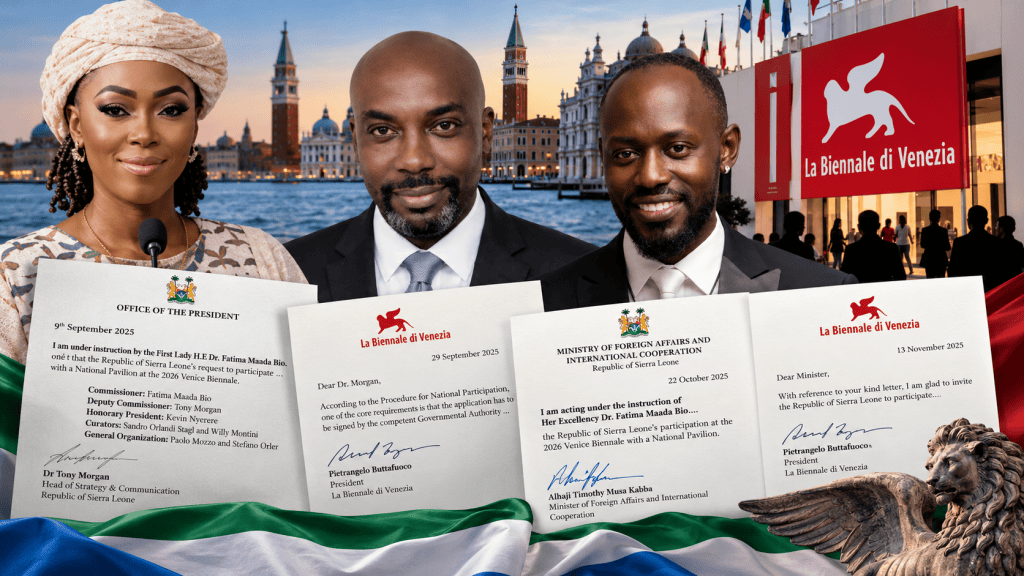
The first request did not come from a ministry. It came on Office of the President letterhead, dated September 9, 2025, stamped received by La Biennale on September 16, and signed by Dr. Tony Morgan, Head of Strategy and Communication, State House. Its opening words: “I am under instruction by the First Lady H.E Dr. Fatima Maada Bio.” Further down, the letter slips into Fatima Bio’s voice, describing the request as made “in my capacity as First Lady.”
By then the structure was fixed. The letter named Fatima Maada Bio as Commissioner, Morgan himself as Deputy Commissioner, Kevin Nyerere as Honorary President, Sandro Orlandi Stagl and Willy Montini as curators, and Paolo Mozzo and Stefano Orler as General Organization, and said the event would seek ECOWAS patronage. Copies went to the Secretary to the President and the Minister of Foreign Affairs. La Biennale had issued no invitation. A pavilion team had been proposed before any government decision appears in the record.
It was also a familiar structure. At Expo 2020 Dubai, as Part II showed, Fatima Bio was Commissioner-General and Tony Morgan her Deputy Commissioner-General. In Venice, Morgan proposed the same pairing, and his e-mail signature on the application still reads “Deputy Commissioner General EXPO 2020” beside his Office of the President title. The next letter, signed by the minister, no longer has a deputy.
La Biennale’s president, Pietrangelo Buttafuoco, answered Tony Morgan on September 29, 2025. He reminded him that the application “has to be signed by the competent Governmental Authority,” and he named the ministers who qualify, and said deputy or co-commissioners could not be accepted. The country, he wrote, should conform to the procedures, and an official invitation would follow once the issues were clarifie

THE INVERSION
After La Biennale’s response, the government’s formal request emerged on Ministry of Foreign Affairs and International Cooperation letterhead, signed by Minister Timothy Kabba, dated by hand October 21, e-mailed October 22 and stamped received on October 28. A Foreign Minister is exactly the kind of authority the procedure expects. Then comes the Minister’s first sentence: “I am acting under the instruction of Her Excellency Dr. Fatima Maada Bio.” The Minister’s letter introduces Fatima Bio as First Lady, Head of the Sierra Leone Expo Secretariat and Commissioner-General for international expositions. He submits the request on behalf of the Government, “in her capacity as First Lady,” and names Fatima Bio “Commissioner.”
Set the two letters side by side and a pattern appears. The deputy commissioner and honorary president are gone, as La Biennale’s reply required, but the Commissioner is unchanged. The minister’s scope paragraph, ECOWAS paragraph and closing track Morgan’s text almost word for word. The cover e-mail that accompanied the minister’s letter repeats, word for word, the one Morgan sent on September 13, including its description of the request as “submitted on behalf of” the First Lady. And the only copy recipient listed on the minister’s letter is the Chief of Staff of the Office of the First Lady. No other office is named. The released documents do not say who drafted the minister’s letter. They do show whose text it follows and whose office was told.
Here is the problem, stated as plainly as the documents allow. La Biennale’s rules require a governmental authority to appoint the Commissioner and require the Commissioner to belong to that governmental authority or to a public institution it delegates. In Sierra Leone’s documents, the order runs backward. First Lady is named Commissioner, in a letter whose author says he acts under the instruction of the same woman he named as Commissioner.
The minister then supplies the government’s signature, saying he too acts under the instruction. The authority that was supposed to appoint her is shown taking direction from the person to be appointed.
Whose decision, then, does the minister’s signature represent? His own? The President’s? Cabinet’s? Nothing released so far says any of them decided. The ministry Part I showed was built for exactly this work, Tourism and Cultural Affairs, does not sign, is not copied and is not mentioned in any released letter. The only instruction on paper is hers. And the only titles these letters give her are First Lady, a position of honor rather than public office as far as I can establish, and head of an Expo Secretariat, the same unexplained body Part II asked about, which these letters again never explain: who created it, who appointed her to it, and whether it is the public institution to which a Commissioner must belong.
So, I will ask what the documents force me to ask. Did Fatima Bio appoint herself?
I say that on this record no one else is shown to have appointed her, and that a process in which the appointee instructs the appointer is not an appointment. It is ratification.
WHO WAS RUNNING THE PAVILION
On November 13, 2025, La Biennale invited the Republic of Sierra Leone in a letter addressed to Minister Kabba, referring to his letter. It named no Commissioner. La Biennale did what its procedure required: it accepted a minister’s signature. It did not examine what stood behind it, and that was never its job. That duty belonged to Sierra Leone.
What La Biennale sent me includes no stand-alone instrument appointing the Commissioner, no Cabinet decision and no budget, and its reply does not say whether such papers exist. It also told me that two of my requests, on who sought ECOWAS’s involvement and how the artists were selected, concern matters outside the Foundation’s activities. If those papers exist, they are in Freetown.
The later records show who handled the machinery. Paolo Mozzo submitted the pavilion’s catalogue texts in January 2026, including the guide text calling the Commissioner “a leading cultural figure.” In February he told La Biennale, in Italian, that “we have chosen” the pavilion’s press office. That press agent, Cristina Gatti, then described Mozzo to Biennale staff as “il responsabile del Padiglione Sierra Leone,” the person in charge of the pavilion. In the correspondence released, no ministry and no Commissioner appears in any of these exchanges.
Interests sit in the credit lines. The catalogue lists “Courtesy: ARTantide Gallery” beside one exhibiting artist and “Courtesy: Artenetwork Orler” beside another. Mozzo’s e-mail signature gives his company’s website as artantide.com, and Orler is the other named head of the General Organization. The English catalogue text also says the pavilion is “Sponsored by ECOWAS,” while the Italian says patrocinato, patronage. Sponsorship and patronage are different things. Commercial overlap between organizers and exhibitors is not unlawful in itself. But a national pavilion is not a commercial fair, and the procedures say that exhibitors’ participation “should not entail any fee.” Who selected these artists? Did any gallery or exhibitor pay anything? Who profited? The answers are not in the record.
WHERE CORRUPTION BEGINS
Corruption, as international anti-corruption bodies define it, is the abuse of entrusted power for private gain, and it seldom opens with a bribe. It opens with a bypass: public authority exercised outside the channels that make it accountable. These documents show Office of the President letterhead, a State House seal, a ministry seal and a Foreign Minister’s signature engaged at the instruction of a woman whose authority to give that instruction is nowhere shown.
Whether that was an abuse of entrusted power is the first question. Whether anyone gained from it, financially, commercially or in reputation, is the second. The pavilion’s own texts called the Commissioner “a figure of continental stature” and presented Sierra Leone as a reliable country for investment. Under the procedures, the participating country pays for transport, customs, storage, security, insurance and installation. If that bill reached the Sierra Leonean public, the public is owed an account. If sponsors paid, the public is owed their names and their terms. Either way, a pavilion that carries the Republic’s name should never have run on instruction instead of authority.
Only government can answer these questions, and each has an address. The Ministry of Foreign Affairs can say what authority Minister Kabba exercised, whether the President or Cabinet decided, who wrote the letter he signed, and why it cites her instruction rather than theirs. State House can say what authority allowed Tony Morgan to write on Office of the President letterhead for a national pavilion and name himself deputy to the Commissioner. The Ministry of Tourism and Cultural Affairs can say whether it was consulted at all. The Office of the First Lady can say what authority underlies the instructions recorded in these letters, what the Expo Secretariat is, and who appointed her to it. And the Government can publish the appointment instrument, if one exists, along with the budget, the contracts and every expense. I urge Sierra Leoneans, Parliament, the press, civil society and the Anti-Corruption Commission to put these questions in writing, including through the Right to Access Information Act, and to keep asking until each one is answered.
WHERE THE SERIES ENDS
Part I asked who appointed the First Lady as Commissioner and asked the larger question: who actually exercises governmental authority in Sierra Leone. Six parts later, the paper trail gives this answer: a plan that began with her instruction, passed through a State House strategist and a Foreign Minister who each said they were acting under it, and was accepted by a Biennale bound to take a minister’s signature at face value. The plan came first. The government’s signature came second.
In Guinea, as Part I showed, the ministry put its own official in the Commissioner’s chair. In Sierra Leone, the minister acted under the instruction of the First Lady as the Commissioner. The government that was supposed to appoint her is nowhere shown to have decided anything.
This is something every citizen should find hard to accept: a gap exactly where accountability is supposed to be. The name on that pavilion was the Republic of Sierra Leone, so the final question belongs to the Republic, and it is the one this series began with:

