
by Fatima Babih, EdD
An Italian network, an unexplained financial trail and a national pavilion that carries the name of the Republic but not its visible government authority.
A country does not enter the Venice Biennale by accident. It enters by authority: a government applies, a government appoints, a government answers. When Sierra Leone made its debut in 2026, one of only seven countries making a first Biennale Arte appearance, La Biennale presented it as the National Participation of the Republic of Sierra Leone, with First Lady Fatima Jabbie Bio as Commissioner and Sandro Orlandi Stagl and Willy Montini as curators.
Here is what the public did not see: the government of Sierra Leone in action.
In Part IV, I followed the people: Tony Morgan, the British national presented on the pavilion website as both “Head of Strategy and Communication, State House, Sierra Leone” and CEO of 10X Consulting, and Kevin Nyerere, the Tanzanian businessman titled Honorary President. Both these individuals orbit First Lady Fatima Jabbie Bio. This Part follows the institutions and the money, and it ends at a question that grows harder to avoid with every document I fail to find: who actually controls this pavilion?
THE DOCUMENT THAT MUST EXIST
La Biennale’s rules are plain. A country without a permanent pavilion participates through a letter from the competent government authority. That authority initiates the participation and appoints the Commissioner, who represents it and takes responsibility for the national presentation. A Commissioner is an agent of government. Commissioners are not self-appointed.
That is what makes this arrangement so striking. The First Lady is not a minister or an elected official and, as far as I have been able to establish, holds no appointment in the government of Sierra Leone. Her honorary position as wife of the President carries influence, but not governmental authority. Being married to the President does not, by itself, give anyone the legal power to commit the Republic to an international exhibition, to spend public money in its name, or to speak for the State.
Someone with that power had to act. Yet I have found no public government document that says who. Which authority submitted Sierra Leone’s request? Who signed the appointment? Who approved the structure beneath the Commissioner?
Until that paper is produced, the official description is that the Republic runs the pavilion. The visible reality points to the First Lady and the circle around her.
THE NETWORK
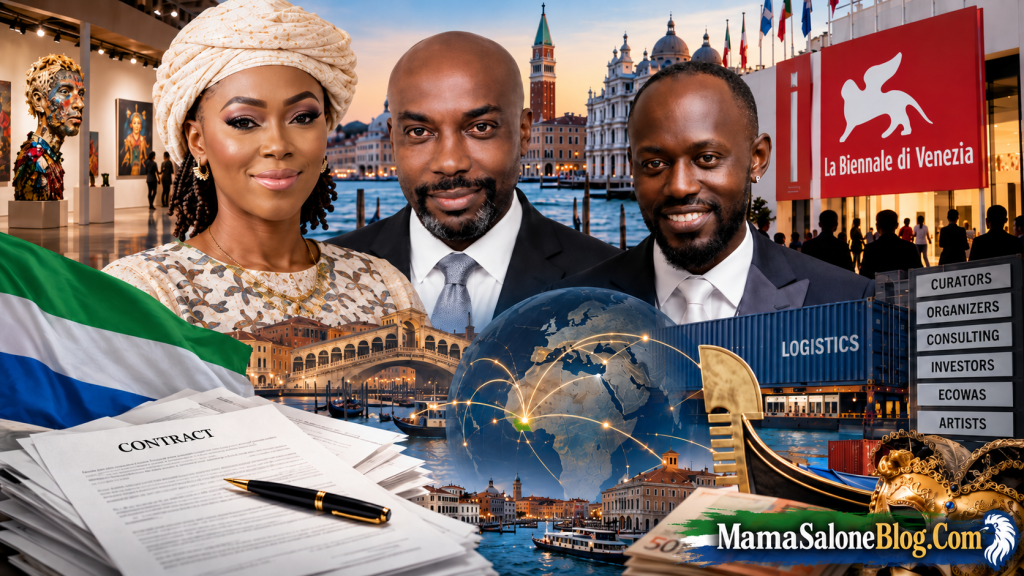
Follow the pavilion beyond its curators and an Italian layer appears. Foreign curators are common at international exhibitions, and their nationality is not my concern. The structure is. The pavilion’s contact page directs inquiries not to the Sierra Leone Ministry of Tourism and Cultural Affairs, not to the Sierra Leone Ministry of Foreign Affairs, not to the Sierra Leone Embassy, and not to any government email address. It points to two private Italian entities: ArteNetwork, listed with an ArtCom Project address, and Origini, whose contact is Paolo Mozzo.
When the public face of a national pavilion is private and foreign, ordinary questions become unavoidable. Who engaged these organizations, and under what arrangement? What did they provide, and were they paid, sponsored or compensated in kind? And who signed for Sierra Leone?
Sierra Leone’s participation at La Biennale was never only an exhibition. On the pavilion website, Tony Morgan says that coordinating Sierra Leone’s presence was meant to convey the sophistication of the country’s commercial infrastructure and the ambition of projects from the Green Skyway to expanded logistics hubs, so that investors and visitors understand where Sierra Leone is heading. Fatima Bio’s own statement speaks of a dialogue between culture and commerce.
A pavilion that markets a nation’s investment agenda is performing a function of State. If it speaks to investors on behalf of Sierra Leone, which Sierra Leonean institution approved what it says?
The artist roster raises the same issue. La Biennale lists sixteen exhibitors. The pavilion’s website places only four names under “Republic of Sierra Leone”: Hawa-Jane Bangura, Ayesha Feisal, Hickmatu Bintu Leigh and Abu Bakarr Mansaray.
The others come from Italy, Mexico, Senegal, Togo, Benin and Nigeria under an ECOWAS grouping. International exchange is part of the Biennale’s purpose. But this is Sierra Leone’s first national pavilion in the history of the event, and by the website’s own classification, most of it is not Sierra Leonean. Who made the selection, and through what process?
ECOWAS, STATE SCHOOL AND A SIGNATURE
At the time Sierra Leone applied for participation at La Biennale, President Julius Maada Bio was Chairman of ECOWAS. La Biennale’s English page says the pavilion is “Supported by the Economic Community of West African States (ECOWAS).” The Italian page says “Patrocinato,” and the pavilion’s website places the exhibition under the High Patronage of the President and ECOWAS. I have submitted formal records requests to La Biennale and to ECOWAS, and ECOWAS has acknowledged receipt. Patronage, however, is not payment.
Until documents show otherwise, my position is that ECOWAS supported or lent its name to the pavilion, and whether that included money, services or something else is yet to be publicly unknown.
The same candor applies to the venue. The pavilion occupies the Liceo Artistico Statale Michelangelo Guggenheim in Dorsoduro, a state art school. I have found no public contract, concession, rental agreement or payment record. But someone signed for that space. Was rent paid, or was the space provided free as sponsorship or cooperation? And which person or institution signed on Sierra Leone’s behalf?
HOW CORRUPTION HIDES
All actors are visible at La Biennal, except the government of Sierra Leone. Put the pieces side by side. La Biennale recognizes Fatima Bio as Commissioner. Tony Morgan says he coordinated Sierra Leone’s presence from a State House role. Kevin Nyerere holds an honorary presidency. Two private Italian organizations answer the public’s inquiries. ECOWAS lends its patronage, private sponsors surround the project, and the venue is a state school in Venice. Everyone is visible except the one party that should come first: the Government of Sierra Leone. The words “Republic of Sierra Leone” are everywhere. The trail showing how the Republic exercised authority over the project is nowhere to be found.
I make no finding of corruption in this series, and I will not pretend that a gap is a crime. But corruption has never needed to announce itself. It lives in exactly this kind of space: authority no one can trace, intermediaries no one can see being appointed, contracts no one has read and spending no one is required to report.
When the wife of the President without public office appears to direct a national undertaking, supported by private foreign organizations and a consultant with a State House title, the safeguards that protect public money are either being bypassed or are invisible to the public they exist to serve. Authorization, procurement, budgeting, audit and parliamentary scrutiny cannot be assumed. They must be shown.
The records that would end the suspicion are ordinary ones. Sierra Leone’s request to participate. The instrument appointing the Commissioner and her signed acceptance of the Biennale’s procedures. The approved budget and the sponsorship agreements. The venue agreement. The contracts with the curators and Italian partners. The invoices for freight, insurance, installation, security, staffing and publicity. The travel, accommodation and per-denim records for officials who attended. Expenditure records from State House, the Office of the President, the Office of the First Lady and the Ministry of Tourism and Cultural Affairs. Any ECOWAS authorization or contribution. No properly run national project lacks these, and none of them is unusual.
First Ladies may advocate. Advisers may advise. Consultants may consult, businesses may sell services, foreign experts may share expertise and sponsors may give money. None of that is improper. What is improper is a project that carries the name of the Republic while no Sierra Leonean institution can be found standing behind it.
Citizens are entitled to know who selected these people, who contracted them, who supervised them, who paid them and who authorized them to act for Sierra Leone, and above all which public institution remained accountable. That principle holds regardless of party. It will matter long after Fatima Bio is no longer First Lady.
This is also not a demand that anyone accept my interpretation. If the pavilion was privately financed, show that. If sponsors covered the costs, show that. If the government paid legitimate expenses, show those too, and tell taxpayers how much. Transparency is not an accusation. It is how a public answers its own doubts.
THE QUESTION THAT REMAINS
Sierra Leone’s debut at Venice should have been a triumph for many of our artists and a moment of real cultural diplomacy on one of the world’s great stages. History deserves a record. After following the First Lady’s pattern of taking over State affairs, from Sierra Leone to Dubai and now to Venice, we are left with a question larger than any individual:
How did an official National Pavilion of the Republic of Sierra Leone come to be organized around this particular network of people and organizations, and where is the public record showing who chose, authorized and financed them?
That question belongs to every Sierra Leonean, because the name on that pavilion is ours. A country’s name cannot be lent to a project that no public institution will explain, and silence from those in power is not an answer. It is the reason to ask louder.
This is not a question about art. It is a question about governance, and about whether our country’s name can be used without our government answering for it. A government with nothing to hide loses nothing by publishing its records. A public that stops asking loses far more. Until the records are public, Sierra Leoneans are right to keep asking.

