
by Fatima Babih, EdD
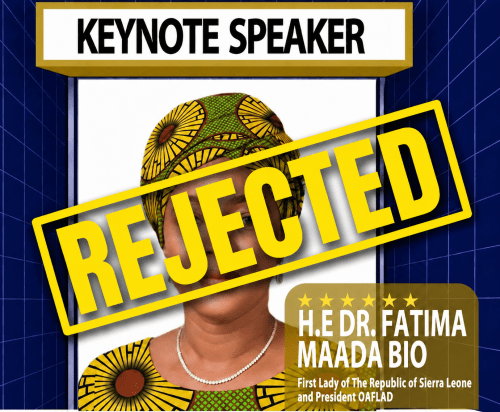
When Women’s Rights Becomes One Woman’s Rights: Fatima Bio’s speech about Cambridge University’s cancellation of her speaking engagement became a revealing portrait of arrogance, victimhood, deflection, political intimidation, and the personalization of public accountability.
Fatima Jabbie Bio’s recent video speech is extraordinarily revealing because it contains several recurring themes that appear throughout her public communications, such as,
- personalization of criticism,
- attacks on critics rather than arguments,
- victimhood narratives,
- political polarization,
- self-aggrandizement, and
- claims that are either unsupported or contradicted by available evidence.
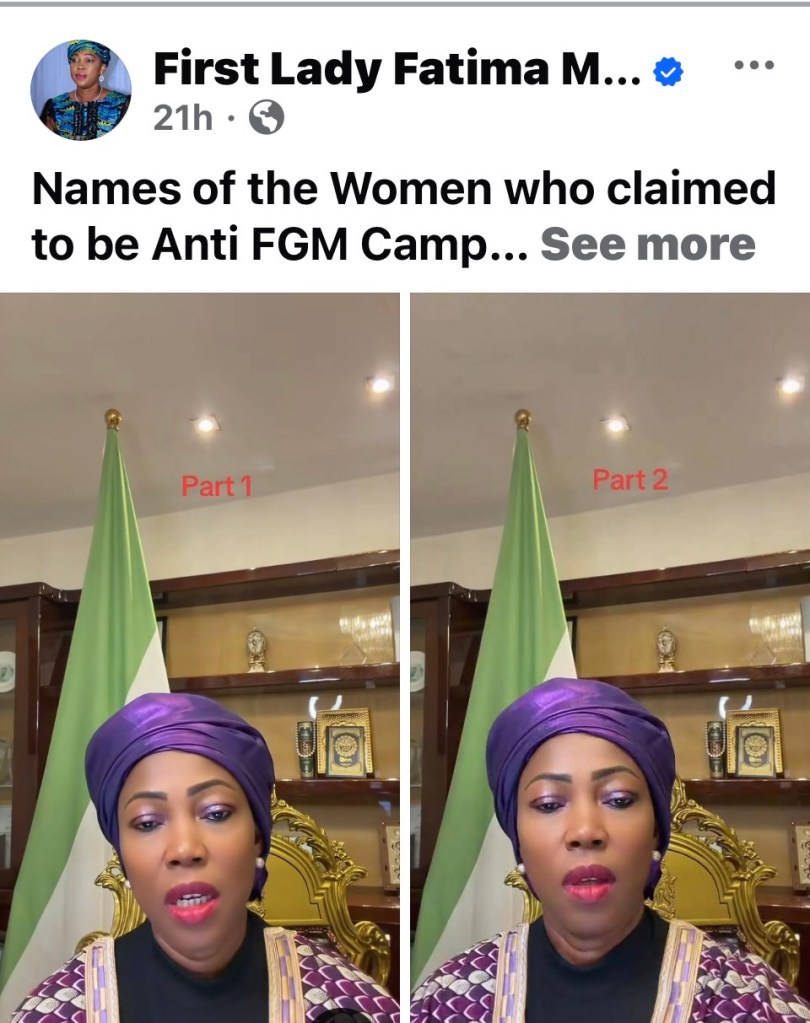
Here is a thematic analysis of Parts 1 and 2 of her June 5, 2026, video speech after Cambridge University rejected her participation.
Arrogance & Self-Importance
One of the dominant themes throughout both videos is Fatima Bio’s repeated elevation of herself above others, especially critics, activists, and even institutions.
Examples in her videos:
- My work speaks for itself because I do not need an introduction.
- I am not looking for platforms.
- No single woman in this country has been able to do what I, Fatima Maada Bio, have done.
- Cambridge would have only been another platform, but it will not be the platform.
These statements go beyond confidence. The repeated message is: ‘I am already too important to need anyone.’
This creates an image of exceptionalism in which criticism is treated not as legitimate disagreement but as an attack on someone who considers herself beyond ordinary scrutiny.
Bragging & Self-Promotion
The speech repeatedly returns to her achievements. She references:
- awards,
- global recognition,
- international invitations,
- friendships with other First Ladies,
- her Hands Off Our Girls campaign,
- and her alleged uniqueness among Sierra Leonean women.
The irony is that she explicitly says:
I don’t want to be a First Lady who brags…
Immediately before launching into a lengthy explanation of why she believes no other woman in Sierra Leone has achieved what she has achieved.
This is a classic contradiction between stated humility and demonstrated self-promotion.
Attack on Anti-FGM Activists
Perhaps the strongest theme in the speech. Rather than addressing the substantive concerns raised by activists, Fatima Bio repeatedly attacks:
- their motives,
- their credibility,
- their political affiliations,
- and their integrity.
- even their names.
Examples in the videos:
- They are just campaigning because they have paymasters in Europe.
- They are making money using titles like MBE.
- These are APC card carriers, jus look at their names.
- Are you campaigning against FGM or are you trying to fight Fatima?
This is an example of an ad hominem strategy: Instead of addressing: Is FGM harmful?
Her discussion becomes: Are the activists bad people? The focus shifts from the message to the messengers.
Cyberbullying & Public Shaming
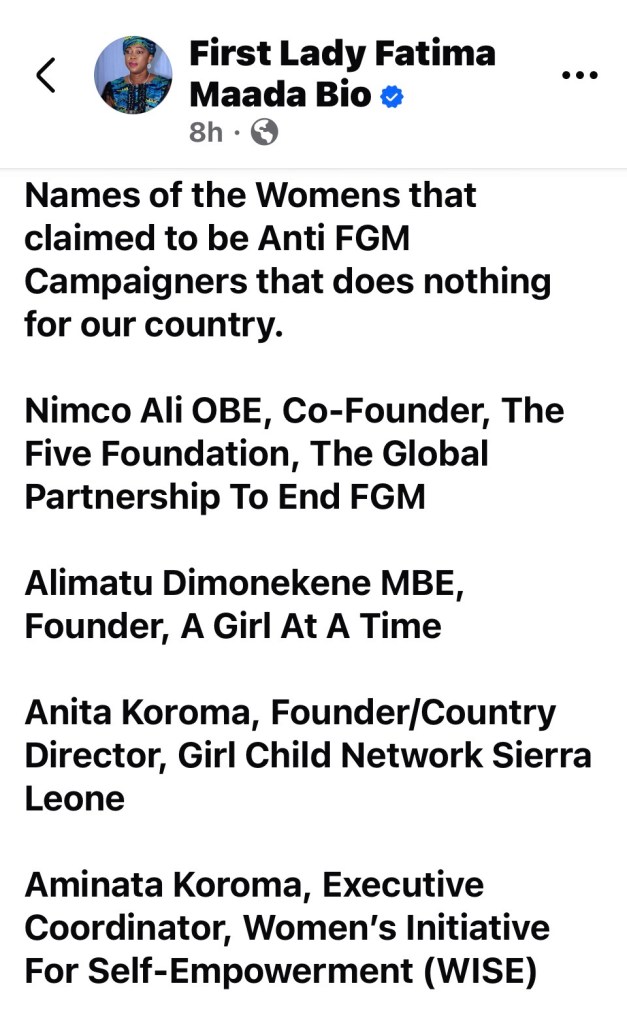
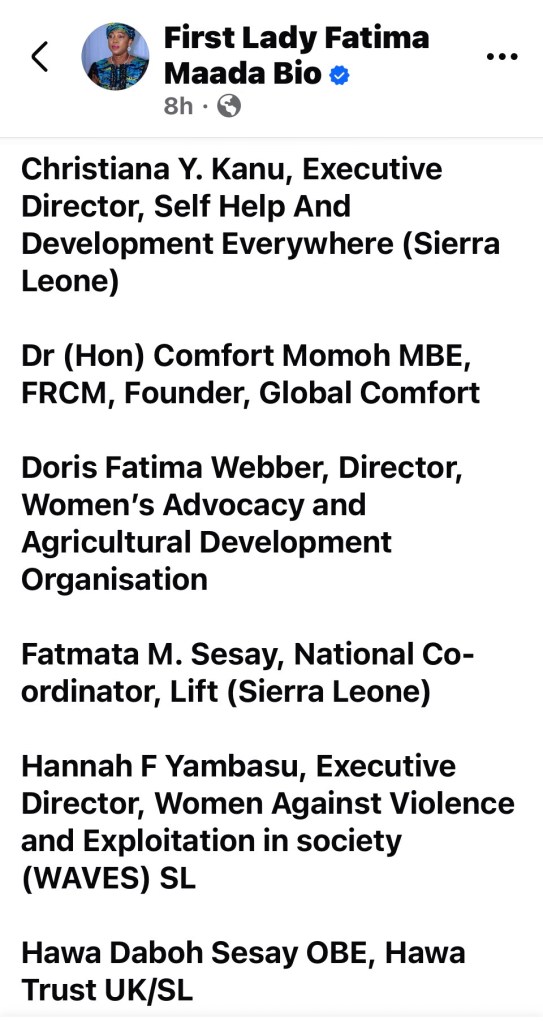
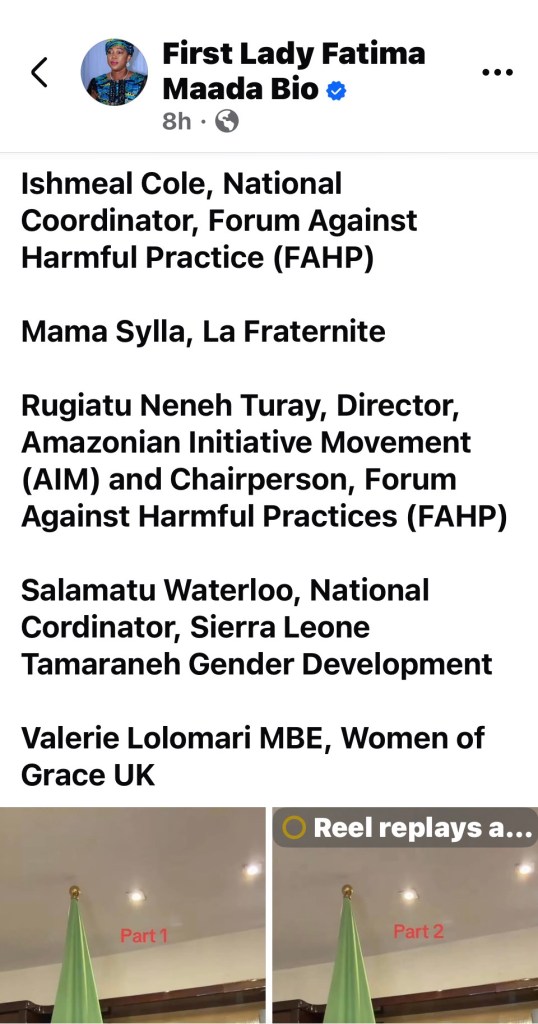
One striking feature is Fatima Bio’s public naming of activists, not only in text but verbally in her video speech. In her speech, she proceeds to call out the names of anti-FGM activists publicly. This is significant because she is:
- the First Lady of Sierra Leone,
- speaking to a national and international audience,
- identifying private activists by name,
- and associating them with political motives.
Many observers could interpret this as an attempt to:
- intimidate,
- shame,
- stigmatize,
- isolate,
- or discredit her critics.
Particularly because she repeatedly frames them as political enemies rather than activists.
Divisiveness & Polarization
Throughout the speech, Fatima Bio portrays criticism as originating from APC card carriers. Her stated proof of this claim is the names of the individuals, which she believes are not names originating from her husband’s southeastern political base. This is important because it reduces a human-rights debate into a party-political battle. Instead of women versus harmful practices, Fatima Bio reframes the issue as SLPP versus APC.
She also describes anti-FGM activists as practicing Western ideology, while aligning herself with the Sande/Bondo women who she claims are practicing our African culture. Weaponizing politics and culture in this deeply polarizing narrative is very typical and consistent in Fatima Bio’s speeches, even within the SLPP.
- JMB women versus SLPP women,
- Ebema Gbi members vs SLPP members,
- Paopa network affiliates vs SLPP members.
Fatima Bio is the wife of the president, which does not make her a “politician” worth targeting by any opposition party. She has shown interest in vying for the SLPP flag in 2028; therefore, at this point in time, she may be an opponent to members of her husband’s party, the SLPP, but not the APC.
Attack on Journalists
Fatima Bio repeatedly targets journalist Tom Ball and The Times.
Examples in the videos:
- Whatever nonsense he sent me.
- I am not his kid.
- The Times newspaper does not feed me.
- ATom Ball, are you a member of APC now?
Notice how quickly the criticism moves from journalism to accusations of political affiliation. Rather than engaging the reported concerns, the journalist’s motives become the issue. In Fatima Bio’s mind, everybody but she is a suspect.
Attack on the Victim
Perhaps the most disturbing part of Fatima Bio’s meltdown video is not her attack on anti-FGM campaigners, journalists, or Cambridge University. It is her verbal assault on the alleged FGM victim. She demanded that the woman reveal her identity, something that a true women’s rights advocate and anyone who has empathy would never say to an alleged victim.
At one point in her speech, Fatima Bio states that the woman at the center of the forced FGM allegation had been examined by two doctors, who she alleges found no evidence that the woman had been circumcised. Fatima Bio then uses this claim to suggest that the woman’s account is a lie and it is misleading.
This raises several troubling questions.
First, how did Fatima Bio obtain information about the medical examination of a private citizen?
- Was Fatima Bio briefed by officials on the case, if so why?
- Did the doctors publicly release their findings?
- Did the alleged victim consent to having her medical information discussed on social media by Fatima Bio?
- Under what law is the First Lady of the country entitled to the citizens’ medical records?
If it is true that officials have allowed Fatima Bio access to the private medical record of the alleged victim, then the public can also speculate that Fatima Bio can influence the same officials to change a positive into a negative result, vice versa.
Or is Fatima Bio falsely claiming to have confidential medical information so that she can discredit and intimidate a woman who has come forward with allegations?
The public needs answers to those questions.
Secondly, even if the medical examination occurred exactly as Fatima Bio described, that still does not justify her publicly attacking the credibility of an alleged victim.
If Fatima Bio were truly a women’s rights advocate, she would understand that her role is to encourage due process, impartial investigation, and protection of vulnerable individuals. But instead of saying, “Let the authorities investigate the matter,” Fatima Bio effectively presents herself as having already reached a conclusion in the case. She publicly acts as the investigator, prosecutor, judge, and jury,
- She portrays the alleged victim as a liar.
- Portrays the alleged victim’s allegation as false.
- And incites the public to demean the alleged victim and dismiss her account.
This approach is particularly troubling in a country where many women and girls already fear reporting abuse because they worry they will not be believed. Whether the allegation ultimately proves true or false is not the point, nor is it the place of the First Lady to judge an ongoing criminal matter publicly.
When the First Lady of a nation publicly questions, ridicules, or dismisses an alleged victim before any transparent due process has taken place, it risks sending a chilling message to other women and girls: If you speak out, you may find yourself publicly disgraced by the most powerful woman in the country.
That is how trust in the justice system is destroyed. It is how fear is reinforced among women in society. Most importantly, Fatima Bio’s interference in this case exposes another contradiction in her public image.
For years, she has portrayed herself as a defender of women and girls. Yet when confronted with a woman making allegations related to a practice that remains deeply controversial, her instinct was not to protect the alleged victim, encourage independent investigation, or call for caution.
Her instinct was to attack the alleged victim’s account and dismiss her case. That may be one of the most revealing moments in her entire speech.
The “Anti-African Bias” Card
One particularly interesting part in her speech is when Fatima Bio says: Because you think we are Africans. Whatever you write about us, the world reads and believes you.
This is a familiar diversion trick. Since she cannot defend her behavior and actions, she tries to reframe her criticism,
from:
- concern about policy,
- concern about FGM,
- concern about public conduct,
to:
Western bias against Africans. The same Western institutions she has been using to create the image she now brags about. The problem with this argument also is that it avoids addressing whether the criticism itself is true.
Diversion and Deflection
A recurring pattern throughout Fatima Bio’s speech is diversion. The controversy concerns:
- FGM,
- Cambridge,
- activism,
- women’s rights.
Yet much of her speech becomes about:
- her awards,
- her achievements,
- opposition parties,
- journalists,
- respect for her,
- invitations from western institutions.
The central issue repeatedly disappears. This is a classic diversion tactic.
Victimhood Narrative
Despite speaking from a self-proclaimed most powerful position in Sierra Leone, Fatima Bio repeatedly portrays herself as the victim.
Examples in the videos:
- They are fighting me.
- They are going after me.
- They are trying to bring me down.
Fatima Bio consistently centers herself as the injured party rather than discussing girls and women allegedly affected by FGM.
Unsupported Claims
Fatima Bio presents several claims as fact without evidence.
Examples in the videos:
- No single woman in this country has done what I have done.
- This is subjective and impossible to verify.
- These activists do not campaign in Sierra Leone.
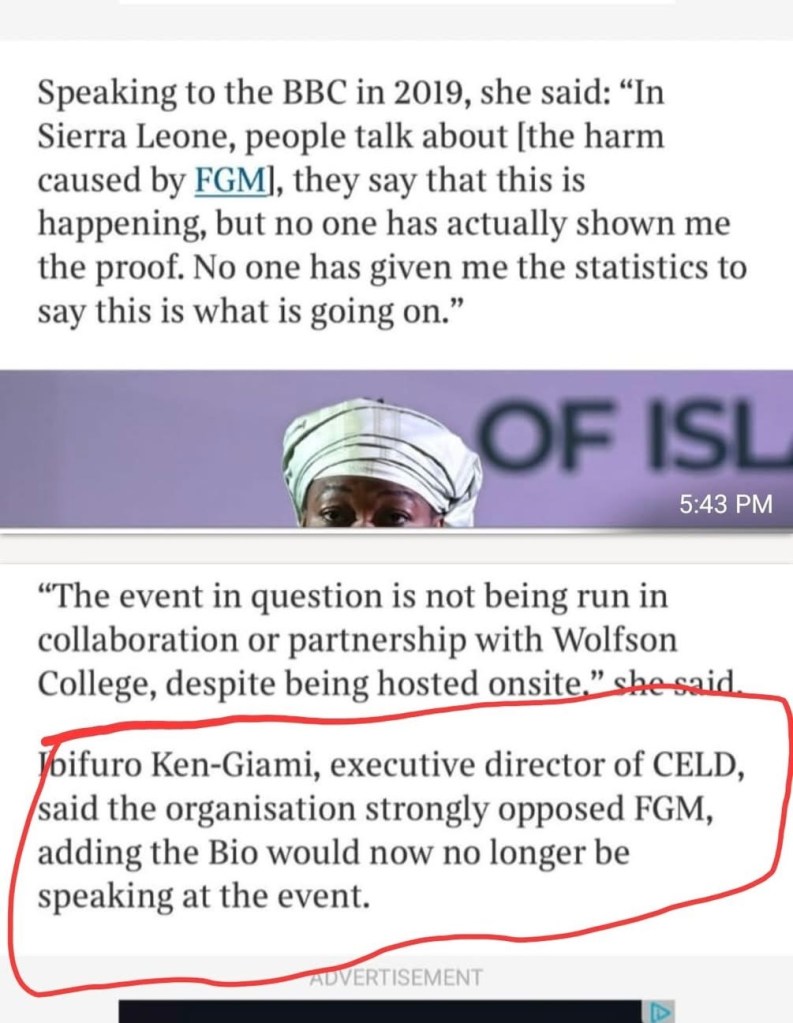
- Many anti-FGM organizations have documented years of advocacy work.
- Nobody has ever brought me data.
- No evidence is presented to support this.
- The law in Sierra Leone says 18.
This last claim is perhaps the most significant. Throughout her speech, she repeatedly references “The law.”
Yet she never identifies:
- the law,
- the statute,
- the section,
- or the year of enactment.
This is particularly important because Sierra Leone has long been criticized for lacking a comprehensive national anti-FGM law.
Contradictions About FGM
One of the most revealing contradictions appears here:
- I am not a campaigner of FGM.
- I am not pro or anti.
Yet elsewhere she:
- defends Sande/Bondo gatherings,
- attacks anti-FGM activists,
- questions victims,
- criticizes journalists covering the issue,
- and publicly aligns herself with traditional institutions accused of perpetuating the practice.
Many observers would conclude that while she claims neutrality, her actions consistently benefit one side of the debate.
Personalization of Public Issues
Perhaps the most important takeaway from the two video speeches is that Fatima Bio repeatedly diverts policy questions into personal questions.
- Instead of: Is FGM harmful?
Fatima Bio’s question becomes: Why are they attacking Fatima?
- Instead of: How do we protect girls?
Fatima Bio says: Why don’t they support my work?
- Instead of: What evidence exists?
Fatima Bio makes it a question of: Why don’t they respect me?
Fatima Bio clearly revealed that the result she seeks in posting these video speeches is that the public issue regarding FGM disappears behind her personality and politics. And that may be the most defining feature of the entire speech. She attempted to deviate the debate about girls, women’s rights, and harmful practices into a debate about herself, as the one and only woman whose voice matters in Sierra Leone.
Fatima Bio’s speech clearly showed that she believes herself to be the most important woman in Sierra Leone and perhaps even in Africa.
This action by Cambridge University, rejecting her participation in their event, may be a well-deserved wake-up call for Fatima Jabbie Bio.
You can watch Fatima Bio’s Part 1 and Part 2 Videos Below:
 MAMA SALONE ~ Lioness of the West Coast