
by Fatima Babih, EdD
From Girls’ Rights Advocate to Defender of FGM Politics. Fatima Jabbie Bio recasts anti-FGM Campaigners as Enemies of African Culture, While Positioning Herself as the Protector of Sande Culture
Fatima Bio’s recent post is essentially her most direct public attack yet against international anti-FGM activists and organizations. Her message can be summarized into five core arguments:
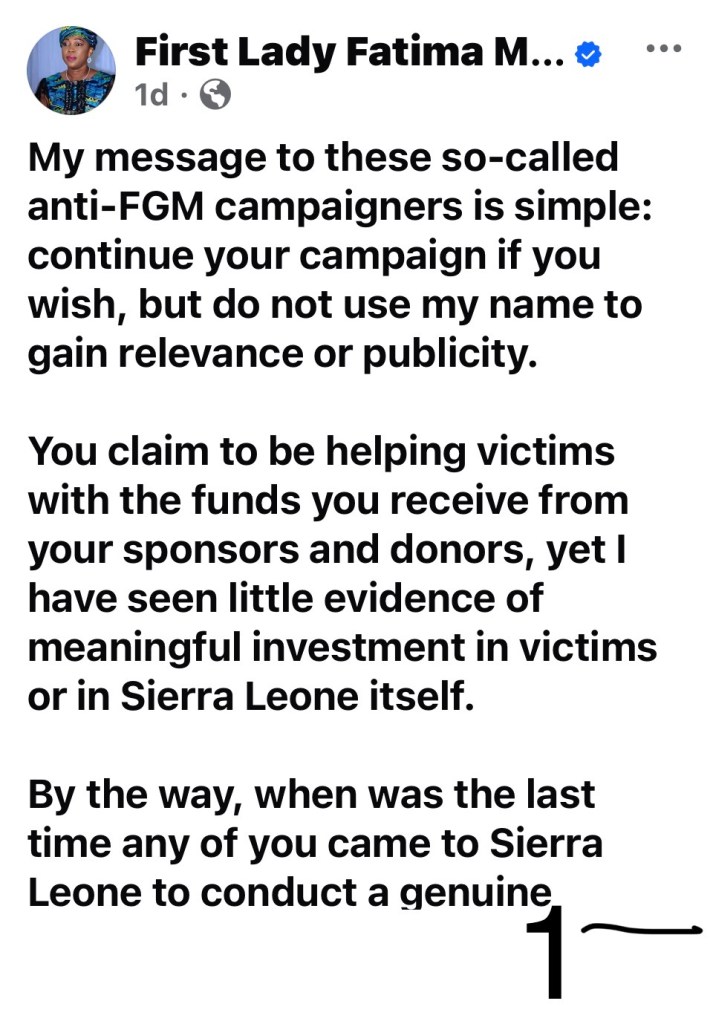
1. Accusing Anti-FGM Activists of Using Her Name for Publicity
Fatima Bio begins by arguing that anti-FGM activists are using her name to gain attention and relevance. Her position:
Continue your campaign if you wish, but stop using my name.
The implication is that criticism directed at her is not motivated by concern for girls or women, but by a desire to attract media attention.
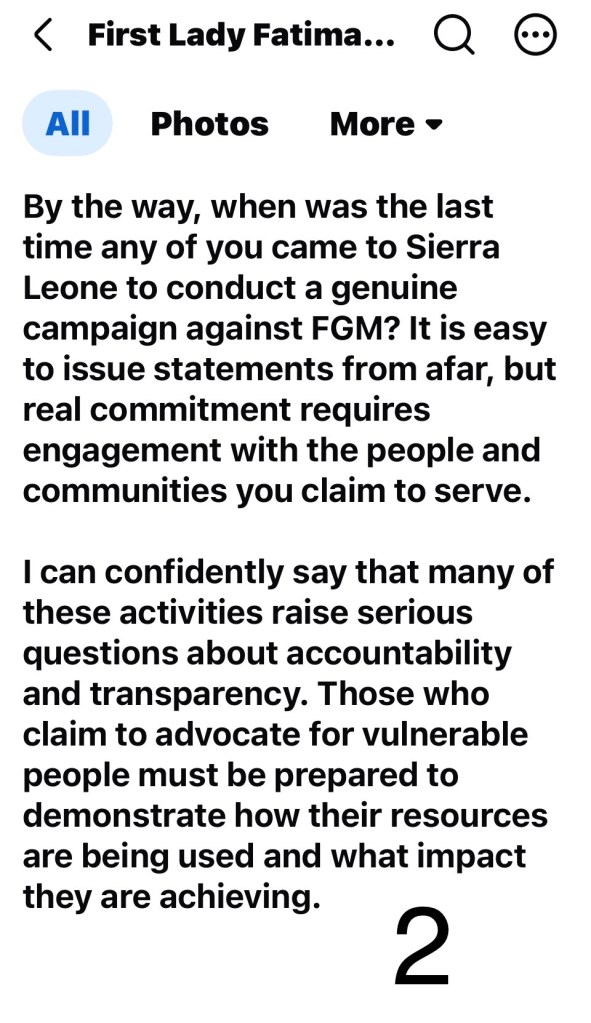
2. Questioning How Donor Money Is Used
Fatima Bio shifts the focus away from FGM and onto the campaigners themselves.
She alleges:
- Anti-FGM organizations receive significant donor funding.
- There is little evidence that these funds are helping victims.
- Activists should be transparent about how resources are spent.
This is quite ironic for a woman who has been receiving state and donor funds for nearly nine years and has never reported how those funds are used. Rather than responding to criticism of her own position on FGM, she attempts to place anti-FGM organizations on the defensive.
3. Challenging the Credibility of Activists
Fatima Bio asks:
When was the last time you came to Sierra Leone?
She argues that many critics operate from abroad and are disconnected from local realities. Fatima Bio spends more time traveling abroad on private jets than in the country.
Everything said about her “wonderful work” is from speeches she gives on international stages. She has no visible programs or projects in Sierra Leone and has never officially reported any outcome of her Hands Off Our Girls Campaign.
But in her post, she suggests:
- Statements issued from overseas are easy.
- Genuine engagement requires physical presence in communities.
- Activists lack sufficient connection with the people they claim to represent.
This is a common rhetorical device used by politicians when confronting international human-rights criticism.
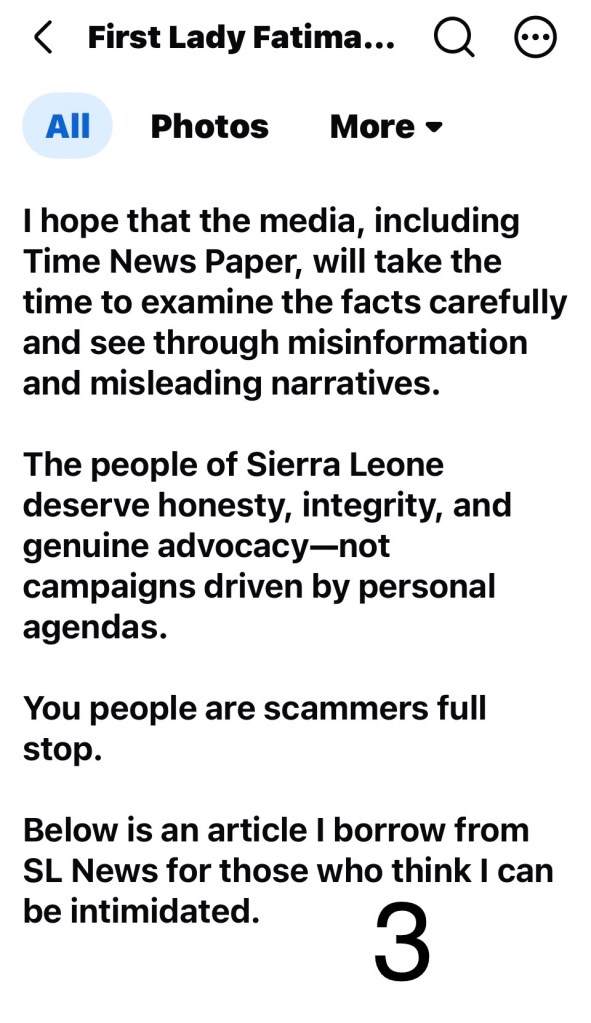
4. Labeling Activists as “Scammers”
This is perhaps the strongest and most controversial part of the statement. After questioning funding and accountability, she concludes:
“You people are scammers full stop.”
This moves beyond policy disagreement and into a direct attack on the integrity of campaigners themselves. But if these activists are scammers for operating outside the country, then Fatima Bio, too, is a scammer for taking millions of dollars over the years in the names of girls and women in Sierra Leone, with nothing tangible to show for it.
Rather than arguing and proving that their evidence is wrong, she argues that the activists’ motives are dishonest; essentially projecting her own dishonesty on others.
5. Using an Academic Article to Legitimize Her Position
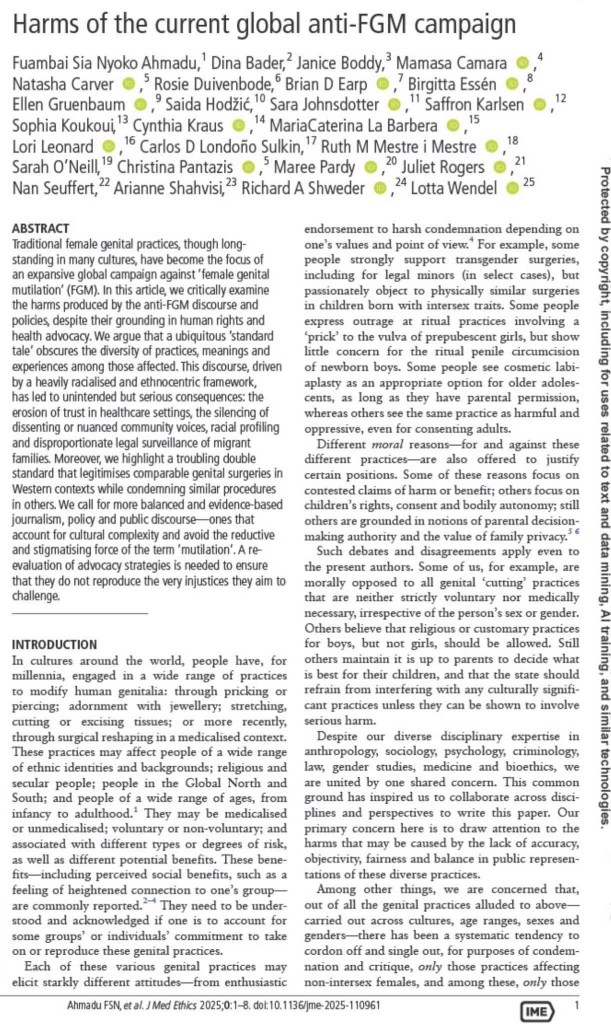
Fatima Bio then shares the article:
“Harms of the Current Global Anti-FGM Campaign”
The biggest weakness in Fatima Bio’s reliance on this article is that she appears to be using a nuanced academic critique of advocacy methods as though it were a defense of FGM itself.
Those are not the same thing.
An academic article that critiques how anti-FGM campaigns are conducted does not automatically validate the practice being criticized. In fact, the argument may actually undermine her position more than it supports it.
Criticizing Anti-FGM Campaigns Is Not the Same as Supporting FGM
The authors’ central argument appears to be that some anti-FGM campaigns:
- oversimplify complex cultural issues,
- stigmatize entire communities,
- fail to distinguish between different practices,
- and sometimes produce unintended consequences.
That is a critique of advocacy strategy. It is not an endorsement of FGM. The article does not conclude:
- “FGM is harmless.”
Nor does it conclude:
- “Children should continue to be subjected to FGM.”
Nor does it argue:
- “Governments should stop efforts to protect girls.”
Therefore, Fatima Bio cannot use the article as evidence that anti-FGM activists are wrong simply because the authors criticize certain campaign approaches.
The Article Calls for Better Evidence. The Same Standard Critics Apply to Fatima Bio
One of the article’s themes is the need for evidence-based discussion.
Ironically, that standard cuts both ways. If public discourse should be evidence-based, then critics are entitled to ask:
- Where is the evidence that Fatima Bio has used state and donor funds appropriately?
- Where is the evidence for the law she repeatedly claims exists?
- Where is the evidence supporting her attacks on activists as “scammers”?
- Where is the evidence that campaigners are motivated primarily by money?
By invoking an article that demands evidence, Fatima Bio invites scrutiny of her own campaign and claims.
The Article Discusses Cultural Sensitivity, Not Political Mobilization
Another problem is that Fatima Bio is not merely discussing culture. She is a political figure. The criticism directed at her is not simply that she respects cultural traditions.
The criticism is that she is:
- appearing at highly publicized political rallies with Sande women,
- using political slogans like “Ebema Gbi” at these events,
- mobilizing her husband’s supporters,
- attacking anti-FGM activists,
- and increasingly positioning herself as a protector of the Sande/Bondo institution.
The article addresses cultural discourse. It does not address the conduct of a First Lady who appears to be building political capital around a controversial practice. That distinction is crucial.
The Article Cannot Erase the Child Protection Question
Perhaps the biggest flaw in Fatima Bio’s argument is that the article does not answer the central concern raised by campaigners: What happens to girls?
Even if every criticism of anti-FGM advocacy contained in the article was accepted as true, the fundamental questions remain:
- Are girls still being subjected to FGM in Sierra Leone?
- Are some of those girls under age 18?
- Are there health consequences for girls subjected to the procedure?
- Are there human rights concerns in the practice?
- Do some communities want stronger protection?
The article does not make those questions disappear. It merely argues that discussions about them should be conducted more carefully, a point Fatima Bio is failing to observe.
The Western Comparison Argument Is Particularly Weak
Fatima Bio appears attracted to the article’s argument that certain forms of genital modification in Western countries are treated differently. However, this comparison may actually strengthen the critics’ position. The central concern in Sierra Leone is not merely bodily modification. It is:
- age,
- consent,
- health consequences,
- social pressure,
- coercion,
- and the ability of children to make informed decisions.
Comparing procedures chosen by consenting adults in different contexts does little to address concerns about practices involving minor girls.
The Article Doesn’t Justify Fatima Bio’s Attacks on Activists
Most importantly, nothing in the article supports her decision to call anti-FGM campaigners “scammers,” or accuse them of merely trying to make money. Academic disagreement is not evidence of fraud.
Even if the article’s authors disagree with aspects of anti-FGM advocacy, that does not mean activists are dishonest or financially motivated. Fatima Bio takes a scholarly critique and turns it into a personal attack weapon. The article does not support that leap.
The Central Contradiction
The irony is that the article actually argues for:
- nuance,
- evidence,
- respectful dialogue,
- and careful analysis.
Fatima Bio’s public response often does the opposite.
- Instead of engaging critics with evidence, she attacks their motives.
- Instead of encouraging dialogue, she portrays campaigners as enemies.
- Instead of addressing concerns about girls, she redirects attention toward activists.
In that sense, the article may do more to expose the weaknesses in her argument than to strengthen it. The article calls for a more thoughtful conversation. Fatima Bio uses it to justify her combative response.
Political Significance
What makes this post important is not simply that she shared an academic article. The significance is that Fatima Bio is no longer presenting herself as a neutral party in this debate. For years, she attempted to balance two positions:
- International advocate for girls and women.
- Defender of Sande/Bondo cultural practices.
Her post moves Fatima Bio further toward openly challenging anti-FGM campaigners. Instead of saying: “We need dialogue.” She is now effectively saying: “The campaigners are the problem.”
The central contradiction critics should highlight is this: Fatima Bio has built much of her international reputation around:
- protecting girls,
- ending child marriage,
- defending vulnerable women,
- promoting girls’ rights.
Yet in this post, she directs her strongest criticism not toward those who perform a harmful practice on children, but toward the activists campaigning against the practice.
That contrast is likely why this post has generated strong reactions.
Key Question Raised by Her Post
The biggest question arising from Fatima Bio’s statements is not whether anti-FGM organizations should be accountable for donor funding. Accountability is a legitimate issue for any NGO.
The bigger question is: Why is Sierra Leone’s First Lady devoting so much energy to attacking anti-FGM campaigners while simultaneously positioning herself as a champion of girls’ rights?
 MAMA SALONE ~ Lioness of the West Coast