
by Fatima Babih, EdD
Fatima Bio’s UCLA graduation is being widely celebrated by her supporters, but the true significance of her new degree warrants a closer look.
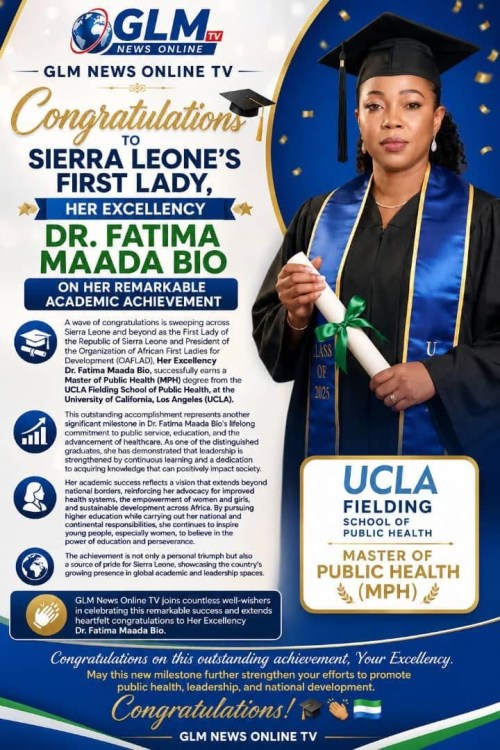
As photographs and videos circulated on social media showing First Lady Fatima Maada Bio in her graduation gown, walking across the stage at UCLA’s commencement ceremony, she and her bloggers quickly turned the occasion into a national celebration. The images are presented as symbols of success, prestige, and accomplishment for the nation; a Sierra Leonean First Lady earning a graduate degree from one of America’s most respected universities.
Congratulatory messages portray Mrs. Bio’s degree not merely as a personal academic milestone but as evidence of exceptional leadership, resilience, and readiness for greater national responsibilities.
No reasonable person should criticize Mrs. Bio for pursuing higher education. As a lifelong learner, I encourage and applaud lifelong learning, especially for women. But beyond the carefully curated photographs and celebratory headlines lies more important questions: what exactly does this degree signify, and does it justify the sweeping claims now being made about Fatima Bio’s qualifications, leadership capacity, and potential contribution to Sierra Leone’s healthcare system?
It is against this backdrop that celebratory articles and Fatima Bio’s own statements deserve closer examination.
Creating Confusion
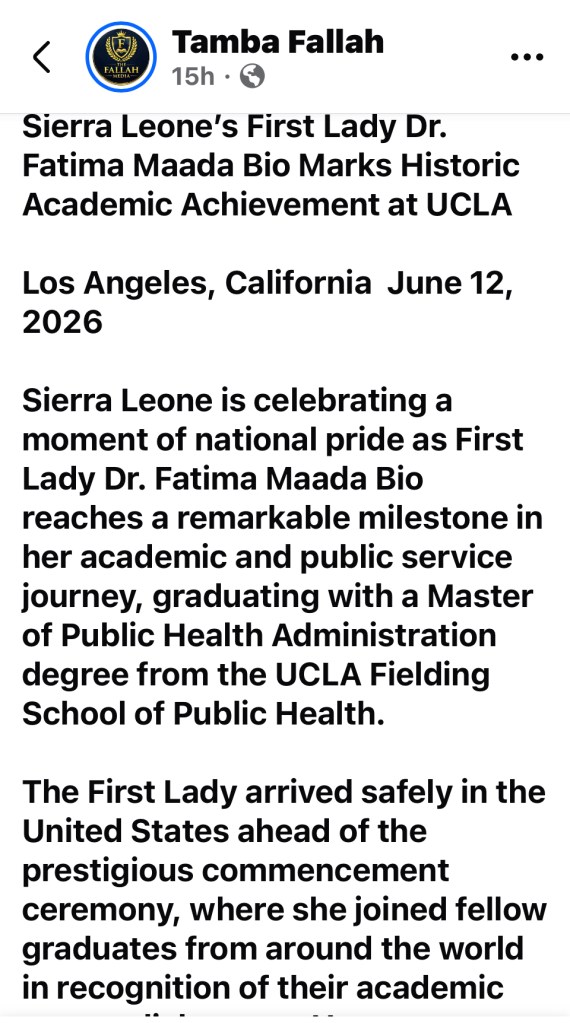
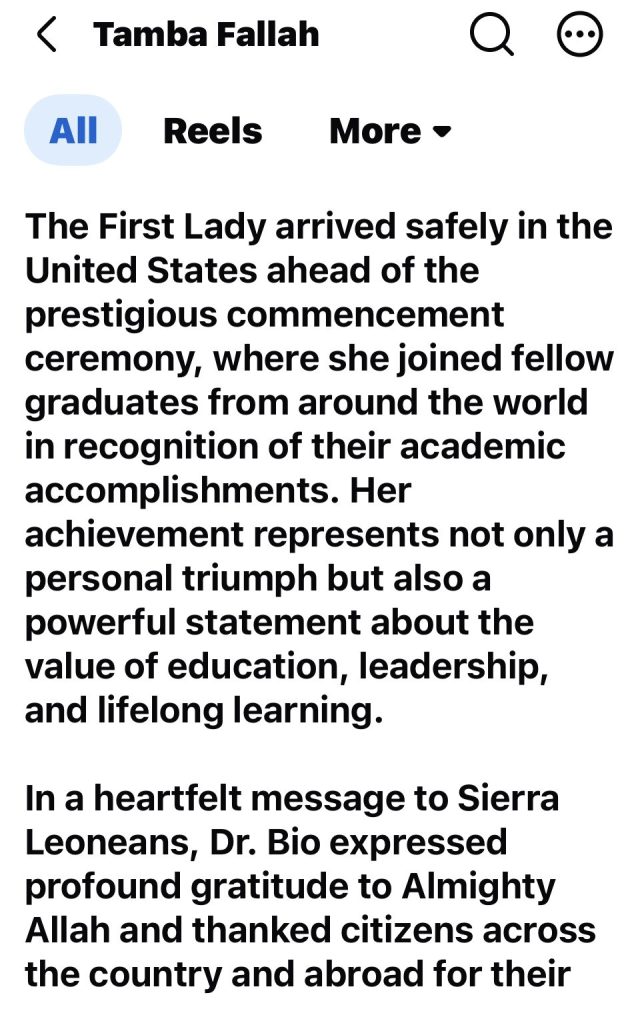
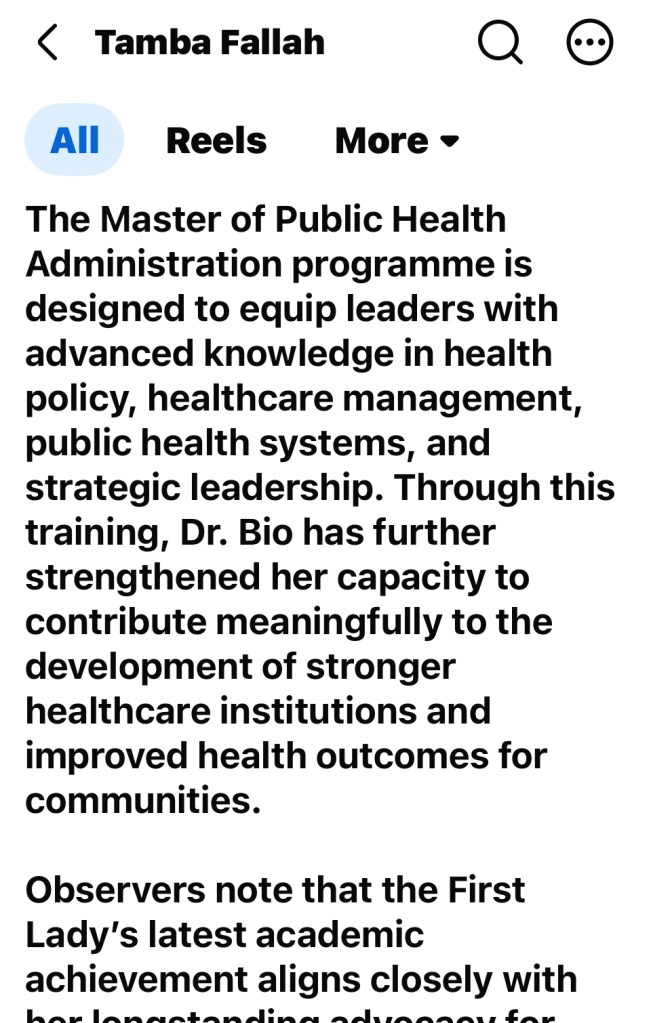
In his article, Tamba Fallah repeatedly refers to Mrs. Bio’s qualification as a “Master of Public Health Administration degree.”
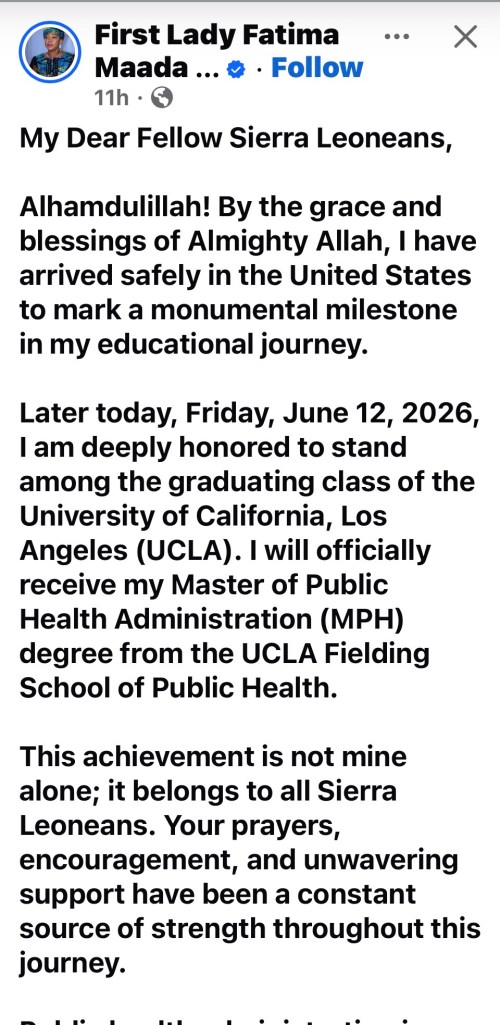
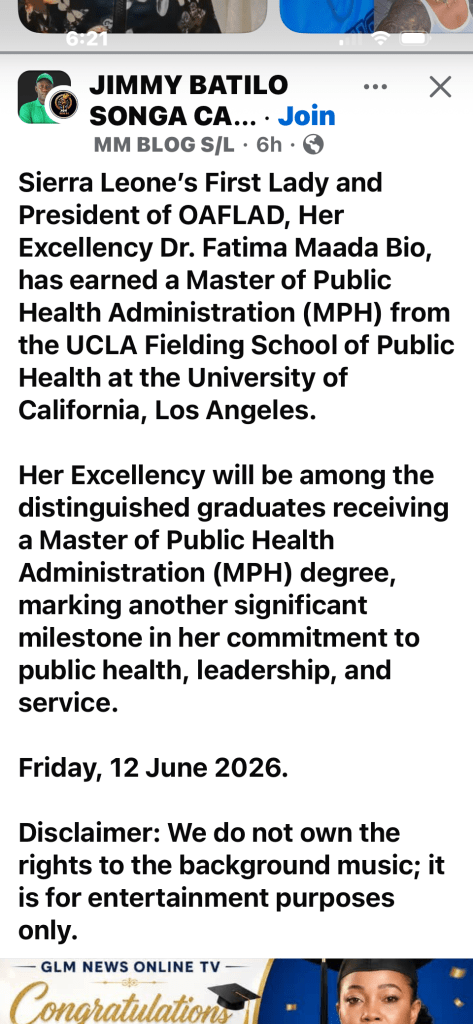
Ironically, even Mrs. Bio’s own announcement raises questions about how this academic achievement is being presented to the public. She announced:
I will officially receive my Master of Public Health Administration (MPH) degree from the UCLA Fielding School of Public Health.
This wording immediately creates confusion.
Traditionally, an MPH (Master of Public Health) focuses on disciplines such as epidemiology, health promotion, and population health, while an MHA (Master of Healthcare Administration) prepares healthcare professionals specifically for healthcare management and administration. Fatima Bio is not a healthcare professional.
Whether this inconsistency reflects imprecise language, public relations messaging, or a misunderstanding of the degree structure is unclear. What is clear is that Mrs. Bio and her bloggers appear more interested in hyping her degree than accurately explaining what it is.
More importantly, both Mrs. Bio and her supporters use language to describe the degree typically associated with an MPH (focused on public health), rather than with an MHA (focused on health administration).
Mrs. Bio writes that public health administration is about:
building stronger health systems, improving access to quality healthcare, shaping effective policies, and preparing future leaders to address global health challenges.
Similarly, Fallah claims that the program will help:
strengthen public health systems and promote the well-being of citizens across the country.
These descriptions, while impressive, conflate the public health practice associated with the MPH with the healthcare administration responsibilities of the MHA, which are distinct fields.
The issue is not whether the degree has value.
The issue is whether the public is being misled to believe that Mrs. Bio has earned a scientific MPH degree and that such academic qualification alone confers expertise in public health, healthcare delivery, health policy, or national health systems.
It does not.
An MHA Is Not an MPH
A misleading aspect of the current public messaging about Mrs. Bio’s degree is the suggestion that healthcare administration (MHA) and public health (MPH) are interchangeable, despite their distinct objectives and curricula.
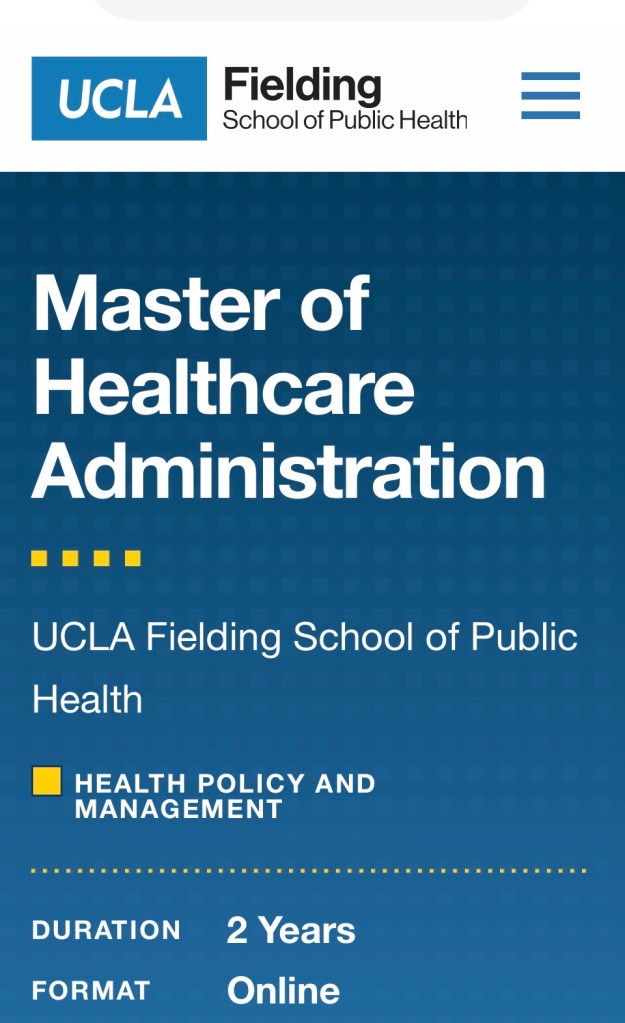
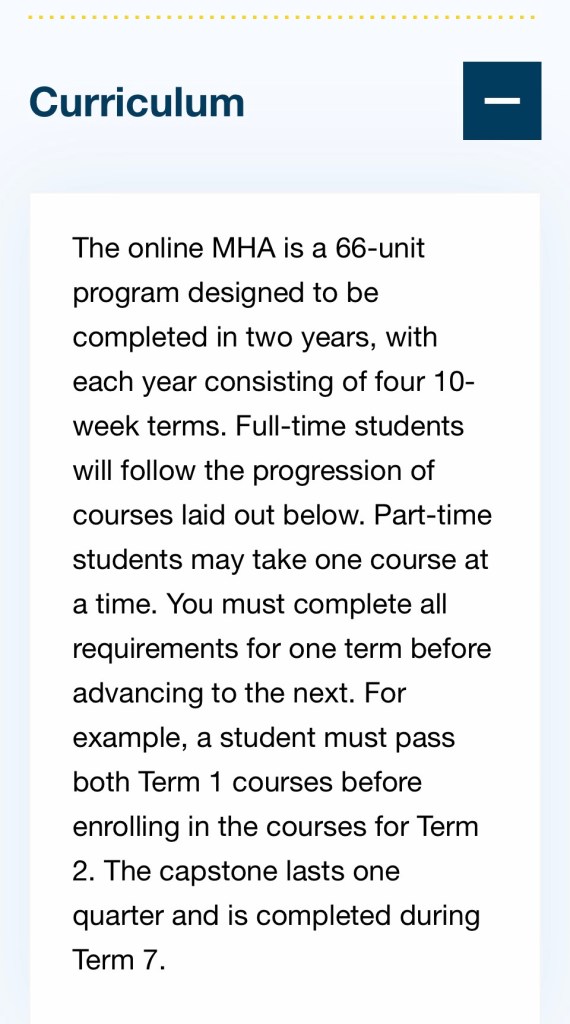
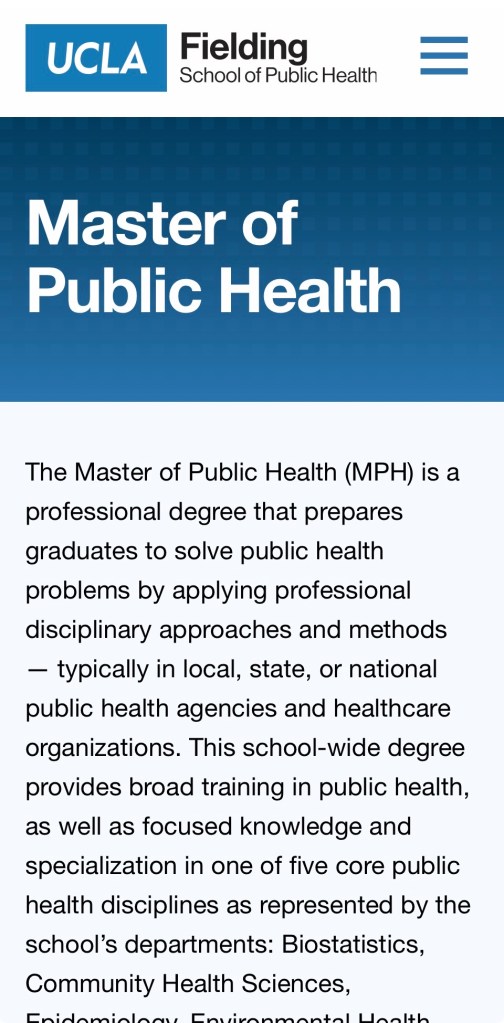
They are not the same.
A Master of Public Health (MPH) program is a scientific curriculum that emphasizes public health research, epidemiology, health risk assessment, disease prevention, and population-based interventions.
A Master of Healthcare Administration (MHA), by contrast, is non-scientific and designed to equip healthcare professionals with skills in healthcare management, including oversight of healthcare organizations and systems.
Its purpose is to prepare administrators who are already in the field to manage healthcare organizations, oversee budgets, develop strategy, navigate health policy, improve organizational performance, and lead complex institutions.
- It does not train students to be physicians.
- It does not train students to be nurses.
- It does not train students to be epidemiologists.
- It does not transform graduates into public health experts or practitioners.
Consequently, Mrs. Bio’s claims that the degree itself will somehow strengthen Sierra Leone’s healthcare delivery system or improve national public health outcomes should be viewed as problematic.
An MHA degree may provide the student with useful management knowledge. Whether that knowledge benefits the public depends on how it is applied.
What MHA Is & Is Not
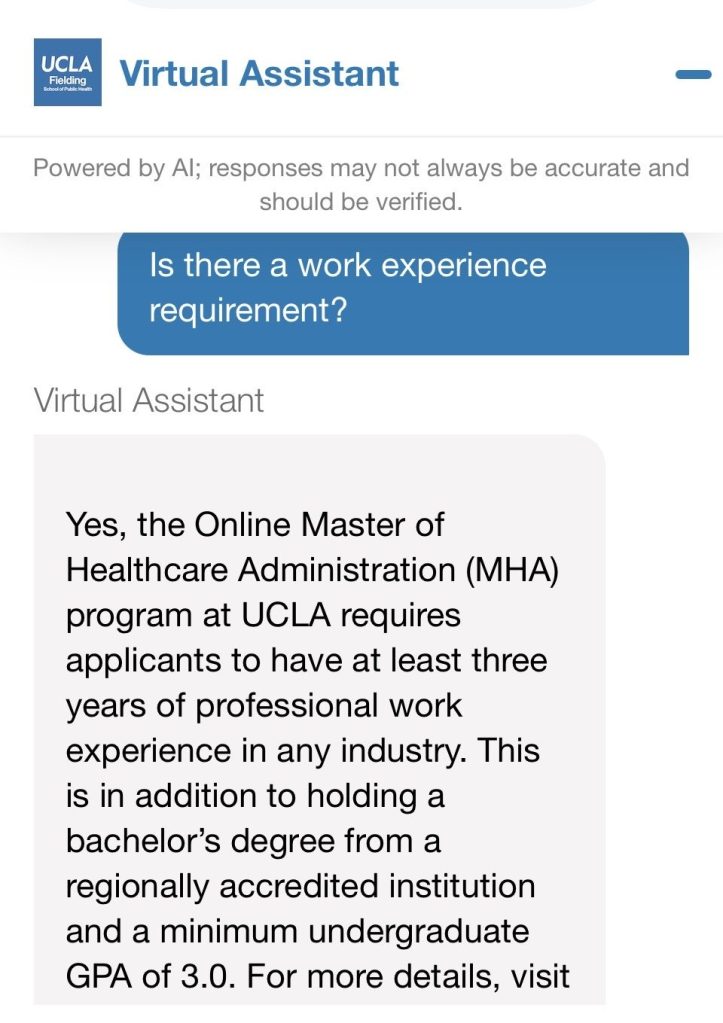
It is also important to understand the structure of UCLA’s MHA program. The program is designed for working healthcare professionals and is delivered online, allowing students to complete most coursework remotely and attend 2 in-person seminars with the two year period. There is nothing wrong with this model. Many accomplished professionals pursue advanced education through such executive and hybrid programs while continuing their careers.
Completing such a program is a legitimate academic achievement. However, Mrs. Bio and her supporters should avoid exaggerating the significance of that achievement.
Successfully completing coursework in healthcare administration is not the same thing as spending years managing hospitals, directing public health programs, administering health systems, or leading healthcare institutions.
The former is an academic accomplishment. The latter is professional experience. Academic accomplishment and professional experience are distinct.
Missing Professional Context
Another uncomfortable reality is that supporters are attempting to portray this qualification as evidence that Sierra Leone has gained a new healthcare expert.
That is a significant stretch.
- Fatima Bio is not a physician.
- She is not a nurse.
- She is not a public health practitioner.
- She is not a healthcare administrator with a documented history of managing hospitals, health systems, health programs, or public health institutions.
Her only prominent public role has been that of First Lady, which is not a profession. Being First Lady is a ceremonial public role. It is not a healthcare profession.
Mrs. Bio and her supporters increasingly present the degree as if it automatically confers authority on healthcare administration and public health policy. Academic qualifications are valuable. But they do not substitute for professional experience.

Leadership Is Measured by Conduct, Not Credentials
The larger problem with both Fallah’s article and the First Lady’s own statement is the assumption that an academic credential automatically validates leadership.
It does not.
A healthcare administration program is built around principles such as:
- Accountability
- Ethical leadership
- Stewardship of resources
- Transparency
- Organizational responsibility
- Public trust
The relevant question, therefore, is not whether Mrs. Bio completed a degree program.
The relevant question is whether her public conduct reflects the values that the program seeks to cultivate.
Degrees certify academic achievement. Degrees do not certify one’s character or integrity. They do not certify integrity. They do not certify ethical judgment. Those qualities are demonstrated through actions.
Turning a Degree Into a Political Narrative
Another revealing aspect of the messaging is how quickly a personal academic accomplishment has been transformed into a political narrative.
Mrs. Bio writes:
This achievement is not mine alone; it belongs to all Sierra Leoneans.
Mrs. Bio’s statement is more than political rhetoric; it is propaganda designed to turn her personal achievement into a tool for mobilizing support.
Tamba Fallah similarly describes Mrs. Bio’s graduation as:
A proud moment for the nation.
This language goes beyond celebrating education. It transforms a personal achievement into a symbol of national validation and leadership. Most professionals who complete graduate degrees view them as personal or professional milestones.
In this case, however, the degree is being presented as evidence of national significance and leadership destiny. Given the growing speculation about Mrs. Bio’s political ambitions after 2028, that framing sounds intentional.
At first glance, their combined statements may sound inspiring. However, they deserves closer scrutiny.
If, as revealed by opposition leader Mohamed Kamarainba Mansaray, Sierra Leonean taxpayers financed Mrs. Bio’s degree at a cost exceeding US$210,000, then citizens certainly have a stake in understanding the value and purpose of that investment.
Yet financing a degree does not make the degree a national asset. The diploma will bear Mrs. Bio’s name, not Sierra Leone’s. The credential will remain part of her personal résumé, her professional profile, and potentially her future political ambitions.
In reality, the degree is Fatima Bio’s only; it does not belong to Sierra Leoneans who paid for it.

The Contradiction
For years, her position as First Lady has helped Mrs. Bio carefully cultivate an international image as a champion of girls and women. That reputation has earned her international recognition, donor funds, speaking engagements, honorary awards, and global visibility.
Yet her public record has also been marked by repeated controversies involving:
- The UK council housing controversy.
- Questions about public accountability.
- Allegations of interference in governance.
- Public attacks on anti-FGM campaigners.
- Dismissive treatment of survivor testimony.
- Claims regarding legal protections that cannot be substantiated.
Whether one agrees with her positions or not is not the point. The point is that leadership is not measured by press releases or academic degrees. Leadership is measured by conduct.
The Real Test
Nobody is criticizing Mrs. Bio for pursuing higher education. Education should be celebrated, especially for women in Sierra Leone. But Sierra Leoneans should resist the temptation to confuse academic attainment with demonstrated leadership.
The real test of Mrs. Bio’s degree will not be found in graduation photographs, congratulatory articles, or social media praises. The real test will be whether the principles of this degree are reflected in practice through her conduct.
Ultimately, credentials do not define leadership quality. Character and accountability shape leadership quality.
 MAMA SALONE ~ Lioness of the West Coast