
By Dr. Fatima Babih
On November 27, 2026, the world observed the first International Day for the Elimination of Child, Early and Forced Marriage. No country was better positioned than Sierra Leone. It was given the privilege of presenting the resolution at the UN General Assembly. It has a 2024 law setting 18 as the minimum age of marriage, with no exceptions. Its president, Julius Maada Bio, told the world in September that this day should be one of “accountability, renewed commitment and measurable progress.”
Then Sierra Leone government had its chance to show the world what that meant at home. Instead, the government threw a birthday party instead of observing such a serious day with the seriousness it deserved.
What the day was for
The General Assembly adopted the resolution by consensus on September 4, 2026. On September 23, President Julius Maada Bio told a high-level event in New York that Sierra Leone would develop a National Action Plan and promised that, beginning with the first observance on November 27, his government would report its progress to other member states.
That is the yardstick, and it is the government’s own. A day of accountability means answering to girls: how many marriages were stopped, how many cases reached court, who is responsible in each district, and what happens to a girl after she finds the courage to speak up.
By that yardstick, Sierra Leone government failed on day one to show the world what it means for girls at home.
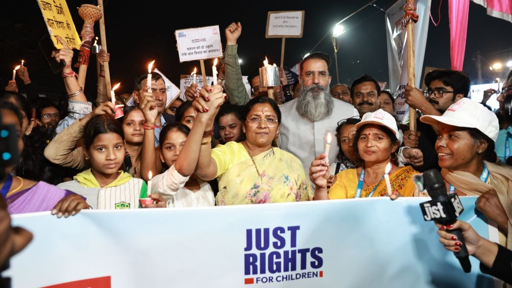
What other countries did with the same day
The examples below are drawn from reporting and public statements on how the day was marked. None of them is perfect. But every one of them treated the day as work.
- Nepal (Itahari): child welfare officers, police, local organizations and journalists sat down together and worked out who must act when a child marriage is planned. Participants pledged to report suspected cases and keep children in school.
- India: the Ministry of Women and Child Development convened prevention officers, child welfare committees, legal services and civil society in New Delhi to review two years of its national campaign, which started on November 27, 2024. In Nagaland, the state launched a 100-day awareness campaign and held consultations with police, education and health officials.
- Lebanon: the National Human Rights Commission pressed Parliament to end its delays and adopt a single national law setting 18 as the minimum age, with no exceptions.
- Nigeria (Enugu State): a civil society coalition demanded enforcement of the state’s Child Rights Law, dedicated funding to prevent child marriage, and programs to bring back to school the girls who left because of marriage or pregnancy.
- Mali, Togo, Senegal, Niger and DR Congo: coalitions and journalists used the day to push for keeping girls in school, press their governments for stronger protections, explain why forced marriage persists, and report on how early marriage still shapes girls’ lives.
The pattern is plain: enforcement, funding, officials in the room, a route back to school. These were demands and plans, not decorations.
What Sierra Leone did
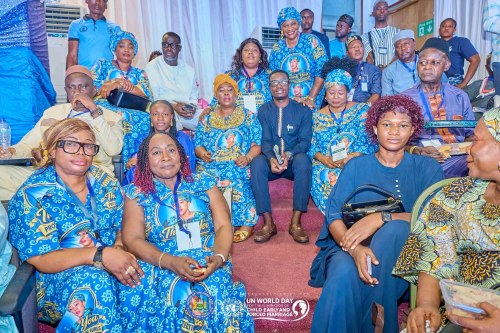
The official photographs from Sierra Leone’s observance, branded with the Office of the First Lady logo, tell a very different story.
Rows of attendees wore matching fabric printed with Fatima Bio’s portrait and the words “Thank You for Protecting Our Girls.”
Think about that. On the one day set aside to ask government whether girls are actually being protected, the attendees came dressed to thank Fatima Bio for doing what? For protecting girls. Even though no single figure had been presented to show that a girl had been protected at all.
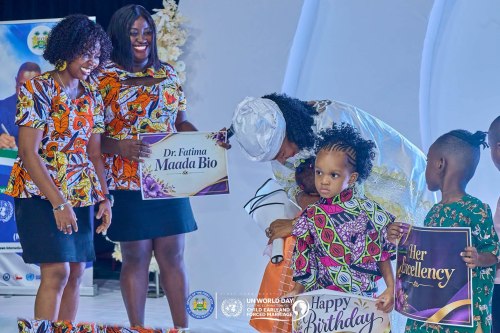
A performer sang on the floor in front of the stage while the First Lady danced beside him. Then came the children. Not adolescent girls at risk of marriage, not survivors, not girls who fought their way back to school, but little toddlers, some barely old enough to stand still, were lined up on stage beneath a giant screen showing Fatima Bio’s Ai generated portrait and the words “HAPPY BIRTHDAY, Her Excellency Dr. Fatima Maada Bio.”
The children in the line held placards reading “Dr. Fatima Maada Bio,” “Happy Birthday,” and “Her Excellency.” Further down the same line, other children held signs reading “My Place Is in School, Not in Marriage” and “Let Me Dream Before I Become a Bride.”
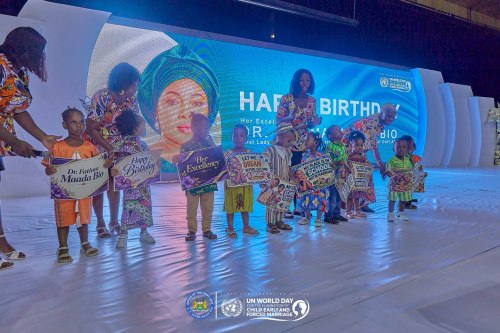
That single frame says everything. The girls’ message was there, but it was pushed to the end of the line. The birthday came first, and the birthday was on the screen.
According to public biographical records, Fatima Jabbie Bio was born on November 27. The author of the UN resolution, Bhuwan Ribhu of the Indian organization Just Rights for Children, proposed this date because it marks the day in 2024 when millions of Indians pledged to end child marriage.
The fact that this date coincides with Fatima Bio’s birthday does not mean she owns the day. Her misuse of it must be scrutinized. A First Lady who truly puts girls first would have kept the two occasions separate and let the focus stay on the issue; the victims and at-risk girls should have the day.
Instead, the first global observance against child marriage was turned into another UK Nollywood production: the celebration of one woman’s birthday, produced under the banner of the First Lady office, which is not a government office.
The November 27 event in Sierra Leone was not a private birthday party. It was a government observance of a UN day, and children were exploited as props, in a country with one of the highest child marriage rates in Africa.
A Manifestation of Weak Governance
It would be easy to make this about one person. It must not stop there. The Prohibition of Child Marriage Act 2024 does not make the First Lady the duty-bearer. It makes the Ministry of Gender and Children’s Affairs responsible for policy, resources, and advocacy. It creates Child Marriage Prohibition Officers whose job is to prevent marriages and gather evidence for prosecution. Police and prosecutors enforce it.
- So where were the duty-bearers in Sierra Leone on November 27, 2026?
- Where were the Child Marriage Prohibition Officers?
- Where was the Attorney General’s office?
- Where was the Ministry of Children’s Affairs?
- And where was the progress report Julius Maada Bio promised the world in New York?
A government that hands an important day and its issue to one personality who cannot be held accountable has not only chosen performance over accountability but has also proven itself to be weak and inept.
The record that should have been presented that day is damning. In June 2026, the ECOWAS Court of Justice ruled against Sierra Leone in the case of a girl married at 11. The court found that the government of Sierra Leone failed to take adequate measures to prevent child marriage, failed to protect her and other girls, and failed to properly investigate her marriage. It ordered legal and institutional reforms and awarded her $10,000 in compensation.
That same month, nearly two years after the Act was signed, the country saw its first prosecution under the law: four men charged in the forced marriage of a 17-year-old girl. One case, in two years, in a country where hundreds of thousands of girls have been married as children. The government has published no follow-up on the outcome.
A law that exists on paper but is not enforced does not protect a girl in Sierra Leone; it is a useless law.
Diplomacy is not enforcement
Fatima Bio’s defenders will point to her diplomacy: her presentation of the resolution at the UN, her speeches abroad, her title as president of the Organization of African First Ladies for Development. But applause in New York does not stop a wedding in a town or village. A resolution does not post an officer in Koinadugu. A birthday screen does not put a girl back in a classroom in Kono.
That is exactly why the first observance mattered in Sierra Leone, and exactly why wasting it on Fatima Bio cost girls so much more. Nepal put officers and police in one room on this day to decide what adults must do when a child marriage is planned. In Nigeria, advocates demanded enforcement, a dedicated budget, and a way back to school.
Sierra Leone, the country given the privilege to present the resolution, put little babies on a stage to wish the country’s First Lady a happy birthday.
What must happen now?
Sierra Leone gets a second chance, because November 27 comes every year. But girls should not have to wait another year. The government must, now:
- Publish the progress report the President promised, and the National Action Plan.
- Name the Child Marriage Prohibition Officer responsible in every district and tell girls how to reach them safely.
- Publish prosecution data: cases reported, marriages stopped, charges filed, and outcomes.
- Fund, in the national budget, the return of married and pregnant girls to the classroom.
- Comply fully with the ECOWAS Court’s judgment.
Civil society, the media, and the donors who sit in the front rows at these events must publicly demand these things and stop lending their logos to ceremonies that deliver nothing.

