
by Fatima Babih, EdD
The people, power, and unanswered questions behind Sierra Leone’s historic debut in Venice
Part I: A Pattern Hiding in Plain Sight
Sierra Leone made history this year. But we did not hear about it from our own government. We heard about it from a comment on my Facebook page.
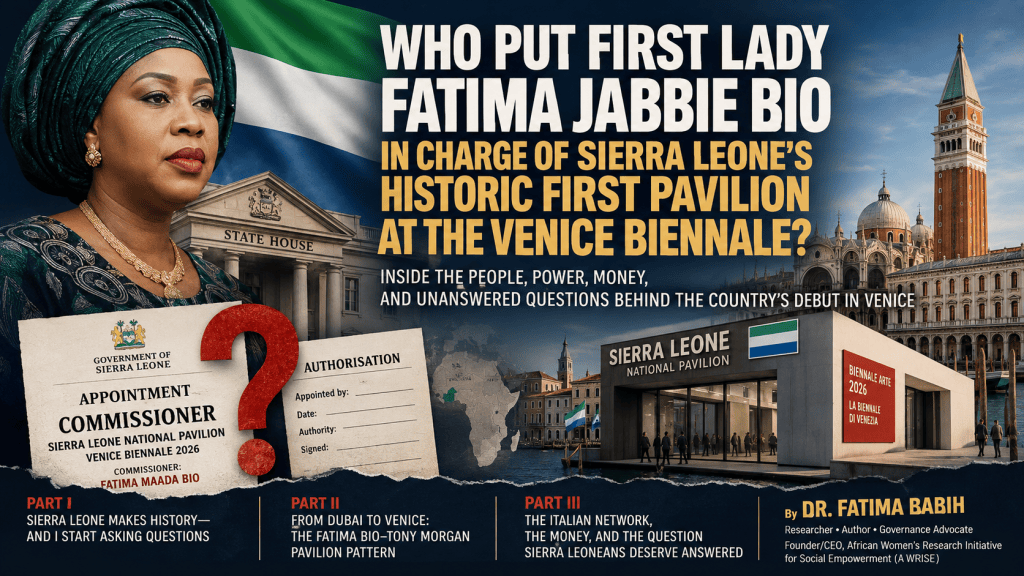
A reader asked me to look into First Lady Fatima Jabbie Bio’s activities in Venice. Buried in his message was a concern about money allegedly Fatima Bio donated at the event, something I have not yet been able to verify. His follow-up comment, however, contained something I could verify: Fatima Maada Bio is Commissioner of Sierra Leone’s first-ever National Pavilion at the Venice Biennale 2026.
Most Sierra Leoneans didn’t even know we had a pavilion. I didn’t either. So, I started digging.
What began for me as curiosity about an art exhibition became something else entirely: an investigation into who actually exercises governmental authority in Sierra Leone, and how one office keeps ending up in charge of things it was never elected or appointed to run.
WHAT WE MUST KNOW
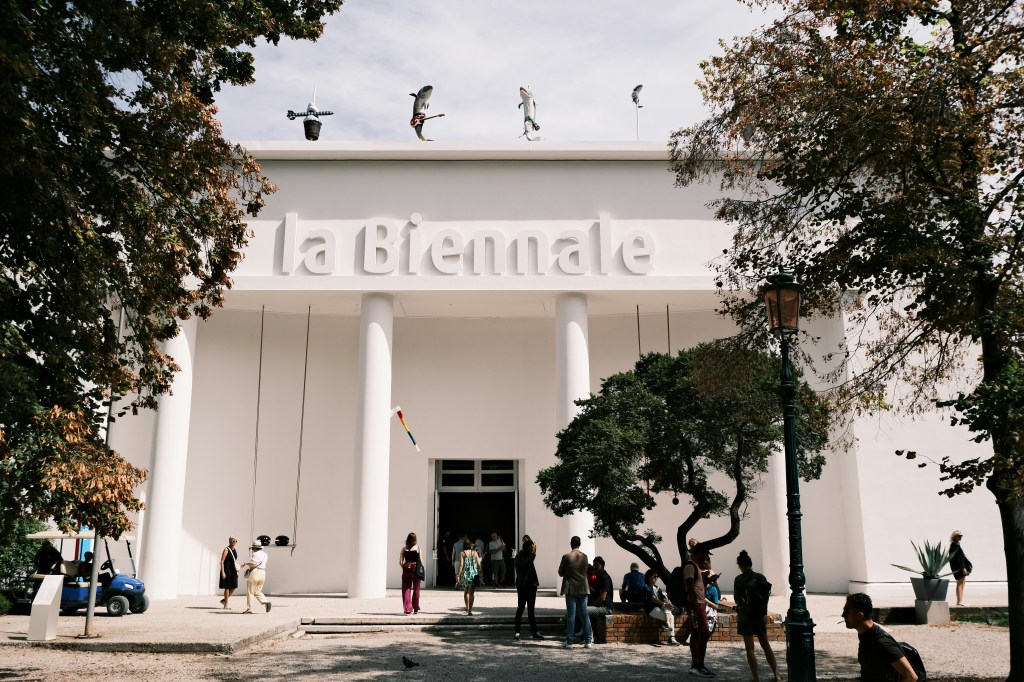
Before the hard questions, the facts deserve to stand on their own, because this really is historic. The Venice Biennale is one of the most important cultural institutions in the world, with a history dating back to 1895. Nations participate through official National Pavilions, and at the 61st International Art Exhibition in 2026, Sierra Leone is participating for the very first time, one of only seven countries making their debut this year.
The official La Biennale di Venezia page names our pavilion “Worlds of Today” (Mondi Presenti), and it is running from May 9 through November 22, 2026, at the Liceo Artistico Statale Michelangelo Guggenheim in Venice. It lists:
- Commissioner: Fatima Maada Bio
- Curators: Sandro Orlandi Stagl and Willy Montini
- Honorary President: Prince Kevin Nyerere
And sixteen participating artists, with only four of them being Sierra Leoneans:
- Hawa-Jane Bangura,
- Ayesha Feisal,
- Hickmatu Bintu Leigh, and
- Abu Bakarr Mansaray.
These artists deserve to be named. They should never disappear beneath the political questions surrounding how they got there.
THE ARTISTS MUST BE CELEBRATED
My investigation into these four artists found real, substantial credentials that owe nothing to this pavilion or to anyone’s political connections.
Hawa-Jane Bangura is a Freetown-based artist who founded The Barray, a community that has trained and mentored Sierra Leonean artists for years.
Ayesha Feisal is a British-Sierra Leonean multidisciplinary artist whose work has shown in major British and African art institutions.
Hickmatu Bintu Leigh is a photographer and filmmaker whose visual storytelling has intersected with major international development and public-health work.
Abu Bakarr Mansaray was internationally established long before Sierra Leone ever had a pavilion to put him in, his extraordinary science-inspired drawings and sculptures have already appeared in major international exhibitions across the world.
These artists did not need Fatima Bio to make them internationally recognized artists.
COMMISSIONER FATIMA BIO
Fatima Maada Bio is named the Republic of Sierra Leone’s National Pavilion. At the Venice Biennale, that title is not decorative. La Biennale’s own procedures require that countries without permanent pavilions submit an official request to participate through “the competent governmental authority.” That authority then appoints a Commissioner, someone who represents the governmental side of the country’s participation. The Curator handles the art. The Commissioner represents the state.
Which means Fatima Bio did not simply show up in Venice one day and decide to call herself Commissioner. Someone exercising the governmental authority of the Republic of Sierra Leone had to put her there. And that is the question at the center of this entire investigation.
WHO APPOINTED FATIMA BIO?
These are not rhetorical questions. They are the basic, elementary questions any citizen should be able to get answered about their own government:
- Which Sierra Leonean governmental authority submitted the country’s official request to participate?
- Who signed it?
- Who formally appointed the President’s wife as Commissioner?
- Was it President Julius Maada Bio himself?
- Was it the Ministry responsible for tourism and culture?
- Was some other public institution delegated to represent Sierra Leone?
- Where is the appointment instrument?
- Where is the government’s announcement?
- Where is the paper trail explaining why the President’s wife, and not a single government official, was selected to represent our nation?
I am not alleging that no authorization exists. I am asking why, after a lengthy search, I cannot find it, and why you, reading this right now, cannot find it either.
“A LEADING CULTURAL FIGURE”
There’s a second detail buried in La Biennale’s official description of Fatima Bio that deserves its own scrutiny. It describes her as:
a leading cultural figure committed to promoting Sierra Leonean artists internationally.
That is a specific, substantive claim, the kind normally backed by a proven career path. In reviewing her publicly documented history before 2026, I have not found a record of Fatima Bio running a national visual-arts institution, directing a museum or gallery, administering government cultural policy, curating a major contemporary art exhibition, or operating any established international program promoting Sierra Leonean visual artists.
So, where did that description come from?
Who wrote it?
Who submitted it to La Biennale, and on what basis?
I’ve researched it. I don’t yet have an answer; but someone, somewhere, decided that description should represent Sierra Leone to the world, and Sierra Leoneans deserve to know who.
WE ALREADY HAVE A MINISTRY
Here is what makes all of this especially hard to explain away: Sierra Leone already has a Ministry of Tourism and Cultural Affairs, and a sitting Minister to run it, Mrs. Nabeela Tunis. She is the one who was appointed to this portfolio. She is the one who draws a government salary for it. Culture and the creative industries are, quite literally, her job.
And 2026 is not an ordinary year for that Ministry. The government itself officially declared 2026 the “Year of Culture and Creativity.”
If there was ever a year when Sierra Leone’s own cultural institutions should have been front and center at our country’s first-ever Venice Biennale appearance, this was that year.
Instead, the official international record places the President’s wife at the head of the pavilion, and the Ministry built for exactly this purpose is nowhere to be found at the scene. That invites an obvious comparison.
LOOK WHAT HAPPENED NEXT DOOR
Guinea just showed us what this should looked like. Guinea made its own first-ever Venice Biennale appearance this year too.
- Same Biennale.
- Same historic first.
- Same West African region.
Guinea’s Commissioner is Bilia Bah, as confirmed by La Biennale, and identified by Guinea’s own Ministry of Culture as Director General of Cultural and Creative Industries.
The difference in transparency between our two countries is even more striking than the difference in the titles of the Commissioners.
On May 9, 2026, Guinea’s Ministry of Culture publicly announced its historic debut, explaining the exhibition, naming the artists, crediting the Italian curatorial partners, and stating plainly that Bilia Bah, in his official government capacity, was serving as Commissioner. That is what institutional agency looks like.
- Two neighboring West African nations.
- Two historic firsts at the same Biennale.
- Two National Pavilions.
Guinea put its Director General of Cultural and Creative Industries in the Commissioner’s chair.
Sierra Leone put the First Lady in the Commissioner’s chair.
Why?
THE PATTERN EXTENDS
Guinea is not an isolated example. Across the region, African nations making their Biennale debuts have consistently placed identifiable government cultural officials, not presidential spouses, in the Commissioner’s seat.
Cameroon’s own participation, built in part by the same Italian organizational network now working with Sierra Leone, followed the same institutional model: a government arts official in the governmental role, not a member of the First Family.
The institutional model already exists in our own region. Sierra Leone chose to ignore it, and installed an unelected presidential spouse in the one seat meant to represent the government itself.
Sierra Leone has a Ministry built for exactly this moment. It took the back seat in Venice. In its place stands the President’s wife with no government portfolio, now representing the Republic on one of the world’s most prestigious international stages, and no public document explains who put her there, or why.
That’s the foundation. But Fatima Bio did not hijack this pavilion alone and Venice was not the first time.
Part II of this investigation traces this pattern back further, examining the non-Sierra Leonean men aiding Fatima Bio’s takeover in Venice, their pre-existing business relationships, and what her history of stepping into governmental roles reveals about who is really representing Sierra Leone on the world stage.
 MAMA SALONE ~ Lioness of the West Coast