The Practical, Mystical and Public Aspects of Sande
The artistic and educational elements of Sande constitute its practical aspect in our society. The officers of Sande society, Soweisia, take the lead in imparting knowledge on the younger generation of women; in addition to teaching them about the mysteries of fertility and reproduction, the young initiates are also taught songs and dances with deep meanings.
In the Kpangwima, girls hone their skills in singing by learning and engaging in regular singing and dance sessions; songs that are learned teach young women about feminine beauty, grace as well as morals and social skills. A serious performer could emerge from the kpangwima as a professional singer or dancer.
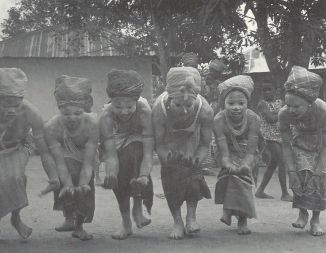
Sande women often sing and dance at events marking significant social and political processes, including visits of an endorsed politician, the inauguration of a new chief, or the funeral of a dignitary. During these celebrations, Sande women display their dancing skills by which they communicate the ideals and role of Sande society in public life.
As much as Sande society has been researched, theorized and analyzed by western scholars, the full essence of the society is not understood by these outsiders, partly due to the privacy emphasized by the practice of the society members and partly due to western bias reporting on the practices of other cultures. Against the backdrop of this privacy or “secrecy,” as perceived by western explorers, there is a “public” side of Sande society and this side is presented through the Sande Sowo Wui (Sowei Mask). Part of the essence of the Sowei Mask is its role in the Sande music and dance training.

One of the officers of Sande is the dancing Sowei known as Ndoli Jowei or Sampa (Bondo), she is the master dance teacher in the society who has also earned the privilege of wearing the sacred Sande mask called the Sowo wui (sowei mask) when she dances in public for very special occasions. The dancing Sowei is the embodiment of the ideals of female beauty and strength; Sande is the only women’s society in Africa in which female dancers wear a mask. Although known as the public face of Sande, the dancing Sowei embodies the mystical spirit of Sande, its principle of privacy; the true identity of the woman wearing the mask can never be revealed in public.
Sande also molds women into storytellers. Even though the Mende people are one of very few in West Africa to have their own ideographic and syllabic writing system, they do not keep written records. Like most ethnic groups in Sierra Leone, the Mende rely on their oral tradition to pass down their history, culture and tradition to the next generation. Sande is one of the primary mediums of this tradition. Storytelling is a skill that is highly respected in Sierra Leonean culture; it is cultivated and nurtured in talented Sande women, who can formulate stories that stress not only Sande principles but also the culture and traditions of our society.

Socio-Political element of Sande
In addition to its wide scope in Sierra Leone and beyond, Sande also has political relevance. Sierra Leone is generally a patriarchal society; male favored and male controlled social structure. However, Sande officers are highly respected elders in their respective communities, they deliberate along with their male counterparts in political, economic and judicial matters. Sande society plays a significant political role, as part of the hale institutions, it shares the responsibility of enacting and enforcing the code of conduct in the society, all individuals must adhere to such code and its tenets, whether or not they are members of the society, so long as they are dealing with Sande women.
Women’s membership in Sande gives them a powerful political platform in both local and national politics; Sande leaders are capable of marshaling large numbers of their members in support of candidates of their choice during elections. When a campaigning politician visits a particular village or town, if the Sande women of that locale do not support him or her, the dancing Sowei and her officers will not put on the elaborate celebration that indicates endorsement for the candidate. Without their support, a candidate usually does not stand a chance of winning in that constituency.
Sande Women’s Capacity for Empowerment
Probably long before Mary Wollstonecraft wrote A Vindication of the Rights of Woman (1792) and before the Women’s Movement in the United States and Europe, there was Sande society in Sierra Leone through which women were already asserting their gender rights and privileges. It is a vital part of Sierra Leone women’s social cycle. Sande is proof that African women have the capacity for collective agency, as exemplified by the various aspects of Sande Society of in Sierra Leone and beyond. Sande/Bondo has a tremendous potential in empowering women in Sierra Leone to once again, be able to resolve our own issues in a culturally sustainable manner.
Over the years, western led campaigns against female circumcision has trivialized our social institutions such as Sande/Bondo by stigmatizing female circumcision, which is part and parcel of Sande/Bondo society. But the fact is that Sande/Bondo is an African institution that has been empowering women for centuries and it holds the promise of providing agency through which women in Africa, particularly in Sierra Leone, can gain advancement not only in collectively resolving their own social problems but also in achieving advancement in the political sphere.
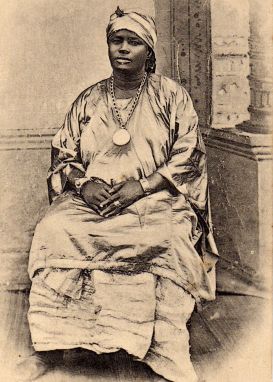
Mammy Yoko – Mende Chief & Sande Woman
Our history tells us that the groundwork for women to play leadership roles in society is well laid in Sande/Bondo; the institution holds best practice lessons that could be transmitted to our modern governing structure in Sierra Leone. Leveraging these lessons would greatly help ease the way for women’s participation in political leadership to move us beyond the current pathetic state of affairs.
The theme for International Women’s Day 2015 is “Women’s Empowering: Make it Happen.” This is very instructive for African women but we must take a step back and ponder “HOW” do we “make it happen?” Do we continue with an agenda that has not necessarily empowered us? Or do we look into our own backyard to see what our grandmothers left us as a foundation on which we could build in our modern context?
Salone Women’s Empowerment:
How Do We Make It Happen?

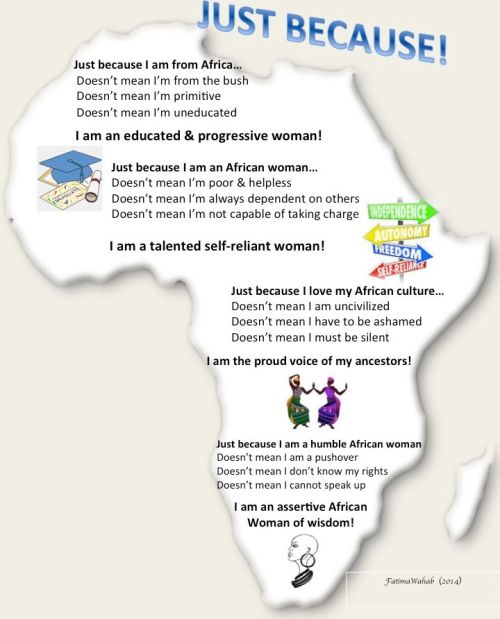 Inspired by Esther Kamkar’s original poem “Just Because…”