General elections are slated to take place in Sierra Leone on March 7, 2018. The whole country is abuzz now with an onslaught of candidates crawling out of the woodwork. Several of the 2018 contenders are hoping to become standard-bearers … Continue reading →
You were given the cause to post a video in response to the pornographic video put out on social media to malign you. Keep smiling girl, it looks good on you!! Without seeing the maligning video, it is nonetheless obvious … Continue reading →
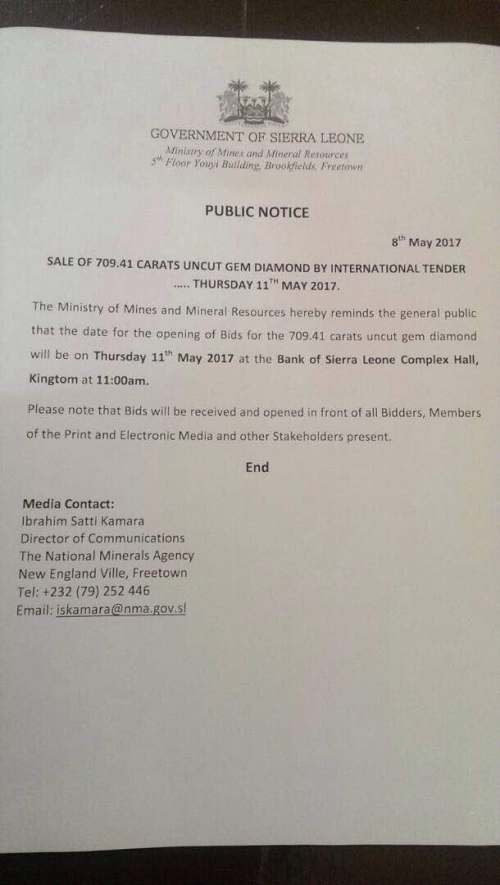
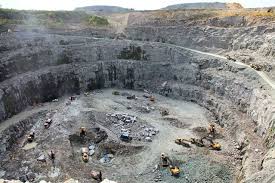
The biggest news out of Sierra Leone for the past couple of days has been the discovery of a giant diamond, which the Sierra Leone State House describes as a 706 carat diamond. This precious stone was found by a … Continue reading →
Having been in Sierra Leone for the past four weeks, wearing various proverbial hats, one of them as President of the Ansarul Alumni Association, my secondary school Alma mater. In this capacity, I had to visit a few of the many schools that are managed by our school’s Mission around the country.
By mid last week, I had visited schools in Bo (South), Kono (East) and Freetown (West). Next on my list was a school in a town called Mile 91 (North). This is the town where Zainab Kamara lives. She is the crippled woman whose video story went viral a couple of weeks earlier. Since then, women on my DIAMONDS Women’s whatsapp forum had sent me messages encouraging me to look for her while in Sierra Leone. After finally being able to watch the video, I too grew interest in seeing her, but did not quite know how.
On Thursday, October 13, 2016, the day of my visit to the school in Mile 91, I toured with the vice principal, spoke to an assembly of students, and to faculty and administrators, as I do on all my visits. At the end of my tour, I asked whether anyone could show me where the famous Zainab Kamara lives in this town. I was then told that one of her daughters is a student at this very school. What a Blessing! I was then given permission to see her.
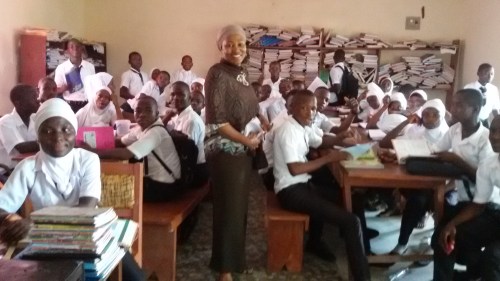
Shortly after, a beautiful, pleasant and neatly dressed young lady came to greet me. Hawanatu and I had a nice brief discussion, as she had to return to class. She assured me her mother and siblings are doing well. I asked whether she needed school fees, she informed me that she has been given a scholarship by an NGO, One Girl Salone. She explained that this organization has paid her tuition for the year, provided her with books, uniform and other school supplies.
I then encouraged her to make good use of this scholarship and any other opportunities she gets, to stay in school, study hard and make her mother proud by becoming a professional woman in the future. I made this shy 15-year-old blush in the presence of her vice principal when I asked her to promise not to get involved with men or get pregnant like most girls are doing these days. She promised me she would not and would stay and finish school.
Then I told her that I would like to enroll her into the DIAMONDS Girls Circle, a program of our nonprofit organization Girls LEAD Change, Inc., which works to help adolescent girls in disadvantaged communities combat negative societal trends, such as teenage pregnancy. Sierra Leone has one of the highest incidents of teenage pregnancy, even though many NGOs are offering scholarships to increase the number of girls in school, a high number of girls drop out of school daily due to pregnancy. Girls LEAD Change is trying to reverse this trend so that girls could reach their highest potential.
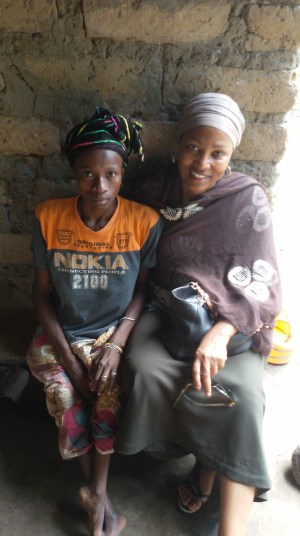
I arrived and parked a distance away from Zainab’s place, as there is no auto road to her house. I sent word to her. She quickly appeared down the road to receive me; in the typical way a Sierra Leonean receives a long lost relative, very warm and welcoming. She invited me to her house and led the way. She offered me a sit and we talked like sisters. I was concerned about hers and her children’s health. She assured me there were no issues of chronic illnesses; except for occasional bouts with malaria and the common cold, they were all doing well.
We talked about the challenges she is facing with the small house in which she and her children live. She talked about Umaru Fofanah and others who were trying to help her with this issue. She introduced her two sons who had just returned from school, the boisterous and polite boys greeted me with big smiles.
I told Zainab I had just met her older daughter who attends one of my alma mater in town. I told her how the women in my organization and I felt it was important for me to meet her in person so we could have an ongoing relationship henceforth. Which she welcomed. I asked for her permission to enroll her daughter in our DIAMONS Girls program. She happily approved.
Zainab & Fatima
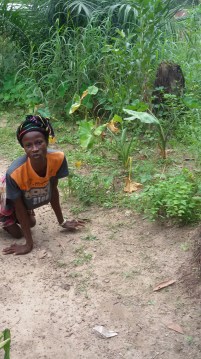
Of course, our discussion led to her famous garden. She gladly took me round, showing me the various fruits and vegetables she is growing. I asked whether she sells them. She told me she does not, that she shares her harvests with her family, friends and neighbors. She also said that thieves take a lot of them. She pointed to the banana tree near her kitchen, which had no fruits on it because thieves had plucked off the bunch the night before, probably to sell. These thieves are obviously able-bodied individuals with functioning legs, eyes, arms, etc., stealing what a crippled woman had labored to plant.
As we were saying our goodbyes and passing the garden near her house, I expressed admiration for the huge garden eggs. She asked if I liked garden eggs? I told her I did very much and was planning to buy some at the next junction on my way to Freetown. Right away she started plucking garden eggs for me. Before long, Zainab was sending me off with two small bags of garden eggs. Who is the “disabled” woman now? I do not think I could survive long if I had to maintain a garden in order to eat.
On my way to see her, I thought I was visiting a crippled “disabled” woman. After our visit, however, her physical deformity was no longer prominent in my thoughts about her. Instead, I remember a gracious hostess who infused me with the human spirit; she made every effort to make me feel comfortable in her home and did not want me to leave empty handed. At no moment during my visit did I feel that Zainab wanted anything from me. An epitome of the Sierra Leonean women I grew up with, she reminded me so much of my grandmother, MaBatu (Habibatu Swaray), God rests her soul, in whose home no guest slept hungry; regardless of what time they arrived.
Zainab is passionate about her garden, which serves not only to feed her family, but also as a way for her to give to others as best as she could. This amazing woman is a positive reminder that no matter our situation in life, we must strive to sustain ourselves and maintain our dignity as human beings by using whatever physical and mental ability with which we are endowed.
I therefore do not see Zainab Kamara as “disabled,” despite her crippled condition. Rather, I see her as “disadvantaged.” A woman with no legs to walk with and no formal education, in a country where you are already at a disadvantage as a woman; the odds are stacked against Zainab and other women with physical and mental disabilities in Sierra Leone. There are no dignified provisions by her government and society, for her to maintain her household and raise her children. She has chosen to do so by using her hands, brain and God-given talent, to function in a society where people in her condition often become beggars in the streets.
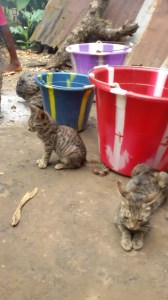
Zainab’s Kittens
This phenomenal woman does not need handouts from us; instead, she needs us to lend a hand in helping her do better what she has already been doing to sustain her family.
To avoid duplication of efforts, we are supporting Umaru Fofanah’s lead in helping to secure financial resources for Zainab and her children. He is a reputable Sierra Leonean journalist and BBC reporter who has taken interest in Zainab’s story. He has set up a trust fund for her in Sierra Leone and the United Kingdom. For now, we encourage members of our DIAMONDS Women’s forum, Mama Salone readers and the general public to please give Zainab a hand by donating to her trust funds.
Thank you in advance & May Almighty God Reward your Generosity!!
As time goes on, we will share information on other ways of helping and we welcome any ideas of how best we can support this dignified phenomenal woman, Zainab Kamara of Mile 91, Sierra Leone.
Here is the Trust Fund information culled from Umaru Fofanah’s Politico article:
The chronic polarization of Kono peoples must stop. While they are asleep by their focus on superficial divisions, the criminal political elite of Sierra Leone is robbing them blind of their land and their human and peoples’ rights.
When a leader wants absolute power but still needs the outside world and donors to see him as a “democratic” leader, he crafts laws that give legitimacy to his nefarious plans; in this way, outsiders can ignore what he does in the name of sovereignty. This is how the Mines & Minerals Act of 2009 came into being in Sierra Leone, at the behest of the current President Ernest Bai Koroma, the “Supreme Leader” with absolute power in “democratic” Republic of Sierra Leone.
This Act instituted a structure in which a place such as Kono District, which is the most diamondiferous district in Sierra Leone, belongs to the political elite and their network. A quick glance at the act tells you that in a place like Kono, the people have lost all rights to their land; the land and what it contains not only belong to the president and his cronies, they have absolute power over the people. This law has taken the people of Kono into a deep hole from which they must find a way to crawl out.
Mines and Minerals Act of 2009- Section 2 – Ownership of minerals
(1) All rights of ownership in and control of minerals in, under or upon any land in Sierra Leone and its continental shelf are invested in the Republic not withstanding any right of ownership or otherwise that any person may possess in and to the soil on, in or under which minerals are found or situated.
(2) The Minister shall ensure in the public interest that the mineral resources of Sierra Leone are investigated and exploited in the most efficient effective and timely manner.
We have all decried the constant police brutality against the people of Kono, especially the youth, whenever they try to protest the injustices they are facing. We have wondered about the arrogance and over-confidence of cabinet ministers who operate in Kono. These ministers are well known for threatening, intimidating and ordering police to arrest, imprison and even kill Kono people who raise their voices against the injustices they face. The absolute power and impunity of Kono ministers are based in the laws.
Ancestral homes are bulldozed daily and people of Kono are relocated by foreign owned mining companies to shabby new locations far away from schools, markets and hospitals. Schools that have existed for decades are bulldozed and relocated to areas that are inaccessible to the children who attend them. The list goes on and chronically corrupt politicians, their network and local leaders continue to enrich themselves at the expense of the people’s lives and livelihood.
The daily or weekly kimberlite blasting by a powerful mining company, Koidu Holdings aka OCTEA, has been causing so much physical, psychological and emotional havoc on the people of Kono; the tremor caused by the dynamite blasts leads to many miscarriages among pregnant women in the vicinity, it also leads to psychological trauma, especially for older survivors of the decade long war. But it is all legitimate because the Mines & Minerals Act of 2009 says it is,
Section 36: Compulsory acquisition of private land.
(1) The Minister may, by order published in the Gazette, compulsorily acquire private land or rights over or under private land for use by the holder of a large- scale mining licence.
As a result, the people of Kono are internally displaced and are facing serious oppressive treatment by the police and the government officials they take orders from. Protecting the source of their diamond wealth has led the politicians and their vulture western investment partner companies to commit serious abuse of human rights in Kono District, yet, these atrocities may seem legally justified based on the mining laws.
In one rare video report of atrocities in Kono, (which may well be a government commissioned propaganda report), a government minister is asked to explain the situation regarding the recent Congo Bridge destruction and mishandling of the youth and other citizens who tried to protest in Koidu City. Part of the minister’s explanation is that the bulldozing, digging, dredging, etc., were being done to “remove unsuitable materials…to protect the people and their interests.” It is very obvious from his responses that the overconfident minister is fully aware of the injustice of this mining activity, which is leading to the loss of a vital bridge and the lives and livelihood of the people. The Mining Act of 2009 provides legitimacy for this minister to claim that he has commissioned a mining company to “remove unsuitable material…,” a language borrowed from the law, which gives him the power to order the wrath of police brutality on the people, which in the last incident, resulted in serious injuries and at least one fatality that we know of in Koidu City.
Diamonds have been mined in Kono District for over 80 years; but the previous regime of the late President Tejan Kabba and the current regime of President Ernest Bai Koroma are probably the worst in history for Kono and its people. Things are only going to get better for Kono District and its people when,
the people use their collective political powers to demand changes in the structure that the current regime has put in place in the guise of a mining law.
Kono people unite in holding their legislators accountable for partaking in the drafting and passing of such laws.
People of Kono realize that politicians are false prophets, their promises are fake and only meant to deceive them into giving them the very powers they end up using against them.
the people of Kono use their voting power to push for changes in the laws that have built the structure in which they have lost their birth rights to their land.
The people of Kono must unite and find legitimate means of using their collective voices to uplift themselves out of this hole dug bycrafty laws drafted by crafty politicians.
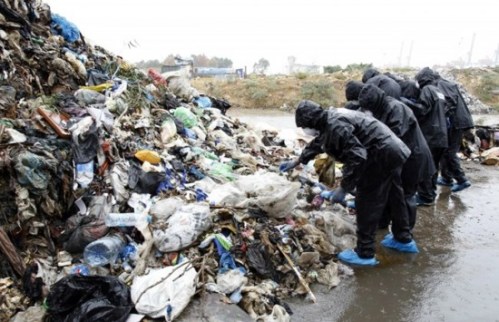
On January 9, 2016, a newspaper in Beirut, Lebanon, The Daily Star, reported, “Sierra Leone agrees to take in Lebanon trash.” The report goes on to say that this comes after a nearly six months trash crisis in Lebanon. The country had apparently entered into contract with a company in the Netherlands, Howa BV to search for a dumping ground for its non recyclable waste. In other words, it useless trash.
Photo Credit: The Daily Star. Lebanon Trash
It took this newspaper report in Lebanon for people of Sierra Leone to know that their government was about to enter into a secret agreement to bring roughly 200,000 tons of trash into the country from Lebanon. Otherwise, people in Sierra Leone would have never found out. If ever, they may have found out after the deal was done, every participant was enriched from the proceeds. Perhaps the poverty ridden masses would have found out after some mysterious illness overtook them.
In a letter from a Sierra Leone government official, dated January 7, 2016, Alhaji I.B. Kargbo, the Special Adviser to the President of Sierra Leone, advises the Netherlands Chamber of Commerce, with whom the agreement is to be signed,
If the Ministry of Trade and Industry, Foreign Affairs and the Office of the Chief of Staff agree on the legality of the transaction, then there will be no difficulty to sign an agreement between the government of Sierra Leone and your Chamber…It should be noted that the President, Dr. Ernest Koroma, has the final say on this matter.
Civil Society has no say
According to Alhaji Kargbo’s advise above, civil society, as stakeholders who pay the ultimate price should this turn out to be disastrous for health and lives, they are clearly being overlooked and dismissed as irrelevant in the matter.
Alhaji I.B. Kargbo, at the date of signing his letter of acceptance for the Lebanese trash, was holding the title of “Special Adviser to the President” as well as a newly “Elected Member of Parliament.” This shows that in Sierra Leone, it does not take a high level government official to enter into contracts that may potentially harm the people. Also as an Elected Member of Parliament, he is supposed to represent and serve the people, as such, overlooking the people’s relevance in his dealings of this sort is injurious and a disservice to them.
As a preemptive defense, Alhaji Kargbo states in his letter, that the trash “…should not be of any toxic nature…be part of development of fertilization for agricultural purpose.”
He also stated in a BBC radio interview that the purpose of the trash was for his Dutch business contact to set up a fertilizer plant in Sierra Leone.
If this were true, it makes one wonder:
What should come first: the fertilizer plant or the trash?
Why isn’t there any record of exchanges regarding a fertilizer plant but there is an exchange for trash transfer?
Is it in the terms of reference of the “special adviser” to the President to broker such deals?
Apparently, this is how all “investment” contracts are entered into in Sierra Leone. It does not have to be in the job description of the contracting official. The evidence of this danger is in numerous parts of the country, where mining and non-food agricultural land grabs are taking place. People in those regions are enduring a plethora of injustices from effects of contracts that they were never part of making.
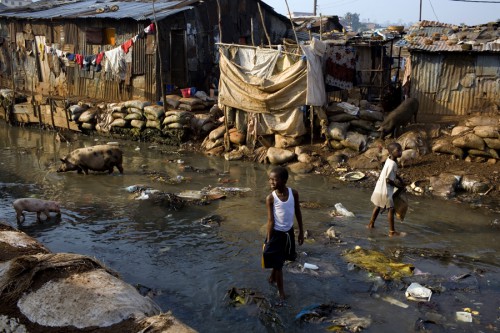
A boy walks through the river in Kroo Bay slum looking for scrap metal to sell. The river is effectively a giant sewage and everyday new garbage arrives in the water from the hills around. Kroo Bay, Freetown, Sierra Leone.
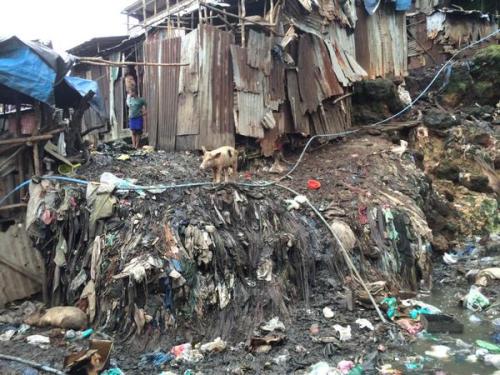
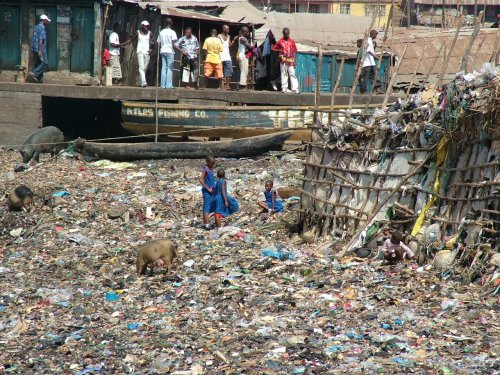
This is a country that has never figured out what to do with its own trash
But our government officials want us to believe that we have room to accept thousands of tons of trash from other countries, in the name of “developing agricultural fertilizer;” when in fact the Lebanese news paper report indicates that specialists have declared the Lebanese waste “infectious and compacted.”
Slum in Freetown Sierra Leone Living on heaps of trash
The worst danger is the fact that this deal, and others like it, are motivated by financial incentives. The Lebanese are ready to pay millions of dollars to get rid of their trash, and a few individuals in Sierra Leone stand to gain a great deal. Alhaji I.B. Kargbo may become a scapegoat and released from his post to shut us up and defuse any tension at this particular moment.
However, this deal might go through at a later date, after a more discrete transaction can be brokered. There are many more officials in Sierra Leone government who are, at any point in time, striking deals just like this. We often find out when out of no where, our people start dying like flies from a mysterious foreign disease they cannot pronounce.
Susan’s Bay Slum. Sierra Leone Photo Credit: Zander’s Blog
There must be an uproar of civil society. Why do we only rise up when the issue is “politics?”
The people of Sierra Leone must demand transparency and detail information about all such contract deals for which the people are the ultimate victims.
Dr. Minkailu Bah, Minister Ministry of Education, Science and Technology
New England Freetown
Sierra Leone, West Africa
Dear Honorable Minister Bah:
With all due respect Sir, your April 2015 education policy, which excludes pregnant girls from continuing their education is like putting plaster on a jigger toe. Your policy puts the blame of girls’ pregnancy solely on the girls and shields the men who impregnate them.
But we all know that the root cause of teenage pregnancy in Sierra Leone is the appetite of older men for young girls. So by punishing only the girls, you are leaving the jigger in our national toe. Your policy is a first aid band-aid covering a jigger, which needs to be removed.
Many of the worldwide reactions decry your policy, pointing to its adverse effects on girls’ education and the further depletion of women’s socioeconomic status in Sierra Leone. As women who grew up in Sierra Leone, we have always known that pregnancy ended a girl’s schooling in our country, due to stigma and shaming of the girl. No pregnant girl wants to sit beside her peers with her projected stomach. We have always hoped for a solution.
We are surprised that a government that is legally and morally obligated to protect their rights as children, has formally implemented a policy that further erodes girls’ basic and human rights, which are protected by national and international laws.
We posit here that pregnant adolescent girls, in majority of the cases in Sierra Leone, are victims of rape, in violation of the laws of Sierra Leone. A policy that makes them the only “culprits,” while shielding the adult men who impregnate them, will not only fail, it will make girls even more vulnerable.
OLDER men WHO IMPREGNATE GIRLS must be prosecuted as a fundamental remedY FOR a national crisis.
IT IS BECAUSE OUR SOCIETY TREATS GIRLS AS INFERIOR. One morning recently, Sierra Leoneans around the world woke up to social media photos of the body of a young woman lying face up on a sandy beach in Freetown (Lumley). Her … Continue reading →
The Practical, Mystical and Public Aspects of Sande
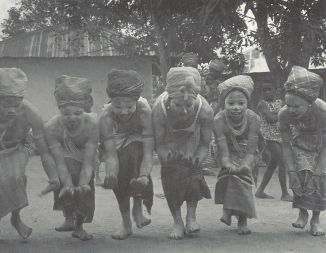
The artistic and educational elements of Sande constitute its practical aspect in our society. The officers of Sande society, Soweisia, take the lead in imparting knowledge on the younger generation of women; in addition to teaching them about the mysteries of fertility and reproduction, the young initiates are also taught songs and dances with deep meanings.
In the Kpangwima, girls hone their skills in singing by learning and engaging in regular singing and dance sessions; songs that are learned teach young women about feminine beauty, grace as well as morals and social skills. A serious performer could emerge from the kpangwima as a professional singer or dancer.
Sande women often sing and dance at events marking significant social and political processes, including visits of an endorsed politician, the inauguration of a new chief, or the funeral of a dignitary. During these celebrations, Sande women display their dancing skills by which they communicate the ideals and role of Sande society in public life.
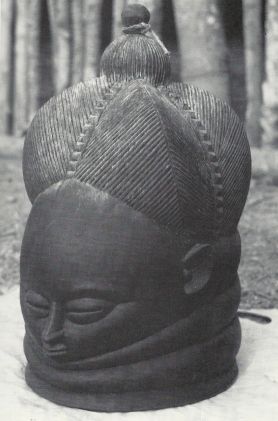
As much as Sande society has been researched, theorized and analyzed by western scholars, the full essence of the society is not understood by these outsiders, partly due to the privacy emphasized by the practice of the society members and partly due to western bias reporting on the practices of other cultures. Against the backdrop of this privacy or “secrecy,” as perceived by western explorers, there is a “public” side of Sande society and this side is presented through the Sande Sowo Wui (Sowei Mask). Part of the essence of the Sowei Mask is its role in the Sande music and dance training.
One of the officers of Sande is the dancing Sowei known as Ndoli Jowei or Sampa (Bondo), she is the master dance teacher in the society who has also earned the privilege of wearing the sacred Sande mask called the Sowo wui (sowei mask) when she dances in public for very special occasions. The dancing Sowei is the embodiment of the ideals of female beauty and strength; Sande is the only women’s society in Africa in which female dancers wear a mask. Although known as the public face of Sande, the dancing Sowei embodies the mystical spirit of Sande, its principle of privacy; the true identity of the woman wearing the mask can never be revealed in public.
Sande also molds women into storytellers. Even though the Mende people are one of very few in West Africa to have their own ideographic and syllabic writing system, they do not keep written records. Like most ethnic groups in Sierra Leone, the Mende rely on their oral tradition to pass down their history, culture and tradition to the next generation. Sande is one of the primary mediums of this tradition. Storytelling is a skill that is highly respected in Sierra Leonean culture; it is cultivated and nurtured in talented Sande women, who can formulate stories that stress not only Sande principles but also the culture and traditions of our society.
Socio-Political element of Sande
In addition to its wide scope in Sierra Leone and beyond, Sande also has political relevance. Sierra Leone is generally a patriarchal society; male favored and male controlled social structure. However, Sande officers are highly respected elders in their respective communities, they deliberate along with their male counterparts in political, economic and judicial matters. Sande society plays a significant political role, as part of the hale institutions, it shares the responsibility of enacting and enforcing the code of conduct in the society, all individuals must adhere to such code and its tenets, whether or not they are members of the society, so long as they are dealing with Sande women.
Women’s membership in Sande gives them a powerful political platform in both local and national politics; Sande leaders are capable of marshaling large numbers of their members in support of candidates of their choice during elections. When a campaigning politician visits a particular village or town, if the Sande women of that locale do not support him or her, the dancing Sowei and her officers will not put on the elaborate celebration that indicates endorsement for the candidate. Without their support, a candidate usually does not stand a chance of winning in that constituency.
Sande Women’s Capacity for Empowerment
Probably long before Mary Wollstonecraft wrote A Vindication of the Rights of Woman (1792) and before the Women’s Movement in the United States and Europe, there was Sande society in Sierra Leone through which women were already asserting their gender rights and privileges. It is a vital part of Sierra Leone women’s social cycle. Sande is proof that African women have the capacity for collective agency, as exemplified by the various aspects of Sande Society of in Sierra Leone and beyond. Sande/Bondo has a tremendous potential in empowering women in Sierra Leone to once again, be able to resolve our own issues in a culturally sustainable manner.
Over the years, western led campaigns against female circumcision has trivialized our social institutions such as Sande/Bondo by stigmatizing female circumcision, which is part and parcel of Sande/Bondo society. But the fact is that Sande/Bondo is an African institution that has been empowering women for centuries and it holds the promise of providing agency through which women in Africa, particularly in Sierra Leone, can gain advancement not only in collectively resolving their own social problems but also in achieving advancement in the political sphere.
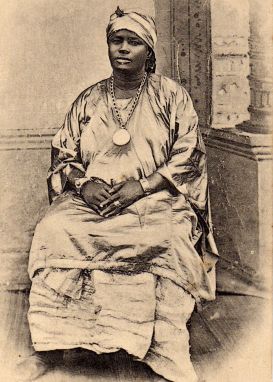
Mammy Yoko – Mende Chief & Sande Woman
Our history tells us that the groundwork for women to play leadership roles in society is well laid in Sande/Bondo; the institution holds best practice lessons that could be transmitted to our modern governing structure in Sierra Leone. Leveraging these lessons would greatly help ease the way for women’s participation in political leadership to move us beyond the current pathetic state of affairs.
The theme for International Women’s Day 2015 is “Women’s Empowering: Make it Happen.” This is very instructive for African women but we must take a step back and ponder “HOW” do we “make it happen?” Do we continue with an agenda that has not necessarily empowered us? Or do we look into our own backyard to see what our grandmothers left us as a foundation on which we could build in our modern context?
Salone Women’s Empowerment:
How Do We Make It Happen?