African Women’s Empowerment: Spotlight on Sande/Bondo Women’s Society

In current media reports, women in Africa are consistently presented as helpless and being helped with their problems. Over the years, countless non-profit organizations have been set up and continue to be set up daily all around the globe to “help African women” resolve the myriad of problems that plague them – from health issues to disparities in education. This has etched the image of women in Africa as helpless and unable to resolve their own problems without outsiders coming to their rescue. With this scenario of women’s condition of helplessness, it is difficult to conceive that women in Africa have social institutions that have given them agency to play vital roles in society.

Given the excess of social issues afflicting women in Africa today, including extreme poverty, poor health conditions and the prevalence of gender disparities at all levels of the social and political structures, and as more and more outsiders pour in to help resolve these problems, African women seem to have no agency or ability to collectively help themselves. This issue of African women’s seeming lack of agency and collective capacity today implores one particular question,

  • How have African women resolved their own social issues before the advent of non-governmental agencies that are now on the scene to rescue them?

As a woman from Sierra Leone, West Africa, I am keenly aware of women’s capability to resolve socio-political issues through women’s social institutions such as Sande/Bondo. Throughout history, Sande/Bondo women’s society has been the collective medium through which women have played viable roles in society as well as demonstrated their capacity to resolve their own issues rather than wait for others to “save them,” as current media reports would have us believe.

Sixteen tribes have co-existed in Sierra Leone for probably centuries, the Mende, Temne, Loko, Limba, Kissi, Mandingo, Koranko, Soso, Fulla, Kono, Vai, Sherbro, Krio, Yalunka, Krim and Gola. The majority of these groups live in the rural regions. With the legacy of colonization, Sierra Leone has struggled over the post independence years to partake in the global development paradigm. Although Sierra Leone is endowed with a rich tropical climate, fertile soil, abundant marine life and precious natural resources, including diamonds, gold, titanium ore, bauxite, iron ore and chromite, it remains one of the poorest countries in the world. The decade long rebel war in the 1990s made matters worst and recovery has been slow, especially given the chronic corruption and ineffective leadership.

In the face of all the socio-economic problems affecting the country and people of Sierra Leone, it is easy for social institutions such as Sande/Bondo, to fall prey to erosion by western imperialistic agenda. Over the years, rather than strengthen such institutions so that women could benefit from their good practices, there has been a steady campaign to pull us away from our traditional practices. In the case of Sande/Bondo, the western-led global campaign against female circumcision has been mounted, in my opinion, as a campaign to erode the very institutions that have empowered women in our society; thereby perpetuating our dependency on western messiahs to “save” us from our traditional and cultural practices. We continue to be presented to the world as primitive and retrogressive and many of our problems are blamed on these traditional and cultural practices.
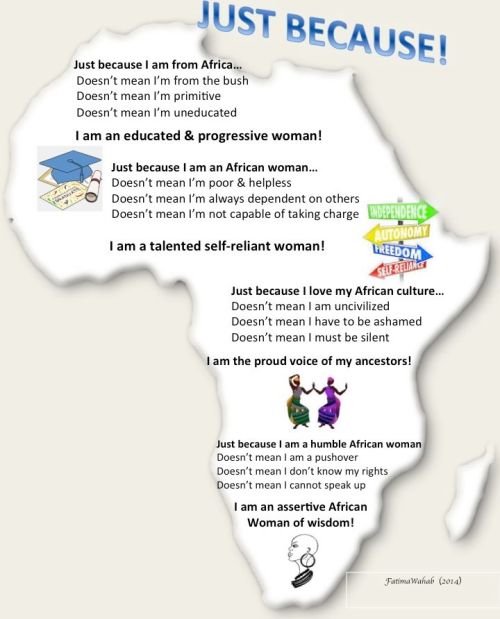
JustBecause

The official United Nations theme for International Women’s Day 2015 is “Empowering Women – Empowering Humanity: Picture It!” In my view, African women should ponder this theme very seriously; we should take this year as a year of consciousness-raising for a look back at our social institutions that have historically “empowered women.”

Specifically, women of Sierra Leone must look back at our Sande/Bondo women’s society and uncover the good practice lessons that could be applied today to enhance women’s collective prospects for empowerment in Sierra Leone. Through these lessons, we could counter the discourse of helplessness and lamentation that currently pervades prevailing discourse on women of Sierra Leone and Africa. Doing so would also help us identify the empowering agency women already have that could be used in transforming our current sociopolitical situation into one that truly empowers and helps us achieve social justice in our society.

In the next few days leading up to International Women’s Day, March 8, 2015, we will put the spotlight on Sande/Bondo Women’s Society of Sierra Leone, highlighting the institutions various aspects and potential for empowering women.

Stay Tuned!

Just Because Poem: Write Yours and Share It

JustBecauseInspired by Esther Kamkar’s original poem “Just Because…”

Gallery

Video on Teen Pregnancy in Salone

Mama Salone just discovered this video by government of Sierra Leone and UNFPA on the launching of their effort to address the teen pregnancy problem. It is a great start but more need to be done to deal with the … Continue reading →

Gallery

Juvie Offensive: Sexual Exploitation of Girls

This gallery contains 4 photos.

In the United States, the term “juvie” is short for juvenile and a colloquial word for juvenile correctional facility or juvenile justice system. It is also used to refer to a young person who has served time in a juvenile correctional facility; … Continue reading →

Gallery

DOUBLE VICTIMIZATION OF RAPE VICTIM BY MALE CONTROLED MEDIA IN SIERRA LEONE

After enduring the horrors of a brutal rape, allegedly, by none other than the Deputy Minister of Education, the 24-year old University of Sierra Leone student is currently enduring the all-common bombardment of harassment and continued victimization faced by rape … Continue reading →

Gallery

Female University Student Allegedly Raped by Deputy Minister of Education

For days we have been reading, with horror and disgust, about the alleged rape of a 24-year old female engineering student of University of Sierra Leone (Fourah Bay College) by the Sierra Leone Deputy Minister of Education. We have learned from newspaper … Continue reading →

Sierra Leone Constitution: Finally Under Review

On Tuesday this week, July 30, 2013, the Government of Sierra Leone launched a Constitutional Review Committee (CRC), which is charged with the task of examining this fundamental document and coming up with recommendations for amendments to the laws of the nation based on its findings.

landrights_03This is obviously not a quick process but it is surely in the interest of Mama Salone to observe patiently and follow the progress of the review. Especially since the President cites  women’s demand for changes in contradictory laws in the current constitution regarding women’s rights as one of the many reasons necessitating this review. In his keynote address at the launching ceremony, His Excellency, President Ernest Koroma made reference to this demand stating, Women are advocating for the review of the 1991 constitution to ensure that we do not have a constitution that protects and promotes their rights with one hand and then draws back these protections in other clauses… At least now we know someone has been listening.

The 80-member CRC, the President says, is made up of a diverse group of citizens from all regions and various political and socio-economic backgrounds. It has two years to complete its findings and submit a draft recommended amendments to the President, who would then present it to Parliament for approval and then to the people of Sierra Leone through referendum.

In his speech, the President emphasized the need for full support and participation by all citizens in this process; however, if the people of Sierra Leone are to have faith in his words, the process should start off as transparent as possible and the committee should be more representative. According to some critics, the CRC is primarily composed of members of the two main political parties (APC and SLPP), it has also been pointed out that the CRC is not gender balanced. The CRC in that case seems to have the same flavor as other governmental appointments in Sierra Leone; based on political and inner circle connections within the political elites. There are so far no indications of civil society’s involvement in these initial stages of the process and none on how citizens’ participation will be ensured.

We assume the best of intentions on the part of the president and his government. however, we cannot help but wonder whether such a select committee could come up with recommended amendments in the best interest of women and other vulnerable groups?

Only time will tell!

Read President Koroma’s Keynote Address here

Gallery

Agenda for Change: What’s in it for Salone Women?

We were encouraged to see that President Koroma dedicated two paragraphs under the heading: Empowering Women toward the end of his speech for the opening of Parliament in December 2012. With nothing else in recent history to give women of … Continue reading →

Gallery

ATTENTION: HEART DISEASE is still NUMBER ONE Killer of Women

This gallery contains 1 photos.

According to the Centers for Disease Control and Prevention (CDC), Cardiovascular disease (Heart Disease) is the leading killer of women in America, accounting for over one-third of all deaths. That’s more than the combined death rates from breast, ovarian, and … Continue reading →

Gallery

A Soul-Searching Quest for Salone Women

This gallery contains 5 photos.

Political leadership is one of the most sought aspirations for Sierra Leonean women and men; as we are acutely aware that socioeconomic and political prosperity come to those who are in this arena in our country, they have tremendous power … Continue reading →