
A timeline mystery that exposes the dangerous rise of ‘truth is whatever we can pay for’ politics in Sierra Leone
by Fatima Babih, EdD
For days, Sierra Leone’s social media has erupted over a seemingly simple question about First Lady Fatima Jabbie Bio’s educational background. What should be a straightforward matter of public record verification has instead become a tribal battlefield of blind loyalty versus breathless outrage.
But strip away the noise, the hashtags, and the performative indignation, what remains is a much more serious problem that threatens the foundation of democratic accountability:
- When did documentation become optional for public figures?
- When did asking for clarity become treason?
- And when did “just believe the story” replace “show the receipts”?
This isn’t about which school is more prestigious. This isn’t about elitism or misogyny.
This is about whether truth still matters in Sierra Leone when power is involved.
Questions That Persist
Here are some facts that keep this controversy alive:
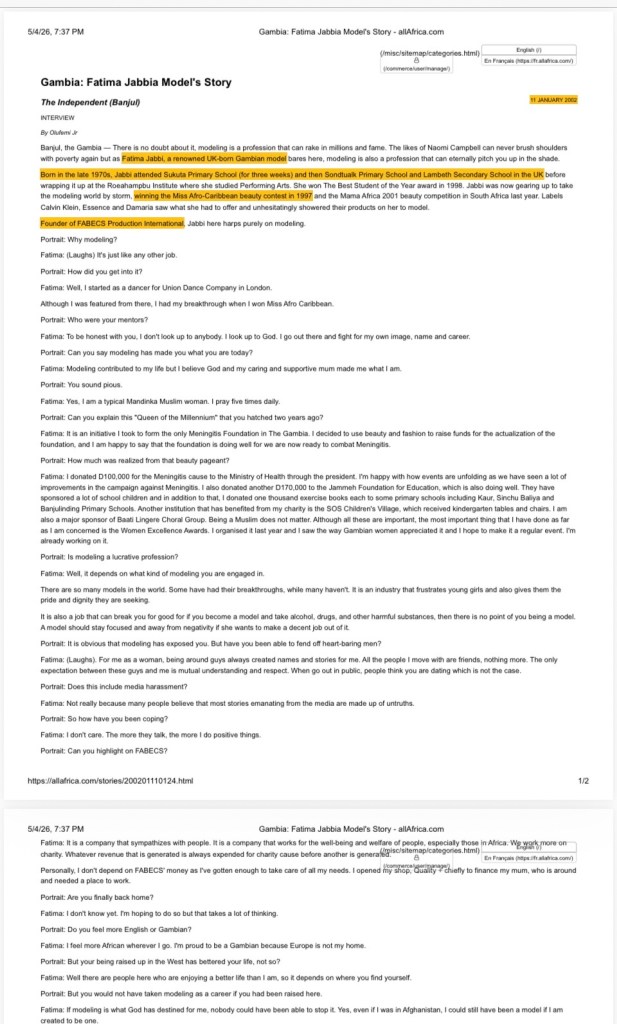
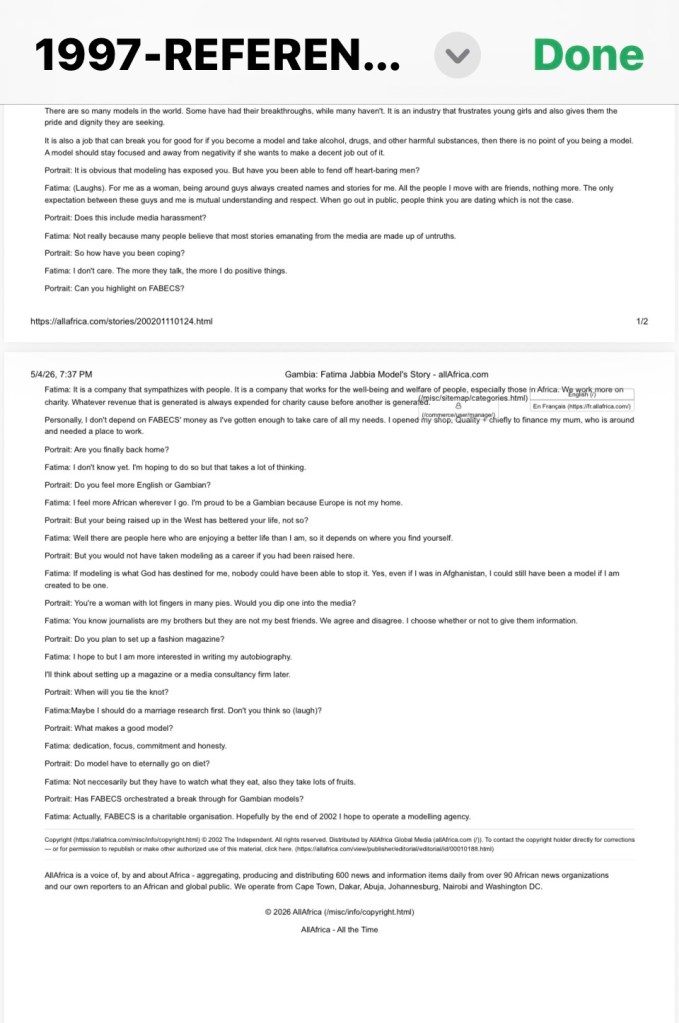
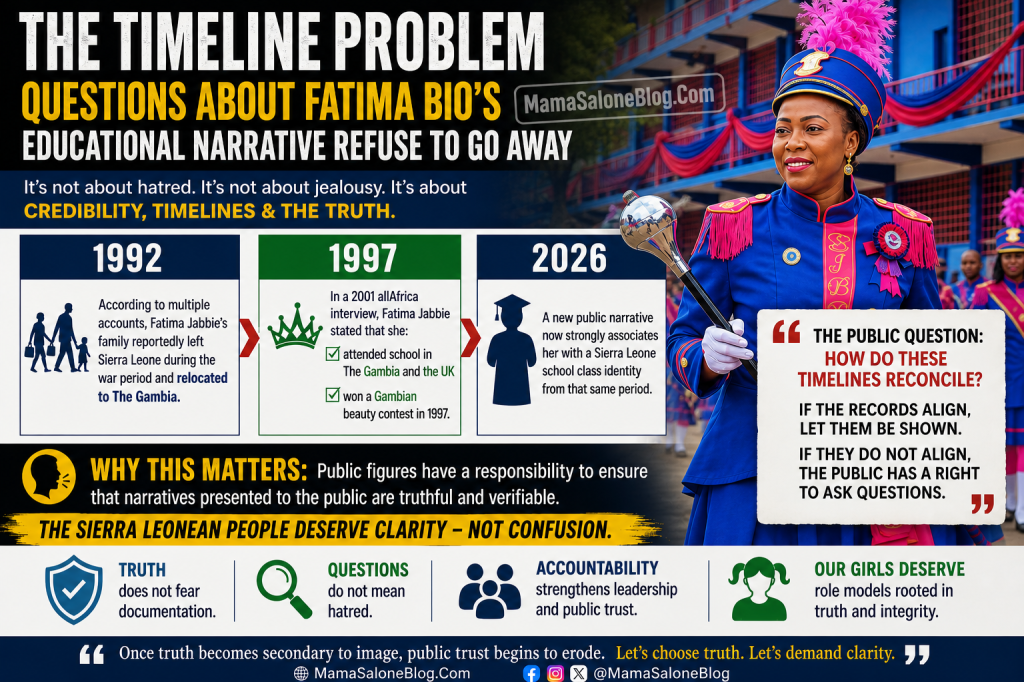
2001: A documented interview (above image) with allAfrica places Fatima Jabbie in The Gambia’s modeling scene, stating she attended school in The Gambia and the UK, and won a beauty contest as a Gambian in 1997.
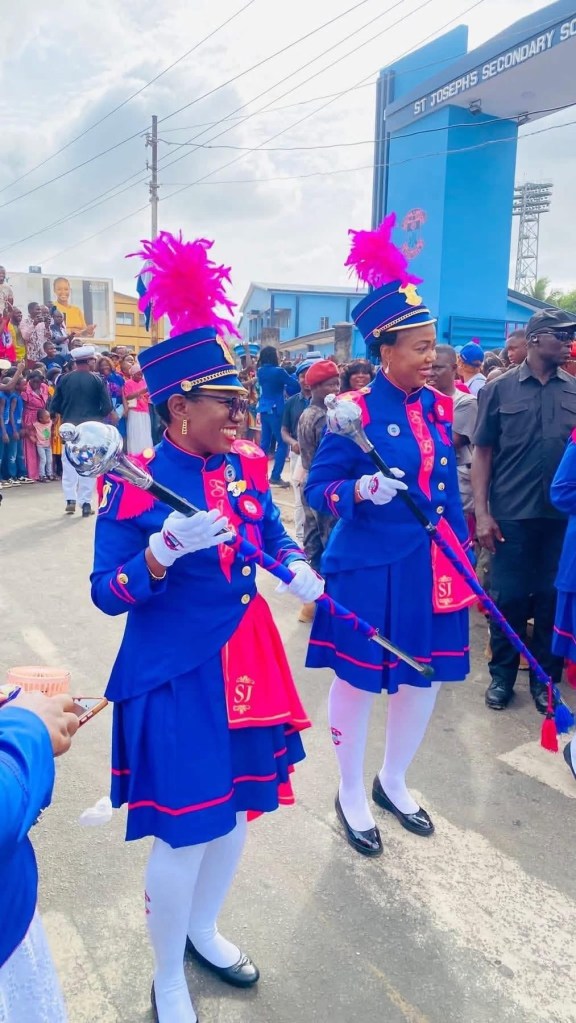
2026: A very different narrative is being amplified by her paid agents about school attendance. They claim Fatima Bio attended St. Joseph’s Convent school in Freetown, Sierra Leone, and was in the class of 1997 during roughly the same period.
The question Sierra Leoneans keep asking is simple: How do these timelines reconcile?
That’s basic fact-checking.
But instead of documentation, we get deflection. When Fatima Bio spoke about this issue, her response in Krio was,
“Nar me for claim school or nar school for claim me?”
Translation: Fatima Bio arrogantly responded that she is such a superior figure in Sierra Leone that schools like St. Joseph’s Convent should be seeking affiliation with her, not the other way around. This is the clarification we get from her and her blind supporters.
Instead of transparency, we get an arrogant response from her, with her blind supporters suggesting that questioning Fatima Bio is somehow unpatriotic.
A Revealing Response
Watch how this controversy has been handled. Notice what’s missing:
- No school records provided
- No timeline clarification offered
- No documentation to resolve contradictions
- No acknowledgment that questions are legitimate
Instead, we get:
- Emotional appeals to stop “attacking” the First Lady
- Accusations of misogyny against anyone asking questions
- Deflection to other topics
- Demands for blind loyalty over basic verification
This response pattern is more revealing than any school record could ever be.
When someone has documentation, they produce it. When someone has clear timelines, they explain them. When someone has nothing to hide, they don’t treat questions as attacks.
When someone responds to requests for verification with outrage and deflection, they’re telling you everything you need to know.
The Dangerous Precedent
Some blind defenders have tried to frame this as an attack on women or education. That argument misses the profound danger of what’s actually happening:
- We are normalizing the idea that powerful people should not be questioned.
- We are accepting that public narratives don’t need to align with documented facts.
- We are teaching young Sierra Leoneans that the truth is whatever those in power say it is.
This isn’t just about one person’s school records. This is about whether Sierra Leone will accept a post-truth political culture where verification is optional, and questioning is treason.
What Message Are We Sending Our Children?
Every day, Sierra Leonean parents tell their children:
• Value education
• Work hard
• Build integrity
• Be truthful
But what message do we send when public figures like Fatima Bio can construct flexible narratives without documentation, and anyone who asks for clarification is attacked as unpatriotic?
What credibility do we have when we demand honesty from our children but not from our leaders?
Young Sierra Leoneans are watching this controversy. They’re learning that power means never having to provide receipts. They’re learning that the right political connections matter more than verifiable achievements. They’re learning that questioning authority is dangerous.
Is this the lesson we want to teach the next generation?
The First Lady Syndrome
In my book The UNBECOMING Mrs. Maada Bio of Sierra Leone: A Case of First Lady Syndrome, I identified a troubling pattern:
Fatima Jabbie Bio’s accumulation of influence through image, prestige, proximity to power, and blind support, often without corresponding accountability.
This educational records controversy is First Lady Syndrome in action:
- Create a compelling narrative (prestigious school attendance)
- Build public sympathy around it (anyone questioning is attacking education/women)
- Use emotional manipulation to avoid verification (outrage instead of documentation)
- Weaponize political loyalty (questioning equals betrayal)
- Never, ever provide actual documentation
This syndrome thrives when truth becomes secondary to image.
The Pattern We Keep Seeing
Sierra Leoneans must be honest about what we’re witnessing in Fatima Bio’s behavior:
The OCCRP Investigation documented Fatima Bio’s unexplained property wealth. Response: Attack the investigators, provide false stories instead of financial records
Fatima Bio’s Educational Background Questions raise timeline contradictions. Response: Attack the questioners, provide outrage instead of school records
Fatima Bio’s Attack on Koidu Holdings exposes institutional corruption. Response: Government silence and continued harassment of critics
Every single time: deflection instead of documentation, outrage instead of answers, attacks instead of accountability.
This is not leadership. This is corruption at the highest level.
This Matters Beyond One Person
This controversy reveals the dangerous evolution of Sierra Leonean political culture:
From: “Here’s the evidence.”
To: “How dare you ask for evidence?”
From: “Public service requires transparency.”
To: “Questioning public figures is unpatriotic.”
From: “Democracy demands accountability.”
To: “Loyalty means never asking questions.”
This shift from accountability culture to loyalty culture is how democracies die.
When powerful people become untouchable, when questions become treason, when documentation becomes optional, that’s not democracy anymore.
That’s corruption with democratic aesthetics.
Test of Democratic Maturity
This moment is testing whether Sierra Leone is ready for a mature democracy or is still trapped in colonial thinking.
Mature democracies operate on the principle: “Trust but verify.”
Colonial mentality operates on: “Trust and never question.”
Which principle are we embracing when we:
- Treat requests for documentation as attacks?
- Frame fact-checking as unpatriotic?
- Demand blind loyalty instead of accountability?
- Punish questions instead of rewarding transparency?
The answer to that question will define Sierra Leone’s democratic future.
Young Sierra Leoneans Are Learning
Right now, young people across Sierra Leone are watching this controversy and learning lessons that will shape their understanding of power and truth:
- If we normalize unverified narratives, they learn that facts are optional.
- If we attack people who ask questions, they learn that power should never be challenged.
- If we accept deflection instead of documentation, they learn that the powerful don’t have to prove anything.
- If we prioritize loyalty over truth, they learn that relationships matter more than reality.
These are the lessons that destroy democracies from within.
Questions That Define Democracy
Every democracy ultimately answers these fundamental questions:
- Can powerful people be questioned?
- Must public narratives align with verifiable facts?
- Is asking for documentation a legitimate democratic right?
- Do citizens have the right to verify claims made by public figures?
How Sierra Leone answers these questions, through Fatima Jabbie Bio’s educational records controversy and others like it, will determine whether we build a mature democracy or slip into soft authoritarianism.

