
by Fatima Babih, EdD
There is a growing body of concern among Sierra Leonean observers and fact-checkers regarding the personal narratives offered by First Lady Fatima Bio on lobbyists acquired international media platforms.
By the way, Fatima Jabbie Bio holds neither a medical degree nor a doctorate, yet she has presented herself and is addressed by academic institutions such as Columbia University, where her highly paid lobbyist is a professor, insist on addressing her as Dr. Fatima Bio. This is the first point of deceit to the international community.
What has emerged is not merely a case of misremembering or misstating, it is a pattern of shifting, contradictory accounts that appear to be tailored to fit whatever platform or audience Fatima Bio is addressing at any given moment. And the stakes are high, because these narratives are being used to shape global policy conversations about serious issues affecting girls, such as child marriage.
Story #1: England Saved Me
In 2020, speaking to journalist Phoebean Swill of AYV (African Young Voices), Fatima Bio offered one version of her personal escape from early marriage. According to the transcript of that interview, she stated clearly and emphatically:
If I didn’t go to England I would have been a victim of early marriage so I know how that fear [feels] from the age of 12 years…
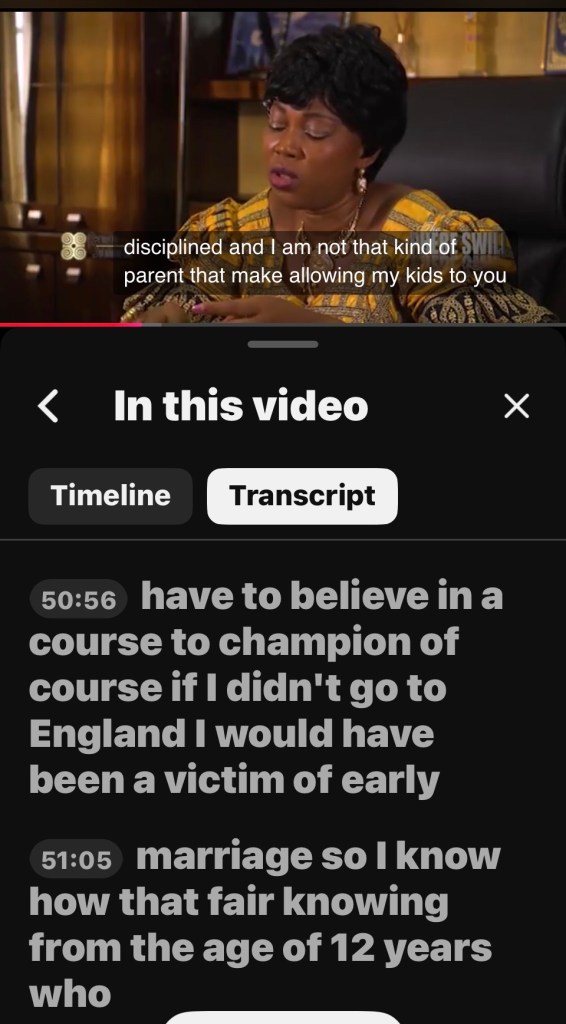
In this telling, England, the United Kingdom, was her savior. In other words, it was her departure from Sierra Leone to the UK that rescued her from the fate of child marriage. This is a compelling personal narrative, and it is precisely the kind of story that resonates with Western audiences. It positions migration to a developed country as liberation from a backward cultural practice.
Story #2: The War Saved Me
Fast forward to March 7, 2026, and First Lady Fatima Bio appears on CNN with anchor Jake Tapper, discussing a report titled Accelerating Efforts to End Child Marriage, alongside Project Founder Sheryl Sandberg. Jake Tapper introduced Fatima Bio, without apparent challenge, as someone who was married at age 12, suggesting she was being presented to CNN’s global audience as a survivor of child marriage.
In response, Fatima Bio told Tapper a completely different story:
I was lucky, I was lucky not to be part of it 100% because we had the war in Sierra Leone so that was the only reason why… I keep saying you don’t want war but the war is what saved me because if not I would have been part of that circle…
In this version, there is no mention of England whatsoever. The UK has vanished from the narrative entirely. Instead, Sierra Leone’s brutal civil war, which began in 1991, is credited as the unlikely savior of Fatima Bio’s childhood.
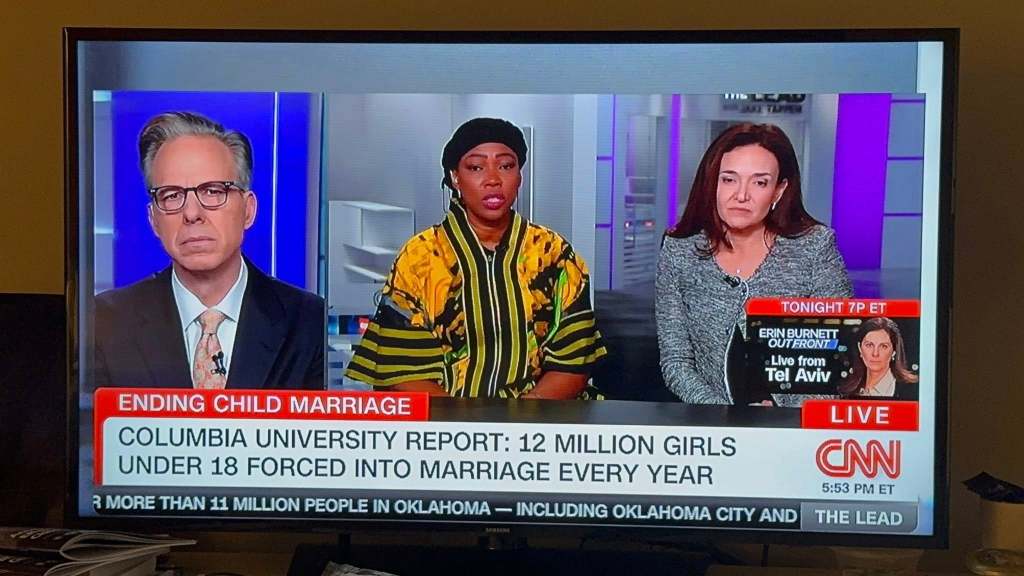
Two separate interviews.
Two completely different explanations.
Two irreconcilable accounts.
But Here Is Where Both Stories Fall Apart
If either narrative were true in isolation, it might be dismissed as a simplification or an emphasis on different aspects of the same story. But documented evidence tells a different story altogether, one that undermines both accounts simultaneously.
Fatima Bio Attended High School in Sierra Leone: There is documented evidence that Fatima Bio attended Ansarul Islamic secondary school in Koidu and she also claims to have completed secondary school at St. Joseph Convent in Freetown, both in Sierra Leone, and that she did so well before the onset of the civil war. This is a critical fact that dismantles the core of both narratives.
- If she attended and completed high school in Sierra Leone before the war, then she was not trapped in child marriage at age 12. Her education continued on a normal trajectory. A child bride does not, as a general rule, complete a full secondary school education in the conventional manner.
- If she had already left secondary school before the war began, then the war cannot credibly be cited as the thing that saved her from child marriage. The timeline simply does not hold up.
- Furthermore, historical records indicate that when she did leave Sierra Leone during the period of the war, her destination was The Gambia, not the United Kingdom. This directly contradicts the 2020 AYV interview in which she credited going to England as her escape from early marriage.
The Problem With Changing Narratives on a Global Stage
One might ask: why does this matter? Fatima Bio is claiming to be doing important advocacy work for girls and women in Africa. Child marriage is a genuine and devastating problem across West Africa and beyond. Does the precise accuracy of her personal story really matter?
Yes. It matters enormously. Here is why:
Credibility Is the Currency of Advocacy: When a public figure positions their personal experience as the moral authority behind a global campaign, the accuracy of that experience becomes directly tied to the credibility of the campaign itself. If the foundational personal story is demonstrably inconsistent, it invites scrutiny of everything built upon it.
Jake Tapper Introduced Fatima Bio as Someone who was “Married at 12: This is deeply troubling. CNN, one of the world’s most watched news networks, introduced the First Lady of Sierra Leone to a global audience with the implied framing that she was a survivor of child marriage.
Fatima Bio did not correct this framing; she leaned into it. Whether or not she explicitly claimed to have been married at 12, her failure to correct the introduction while proceeding to describe how she “luckily” escaped the practice is, at minimum, misleading.
It Disrespects Actual Survivors: There are real girls and women in Sierra Leone and across the world who were married as children, who did not escape, whose education was cut short, whose bodies were violated under the cover of legality. Using a fabricated or embellished personal connection to their suffering to gain international platforms is a profound disservice to those genuine survivors.
It Misleads Policymakers: Reports like Accelerating Efforts to End Child Marriage are used to inform donor funding, international policy, and governmental programs. When the messengers of such reports misrepresent their own experiences to gain authority, it corrupts the entire policy conversation.
Questions That Deserve Answers
The Sierra Leonean public, and indeed the international community, deserves honest answers to the following questions:
- Did Fatima Bio attend and complete secondary school in Sierra Leone before the war? If yes, how does she reconcile that with claiming child marriage was imminent for her?
- When she left Sierra Leone during the war, did she go to The Gambia or the United Kingdom? The record appears to say The Gambia.
- Was she ever at risk of being married at age 12, or is this a narrative constructed to lend personal moral authority to an advocacy position?
- Why did she not correct Jake Tapper when he introduced her under the implied framing of being a child marriage survivor?
Advocacy Built on Falsehood Serves No One
Fatima Bio’s advocacy around child marriage, her Hands Off Our Girls campaign, and her engagement with international bodies on issues affecting women and girls in Sierra Leone are, in principle, worthy endeavors. Child marriage is real. Sexual violence against girls is real. These issues demand urgent attention and bold champions.
But bold championships must be built on truth.
When a First Lady changes her personal origin story depending on which camera is pointed at her, crediting England in one breath and a civil war in another, while documented records suggest neither story is accurate, she is not serving the girls she claims to champion. She is serving her own narrative to gain fame and fortune.
The international media, including platforms as powerful as CNN, have a responsibility to verify the personal claims of the advocates they bring on their platforms, not simply amplify emotionally resonant stories without scrutiny.
And the people of Sierra Leone have every right to ask: Who exactly is speaking for our girls, and are they telling the truth?
——–
This blog post is based on publicly available interview transcripts and documented historical records. The author encourages corrections from any party with verifiable evidence to the contrary.
 MAMA SALONE ~ Lioness of the West Coast