
by Fatima Babih, EdD
A civic education briefing for Sierra Leoneans who deserve accurate information about how international diplomacy works.
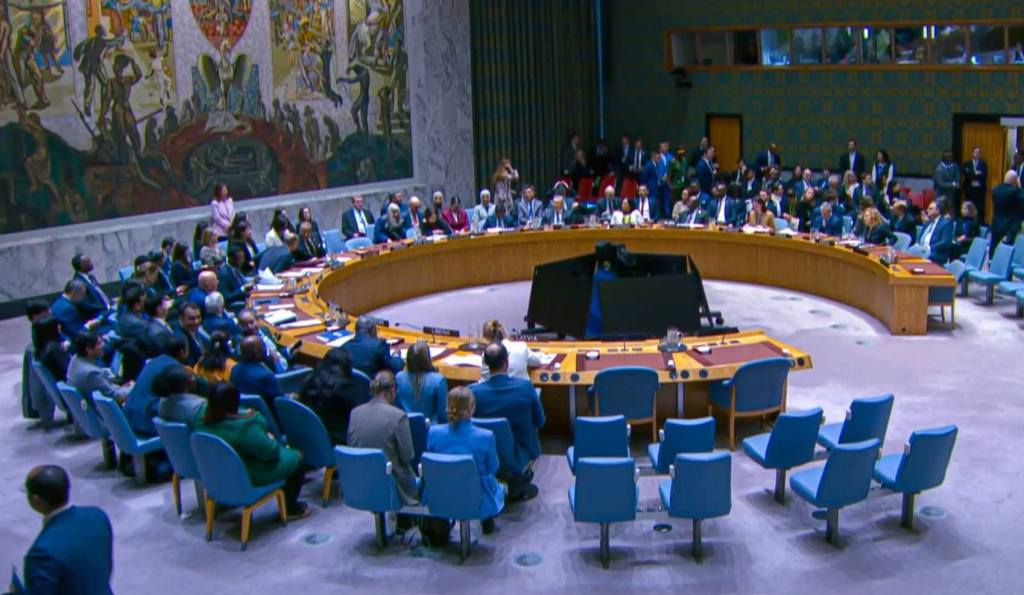
On March 2, 2026, the United Nations Security Council convened for its 10113th session to discuss one of the most urgent humanitarian crises of our time: the fate of children caught in the crossfire of war, displacement, and digital danger. The session, chaired by U.S. First Lady Melania Trump during the United States’ rotating one-month presidency, addressed Children, Technology, and Education in Conflict.
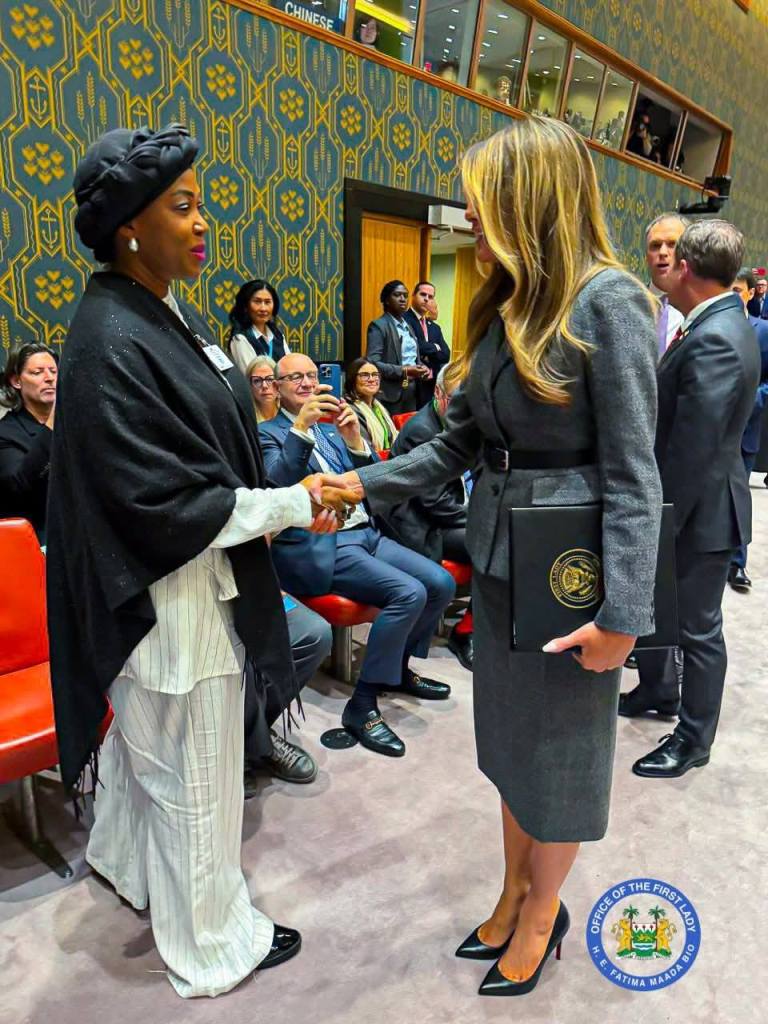
Shortly after the meeting, Sierra Leone’s First Lady, Fatima Jabbie Bio, shared a Facebook post that quickly circulated widely. In it, she wrote that she was:
…honoured to attend the 10113th Meeting of the United Nations Security Council…”
and that she had been:
…officially invited by the First Lady of the United States, Her Excellency Melania Trump, who currently serves as President of the Security Council.”
These statements were accompanied by a short video clip and photos of Fatima Bio shaking hands with Melania Trump. These images have since been amplified by Fatima Bio’s paid praise singers on social media, who are claiming the event was a great achievement and spreading further misinformation about what actually took place.
Her attendance is not in dispute. What is in dispute, and what the public deserves to understand clearly, is the institutional context of that attendance, and the precise limits of Sierra Leone’s role at that moment in history.
This is a civic education exercise. Because when citizens understand procedures, it becomes much harder for politicians to blur the line between propaganda and reality.
The Official Record
Let’s begin with what is unambiguously true, as confirmed by the official UN meeting summary (document SC/16308, 2 March 2026):
- The 10113th Meeting of the UN Security Council took place on March 2, 2026.
- It was presided over by U.S. First Lady Melania Trump, in the context of the United States’ rotating monthly presidency.
- The formal agenda topic was Children, Technology, and Education in Conflict.
- The session was held in an open format, meaning non-Council members, including First Ladies, senior officials, and civil society representatives, can attend by invitation.
So yes: Fatima Bio could legitimately have been present. Attendance at open-format Security Council meetings by non-members is procedurally normal and unremarkable. That part of her post is not disputed.
Sierra Leone’s Actual Status
Here is where procedural clarity becomes essential.
Sierra Leone served as an elected non-permanent member of the United Nations Security Council. That term ended on December 31, 2025.
This means that on March 2, 2026, the very day of this meeting, Sierra Leone held no seat on the Security Council. It had:
- No voting rights
- No formal speaking role as a Council member
- No presidency role or Council authority of any kind
On that day, Sierra Leone’s standing at the United Nations was identical to that of any of the over 170 other member states not sitting on the Council: entitled to observe, but not to deliberate as a Council actor.
This distinction is not a technicality. It is the foundation upon which the entire structure of UN authority rests. A country that was on the Council three months ago does not retain any residual Council powers or privileges once its term expires. Institutional authority is not a lingering influence, it is a formal status with a start date and an end date.
Was Fatima Bio a Speaker?
Fatima Bio’s post speaks of joining global leaders in raising urgent concerns and reaffirming commitments at the Security Council. The language is vivid, active, and authoritative.
But the official UN meeting summary (SC/16308) identifies only the following speakers on the record:
- Rosemary DiCarlo: UN Under-Secretary-General for Political and Peacebuilding Affairs
- Melania Trump: speaking in the United States’ national capacity as Council President
- The Representative of Liberia
- The Representative of the Democratic Republic of the Congo
- Other Council member state representatives
There is no record in the official UN summary of First Lady Fatima Bio addressing the Security Council. This is a critical distinction that gets lost in the propaganda and praise-singing noise of social media. There is a profound difference between:
- Attending a Security Council meeting, and
- Addressing the Security Council on the record
In UN procedural terms, only the latter carries institutional weight. Observers, even distinguished, invited observers, do not raise concerns at the Security Council in any formal sense. They are present. They witness. They may engage informally in the corridors of power. But their voices do not enter the Council’s official deliberative record unless they are formally called upon to speak.
The official transcript does not list Fatima Bio as a speaker. Attending is not equal to addressing.
“Official Invitation?”
Fatima Bio writes that she was officially invited by the First Lady of the United States. This framing deserves careful examination.
Here is the procedural reality: formal invitations to UN Security Council meetings are not issued by First Ladies as a matter of institutional authority. Official invitations to open-format Security Council sessions are processed through the U.S. Mission to the United Nations and the UN Secretariat.
A First Lady, even one chairing a session in a ceremonial presidential capacity, does not independently issue binding formal UN Security Council invitations. The formal mechanism of any such invitation runs through official diplomatic and UN administrative channels.
This matters because the framing of a personal invitation from one First Lady to another, amplified by Fatima Bio and her operatives, creates a bilateral, personal narrative that obscures the institutional reality: that both women were operating within a highly structured multilateral system that predates them and will outlast them.
Why Language Matters
Reading the full arc of Fatima Bio’s post carefully, the framing layering personal attendance with institutional language about raising concerns…joining global leaders, and representing dual capacities as First Lady and OAFLAD President, creates a composite impression that does not accurately reflect what actually occurred.
The post may lead readers to believe that:
- Sierra Leone had an institutional role in the March 2 Security Council meeting
- Fatima Bio addressed the Council in her formal capacity
- She was acting as an official diplomatic actor on behalf of Sierra Leone at the Security Council level
The official record does not support any of these readings.
A Framework for Citizens
For Sierra Leoneans trying to make sense of these distinctions, here is a plain-language breakdown of how the Security Council actually functions:
What is the UN Security Council?
The Security Council is the only UN body with binding authority over international peace and security matters. It has 15 members: 5 permanent (the P5: the U.S., UK, France, Russia, and China) and 10 elected non-permanent members who serve staggered two-year terms.
What does holding the presidency mean?
Each month, one of the 15 member states rotates into the presidency. In March 2026, that is the United States. The presidency manages the agenda and chairs meetings, it is an administrative leadership role, not a grant of supreme authority.
Can non-members attend Security Council meetings?
Yes, in open-format sessions, invited guests including heads of state, First Ladies, civil society leaders, and UN agency heads can attend. But attendance confers no Council authority, no formal speaking rights on the record, and no vote.
What happened to Sierra Leone’s Council membership?
Sierra Leone’s elected term ended December 31, 2025. As of January 1, 2026, Sierra Leone is a regular UN member state, not a Security Council member. There is no grace period. There are no residual privileges.
Does attending a UN meeting as a First Lady equal official representation? No. A First Lady holds no formal diplomatic authority under international law unless she has been specifically designated to act in that capacity by her government through official channels.
Clarity Is Imperative
After eight years as First Lady, there is no evidence confirming Fatima Bio’s claimed commitment to children in conflict zones and girls’ education beyond speeches. Her work through OAFLAD claims to be building resilience for women and children, but she has been in that position for a year now with no proof of her claims. Her presence at a high-profile Security Council session may feel like a meaningful symbolic moment for her, but symbolic moments must not be allowed to masquerade as institutional authority.
Sierra Leone was not at the table on March 2, 2026, not in any Council capacity. Fatima Bio was present as an invited guest, not as a designated speaker on the record. The invitation was not a grant of formal UN authority.
When politicians communicate about their international engagements, precision matters. Citizens deserve an accurate understanding of how global governance actually functions. The Security Council is not a summit of presence. It is a system of structured authority, recorded deliberation, and formal accountability.
Understanding the difference between sitting in a room and having a voice in that room, between attending and addressing, between presence and power, is not pedantry. It is the foundation of an informed citizenry.
And an informed citizenry is the most powerful check on any form of propaganda theater.
References
UN Security Council Meeting Summary SC/16308, 2 March 2026
First Lady Fatima Bio’s official Facebook page post dated 2 March 2026
#ChildrenInConflict, #EducationForAll, #UNSecurityCouncil, #CivicEducation, #DiplomaticClarity, #SierraLeone,
 MAMA SALONE ~ Lioness of the West Coast