
by Fatima Babih, EdD
Part I of a multi-part analytical series examining the February 9, 2026, African Young Voices (AYV) Television interview with Sierra Leone’s First Lady, Fatima Jabbie Bio.
On February 9, 2026, viewers tuned in expecting a television interview.
What they witnessed was something more revealing.
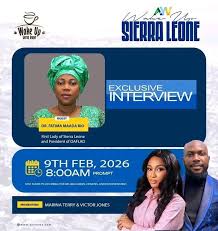
Instead of welcoming their guest into the AYV studio, the neutral ground where journalists typically control lighting, framing, pacing, and tone, the hosts traveled to the Presidential Lodge. The conversation unfolded inside the residence of state power.
That decision was not a minor production choice. It was the first signal.
The Power of Setting
In political communication, location is never accidental. A studio would place the public figure inside the journalist’s turf. A presidential residence places the journalist inside the politician’s home turf. The difference is subtle, but hugely significant.
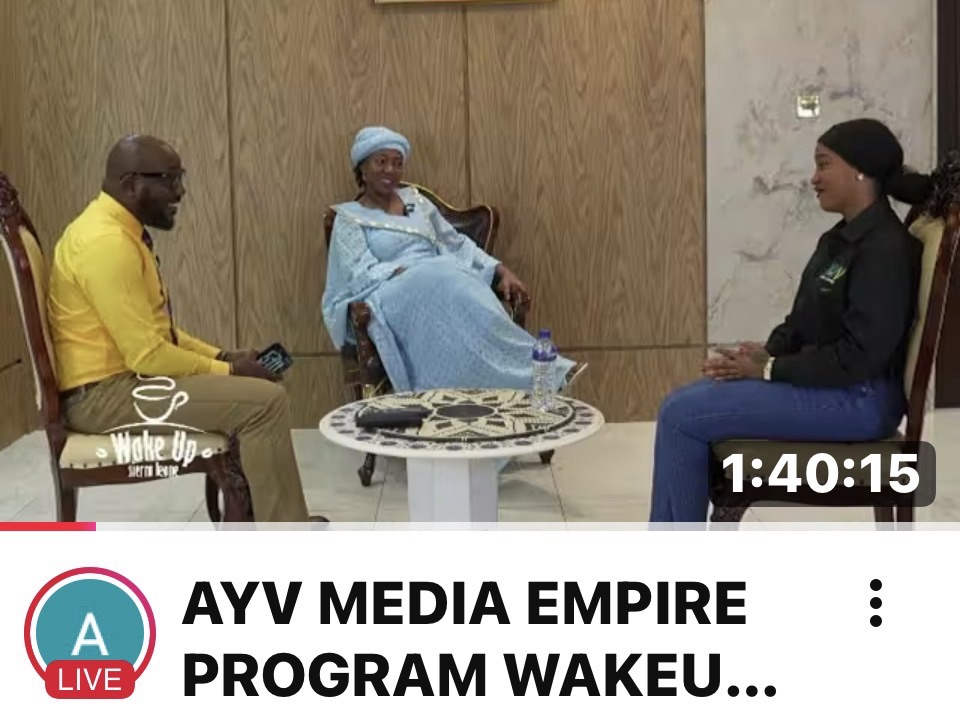
At the Presidential Lodge:
- The guest effectively becomes the host and controls the environment.
- The aura of state authority surrounds the conversation.
- The symbolism of office frames the dialogue before a single answer is given.
This matters especially when the interview’s stated purpose was to address allegations, controversies, and questions about influence.
When accountability conversations occur inside the architecture of executive power, it shifts power dynamics, for the hosts and for the audience.
Framing Before Questions
Even before the First Lady spoke, the AYV hosts guided viewers toward a particular interpretation. They referenced:
- “deep misinformation”
- “brown envelope journalism”
- “unverified claims”
- the need to hear “from the horse’s mouth”
Those phrases are not neutral.
They prime the audience to view critics as unreliable before claims are examined. The interview begins not with scrutiny, but with narrative rehabilitation.
In journalism, framing shapes perception as much as facts.
Access vs. Accountability
There is nothing inherently wrong with interviewing a public figure at the Presidential Lodge. Access journalism exists everywhere in the world. But access comes with responsibility.
The harder the access, the harder the questions must be.
Not in this interview.
When an interview is described as a “rare media spectacle,” the moment carries weight. It becomes an opportunity not just to clear the air, but to test assertions, verify claims, and interrogate contradictions.
The question for viewers is simple:
Did the setting encourage accountability, or did it reinforce authority?
Optics in a Polarized Climate
Sierra Leone’s political climate is deeply polarized. In such an environment, optics become amplified.
To supporters, the Presidential Lodge setting signals legitimacy and confidence.
To critics, it may signal insulation from independent scrutiny.
Both interpretations coexist, and both are shaped by where the conversation took place.
That is why setting matters.
Because in politics, performance and power are inseparable.
Why This Analysis Is Needed
This series is not about personalities.
It is about public power. Accountability is not an attack. It is a democratic obligation.
When state influence, philanthropy, party politics, and financial allegations converge in a two-hour interview, citizens have a responsibility to examine not just what was said, but how it was presented.
In the next installment, we move from setting to substance, examining a major theme introduced in the interview and what it reveals about how legitimacy was framed from the start.
 MAMA SALONE ~ Lioness of the West Coast