“We Are Hard Workers Both Day and Night:” How Julius Bio Failed to Demonstrate Policy Literacy on Population Growth
by Fatima Babih, EdD
When a sitting president faces a serious policy question on the global stage, the world expects substance. What Sierra Leone got instead was a sound bite that trivialized one of Africa’s most pressing development challenges.
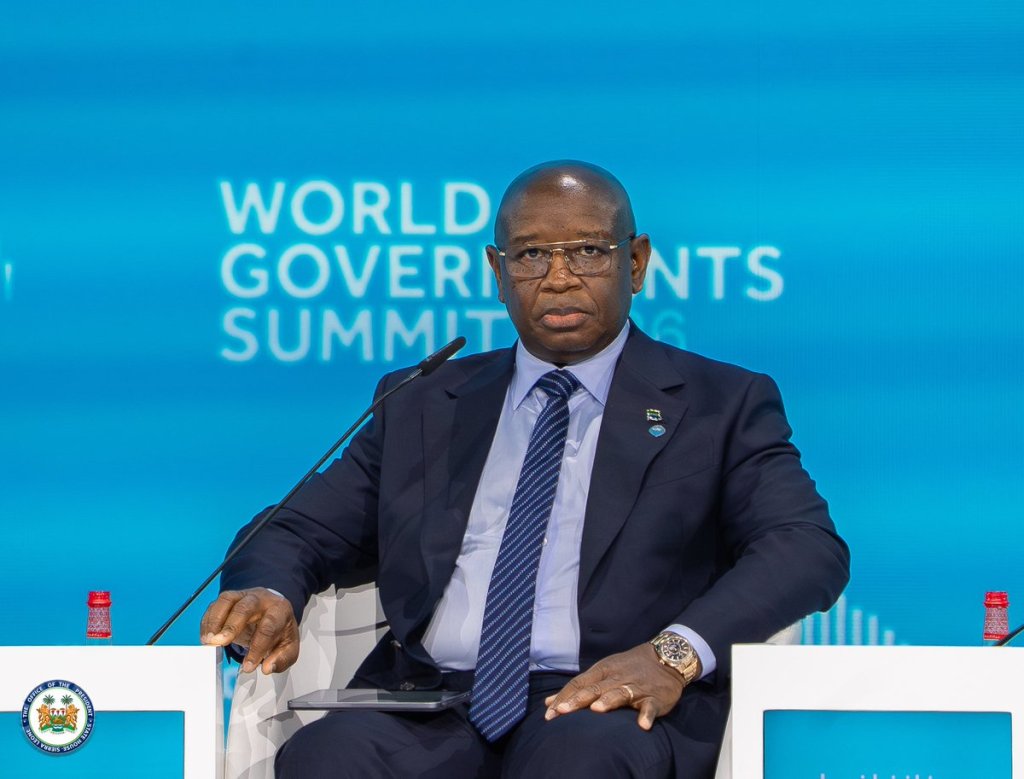
In early February 2026, President Julius Maada Bio sat down with American media personality Tucker Carlson at the World Government Summit in Dubai. Among several conversations with global leaders, Carlson posed a question that should have been a diplomatic layup, an opportunity to showcase Sierra Leone’s approach to demographic challenges and development planning.
Instead, what followed was a masterclass in evasion.
Carlson’s question was straightforward and substantive:
Mr. President, I think this may be one of those topics that’s too difficult to talk about in public, so let me ask you about one of the strengths of your country and on the continent, which is its birth rate, which so far surpasses that of any other region in the world, and that seems like a strength. How has your country, Sierra Leone, but also many other countries in Africa, been able to maintain a birth rate at replacement, when Europe, the US, Canada, and lots of other parts of the world have not been able to?
This wasn’t a gotcha question. It was an invitation to discuss demography, development policy, social structures, health systems, and long-term planning. The kind of question that allows a leader to demonstrate command of their country’s realities and vision for its future.
The Response
Bio’s immediate reply:
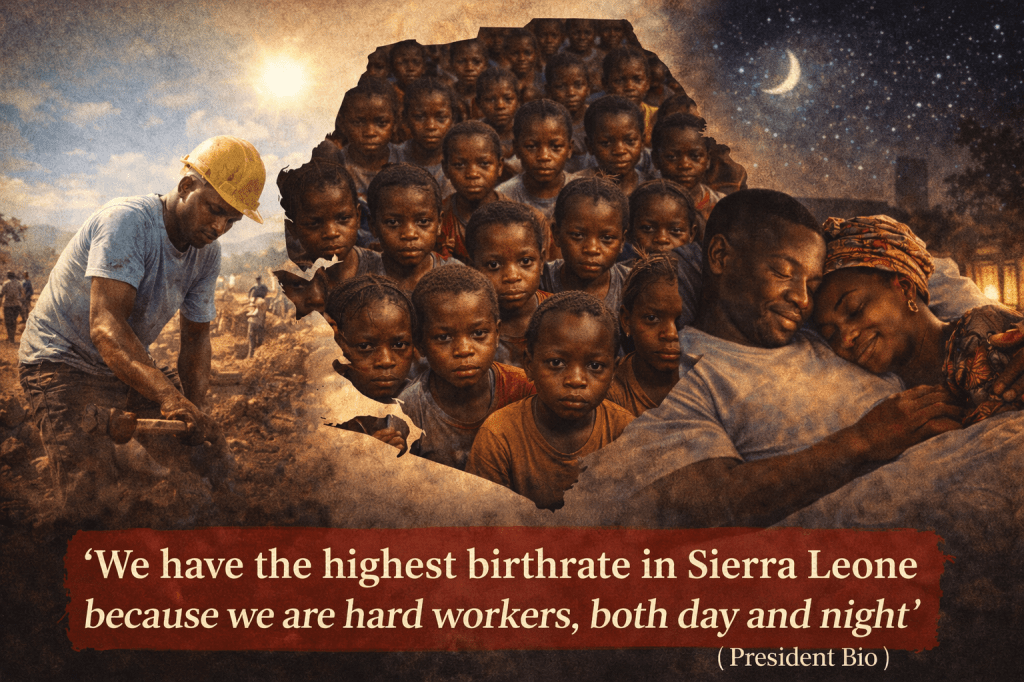
We are hard workers, and we work both in the day and at night.
He then pivoted to generic talking points,
It is essential to have young people and to keep the birth rate at the right level so that there is sustainability in development. What we do today, or as leaders who provide the enabling environment, is provide them with the equipment to navigate the world, which is extremely tough, complicated, evolving, and changing all the time. So, it is our responsibility to bear that in mind, we have to plan ahead of you know, be ahead of the curve, to be able to respond accordingly, so that we don’t have a gap in our development process. So, we have been busy producing as much as we can, a lot of good people, and we are investing in their education so that they are fit for purpose for a world that is becoming digital and of course going extremely to the edge of technological advancement.”
Talking about investing in young people, preparing them for a digital world, and staying ahead of the curve. This is language that could have come from any development conference keynote, anywhere in the world.
What was notably absent in Bio’s response is any actual answer to Carlson’s question. At no point did Bio explain:
Why Sierra Leone’s birth rate is high
What specific factors drive population growth in his country
How his government manages the consequences of rapid population growth
What policies are in place regarding reproductive health, family planning, or maternal care
The problem wasn’t just what he said. It was what he didn’t say.
Three Critical Failures
Trivialization of a Development Crisis: The high fertility rate in Sierra Leone is not the result of hard work, day and night. It is driven by measurable, addressable factors:
Early marriage and adolescent pregnancy
Limited access to modern contraception
Gender norms that restrict women’s reproductive autonomy
High rates of sexual violence leading to pregnancy
Poverty and the absence of social safety nets
Weak enforcement of child protection and education laws
Each of these represents a policy challenge. None was acknowledged by Bio.
Reinforcement of Harmful Stereotypes: Rather than presenting Africa as a continent grappling thoughtfully with demographic transition, Bio’s remark invited exactly the kind of reductive stereotyping African leaders routinely condemn. On a platform designed to showcase governance and innovation, he showed no insight.
The optics matter. When African leaders demand to be taken seriously on the global stage, that seriousness must be earned through substantive engagement, not undermined by flippant remarks.
Erasure of Women’s Lived Realities: Population growth is not gender neutral. It is overwhelmingly women and girls, often poor, often undereducated, often lacking agency over their own bodies, who bear the physical, social, and economic consequences of high fertility.
Sierra Leone has one of the world’s highest maternal mortality rates. Teenage pregnancy remains endemic. Girls are pulled from school to become mothers before they’ve finished childhood. Bio’s answer erased all of this.
When Bio invoked aspirational language about investing in education and preparing young people for a digital world, he made claims that sound impressive but crumble under scrutiny.
Sierra Leone continues to struggle with:
High learning poverty rates
Significant school dropout rates
Chronic youth unemployment, including among graduates
High rate of drug addiction among the youth
Weak digital infrastructure
Without evidence of progress on these fronts, such statements amount to political branding, not policy explanation.
A Squandered Opportunity
The World Government Summit attracts global leaders, policymakers, and media. It’s a platform where countries showcase their governance philosophy and development strategies. Carlson’s question offered Bio a rare opportunity to:
Articulate Sierra Leone’s demographic reality with honesty and nuance
Highlight the government’s approach to managing population growth
Demonstrate understanding of the relationship between fertility, development, and women’s rights
Position Sierra Leone as a country thinking seriously about its future
Instead, Bio offered a cheap joke where judgment was required.
Policy literacy isn’t about memorizing statistics. It’s about demonstrating that you understand the challenges your country faces, the forces shaping them, and the levers available to address them. It’s about showing that governance is more than slogans.
When a president cannot engage substantively with core development issues, it raises fundamental questions about competence and seriousness of purpose.
Tucker Carlson asked a policy question. Maada Bio gave a punchline.
The women and girls in Sierra Leone, whose lives, health, and futures are shaped by the very issues Bio failed to address, deserved better.
The question Bio failed to answer deserved a policy response grounded in data, context, and accountability. What it received instead was a sound bite that obscured the lived realities of women, girls, and young people who bear the consequences of unchecked population growth. On an international stage, the cost of such failure is not merely reputational; it is developmental.
Sierra Leone deserves leadership that can articulate its challenges with clarity and its solutions with credibility. On a February day in Dubai, that’s not what the world saw.

 MAMA SALONE ~ Lioness of the West Coast