
By Dr. Fatima Babih
In Sierra Leone, corruption has manifested itself as a pandemic that is literally killing not only the economy but the people of Sierra Leone! Corruption has always been an incurable disease carried by politicians and their networks. But for the past five years since Julius Maada Bio became president, corruption has worsened in the worst kind of ways.
It, therefore, comes as no surprise that in Sierra Leone, most of the country’s population is deprived of the most basic human needs, such as food, clean water, electricity, and healthcare.
Hospitals lack doctors, medicines, and equipment. Pregnant women and their infants continue to die at an alarming rate. School teachers and nurses are underpaid and seldom get paid. Classrooms lack trained teachers and textbooks; most children go to school hungry and stay hungry throughout the day until their one family meal for the day.
A majority of the youth who make up the majority of the population are unskilled, unemployed, unemployable, hooked on drugs, dying, or otherwise wasting away in illiteracy and hopelessness.
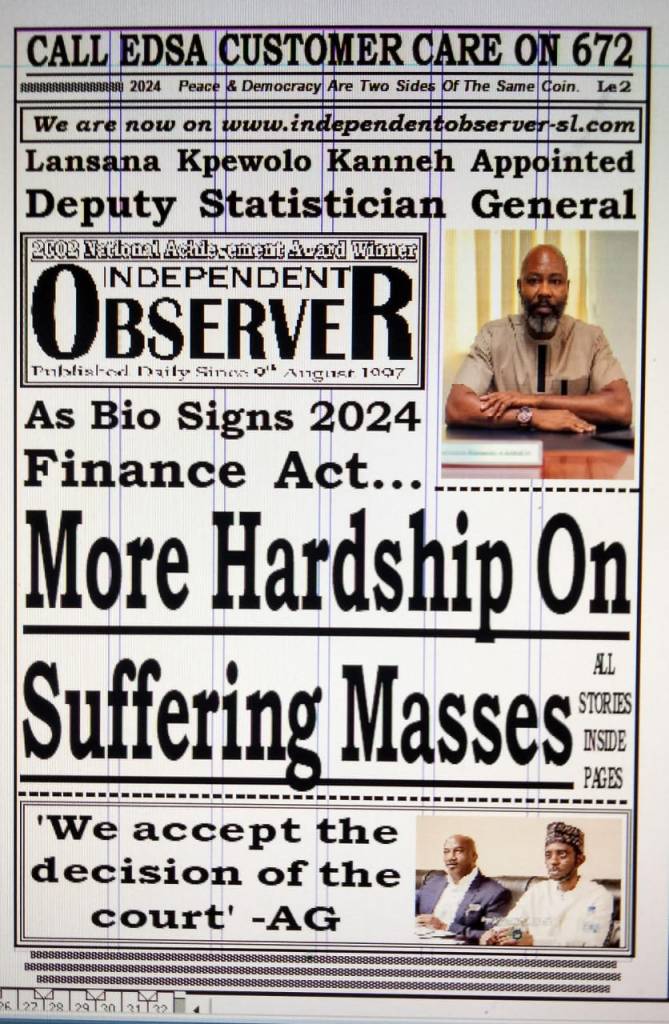
But here, in this same God-forsaken country, lives a set of people called politicians, who have plenty of food to eat, clean imported water to drink, and powerful generators so they never lack electricity. These politicians receive healthcare in the United States or Europe, never in Sierra Leone. Their children are born and raised in Western countries, where they receive the best education money can buy.
Sadly, the overwhelming plight of the majority remains unnoticed by the privileged and corrupt politicians who seem disconnected from the harsh reality of the masses. It is disheartening to see how their opulent lives thrive on the very resources that are intended to nurture the population, making them parasites feeding on the very sustenance meant for the people.

The Clerk of Parliament, Mr. Umar Paran Tarawally, and his wife, Mrs. Abibatu Parana Tarawally, are a perfect example of such parasites in Sierra Leone.
Mrs. Tarawally is a woman endowed with beauty, youthfulness, and apparent intelligence. But she is not using these God-given assets to do good for the country and people. Instead, a darker aspect of her character has recently come to light, overshadowing her seeming representation of a young and upward-mobile Sierra Leonean woman – she stands accused of committing theft against the people of Sierra Leone, which puts her among common thieves who roam the city streets for their livelihoods.

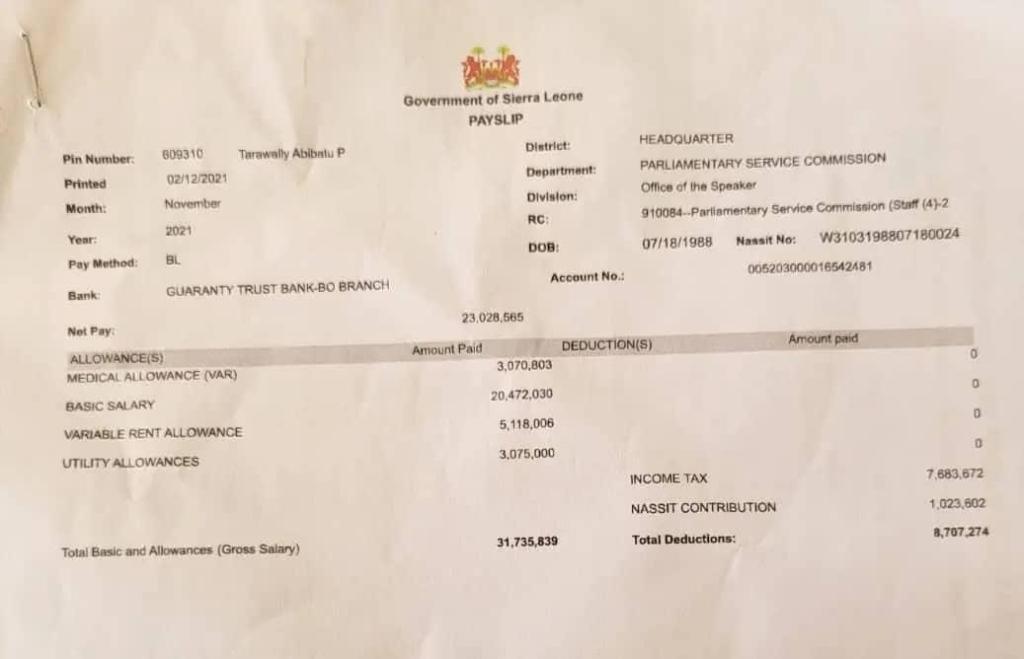
As revealed in the pay slip below, Mrs. Tarawally, who is married to Mr. Umar Paran Tarawally, the second most powerful man in the Parliament of Sierra Leone, has been engaged in an extended act of embezzlement. She is alleged to have functioned, for several years, as a ghost worker on the Parliament’s payroll, enjoying a substantial salary and additional perks while contributing nothing in return.
A Disturbing Pattern in the Julius Bio Regime
Starting with Julius Maada Bio as the President whose wife is alleged to have been engaged in misappropriating government funds, this regime has sustained a pattern of rampant corruption among members of Mr. Bio’s Paopa cabal.
The corruption allegations against Mrs. Bio and Mrs. Tarawally have led Sierra Leoneans to the understanding that while high-powered politicians pilfer from one end of the country’s resources, their wives and other members of their networks engage in theft from other ends.
Mrs. Tarawally ‘s considerable salary from the Parliament, where she never held a legitimate position, is repugnant, especially as her husband, in his capacity as Clerk of Parliament, recently dismissed over one hundred and thirty low-level Parliamentary workers. Sierra Leoneans are now convinced that Mr. Tarawally’s dismissal of workers was to accommodate more people in his network as ghost workers on the Parliamentary payroll.
The Tragic Consequences
The repercussions of such chronic corruption extend beyond financial malfeasance. It literally kills the people who are deprived. For instance, two of the wrongfully dismissed Parliamentary workers reportedly succumbed to cardiac arrest due to the shock of their abrupt terminations, shedding light on the human toll caused by such chronic corrupt practices in the country.
The economic drain of this insidious system of corruption among Mr. Maada Bio’s cabal is not confined to individual cases but threatens to drain the lifeblood from Sierra Leone’s economy. The diversion of resources and opportunities to a select few, driven by greed and nepotism, has contributed to the country’s current economic status, with inflation at an all-time high.

Here is what the World Bank says about the economic condition of the country:
- Between 2011 and 2018, Sierra Leone achieved a poverty reduction of about 9 percent, from 62.4 percent to 56.8 percent at an annual rate of about 1.4 percent…
- …However, poverty reduction was not accompanied by a reduction in inequality, and Sierra Leone remains one of the most unequal countries in the world, with the national Gini coefficient rising from 0.53 in 2011 to 0.57 in 2018…
- Food inflation increased by 13.9 percent and 17.0 percent, in 2020 and 2021, respectively…
- …However, food inflation index increased from 125.6 in 2022 to 174.1 (6-month average) in 2023-a 40 percent increase in 2023 compared to 30 percent in 2022. Inflation is expected to remain in double digits in 2023…
- …WFP Hunger Map Live 2023 ranks the prevalence of inadequate food consumption in Sierra Leone as very high at 4.7 million (57.3% of the population). This is an increase of 800,000 from mid-April 2023 to mid-July 2023…
- …In addition, chronic malnutrition for children under the age of 5 is still high at 29.5 percent…
As we can see from the above World Bank report, between 2011 and 2018, Sierra Leone experienced a noteworthy reduction in poverty. But all that changed after Julius Maada Bio became President in April 2018. He and his cabal immediately latched on to the country’s resources, sucking it dry.
With increased food inflation, Sierra Leone continues to be one of the world’s most unequal nations in the world.
The World Food Program highlighted a significant prevalence of inadequate food consumption in Sierra Leone, affecting a substantial portion of the population. Additionally, the country continues to grapple with persistently high rates of chronic malnutrition, particularly among children under the age of five.
The exposure of Mrs. Abibatu Parana Tarawally’s alleged corruption highlights a broader issue plaguing Sierra Leone – the corrosive impact of corruption among the political elite. This corruption pandemic is destroying the economy and devastatingly affecting the lives of the masses. Urgent measures are needed to address this systemic virus and restore the health of the country’s economy.
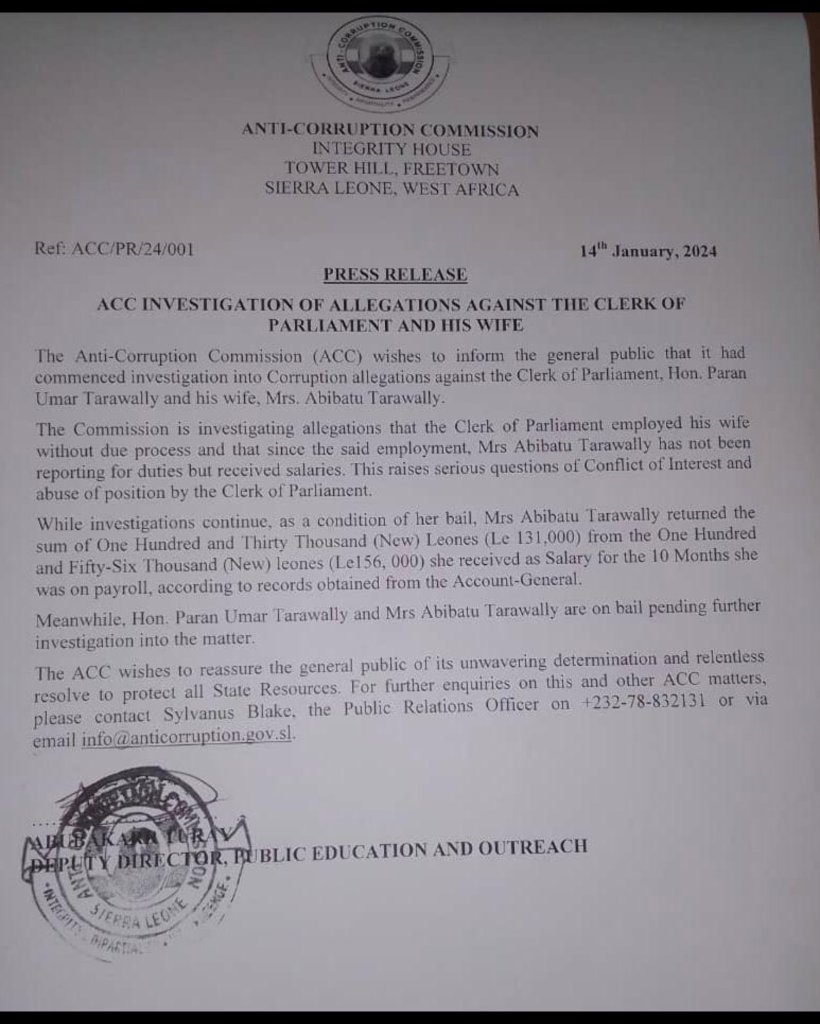
The role of the Anti-Corruption Commission (ACC) in stemming this devastation on the people is crucial, yet Sierra Leone’s ACC, mandated to combat corruption, appears to be part of the problem. ACC exhibits a double standard in the fight against corruption. For instance, while teachers, earning meager salaries, face public humiliation for unproven allegations of bribery, Mrs. Tarawally’s documented crimes, akin to those of Mrs. Fatima Jabbie Bio, seem to receive preferential treatment.
The weak responses from the ACC to members of Mr. Bio’s corrupt cabal have shattered the people’s trust in the agency’s dedication to fighting the widespread corruption gripping the nation. There’s a prevailing sense among Sierra Leoneans that, much like the corruption accusations against Mrs. Fatima Maada Bio exposed in the 2020 Auditor General’s Report, Mrs. Tarawally’s case will also be conveniently brushed aside by the ACC, leaving the people disillusioned and disheartened.
Without leadership’s unwavering commitment to transparency, accountability, and gender equality in Sierra Leone, overcoming this pandemic of corruption and paving the way for a brighter future will continue to be mere rhetoric, regime after regime, while the people continue to suffer!!
References
The World Bank. (October 2023). Poverty & Equity Brief Sierra Leone Africa Western & Central October 2023.
 MAMA SALONE ~ Lioness of the West Coast